About Carex vesicaria L.
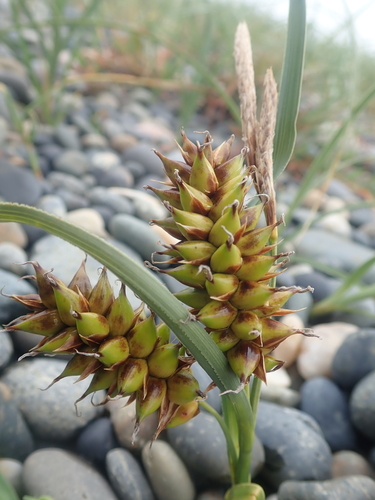
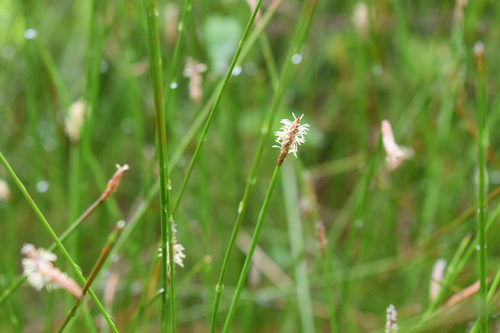
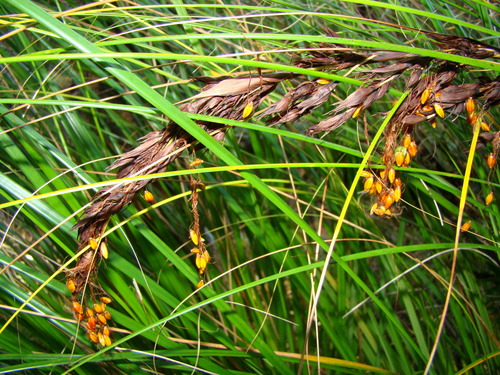
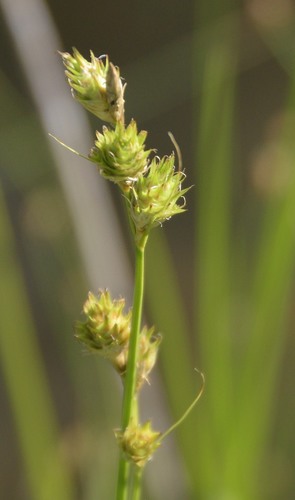
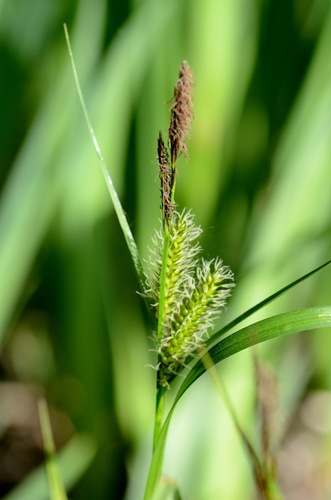
Carex vesicaria L., commonly known as bladder sedge, is a perennial plant with short creeping rhizomes that produce shoots growing in small tuft-like clusters. It reaches heights between 30 and 120 cm (12 to 47 inches). Its stems are rough near the tip, but grow smoother toward the base. The plant's narrow, ridged and pleated leaves can reach around 1 m (3.3 ft) in length or longer, with fine-toothed edges and sharp points. Its fruits are erect, glossy, and bulbous. The flower clusters are long and cylindrical, and each cluster holds up to 150 developing fruits. Bladder sedge has a circumpolar boreo-temperate distribution. It is native to northern North America, recorded across most of Canada and the northern United States, ranging as far south as California. It is also found across almost all of northern Europe and northern Asia, extending east to Japan and Korea. It is widespread in Britain and Ireland, though it does not grow on Orkney and Shetland, and is very rare in the Western Isles. Carex vesicaria grows in damp habitats, mostly in mesotrophic, slightly basic soils where the water table is at or above the soil surface. It grows along the edges of many types of waterbodies, as well as in damp depressions in pastures and wet woodlands. It can also colonize wet areas in pits dug for extracting aggregates such as sand, gravel, or clay. In Britain, it grows at altitudes from 0 to 455 m (0 to 1,493 ft); the highest elevation recorded for the species in Britain is at Llyn Gorast in Cardiganshire. Indigenous peoples in North America cultivated Carex vesicaria to use its rhizomes for basketry. Its dried fibers, sometimes used as thermal insulation in footwear in polar regions, are called sennegrass, saennegrass, or similar terms, derived from the plant's Bokmål name sennegras.