About Carex pensylvanica Lam.
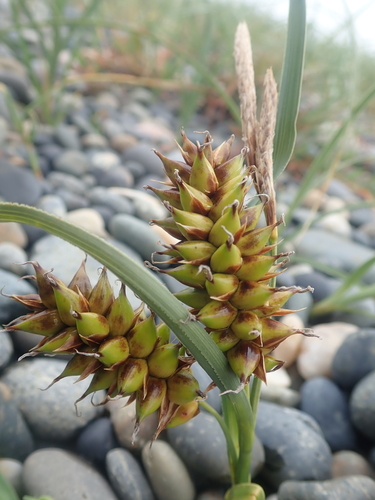
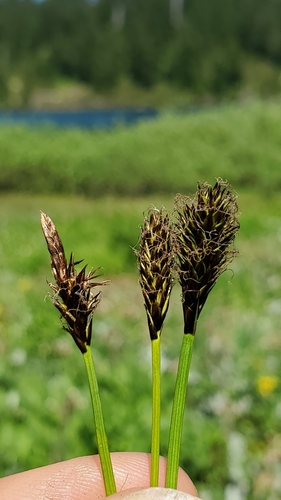
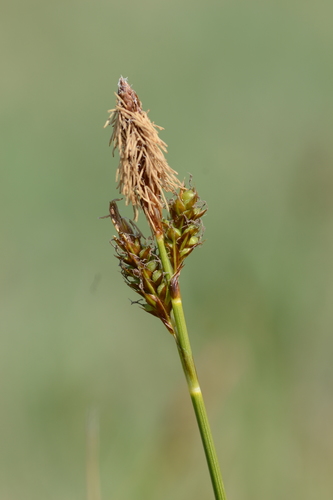
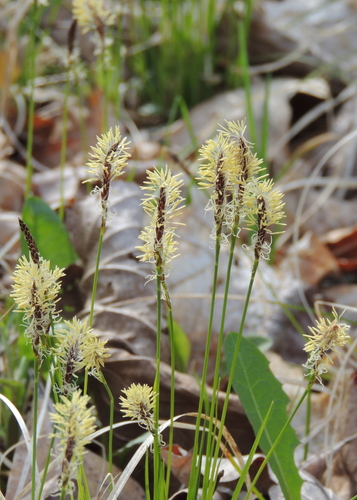
Pennsylvania sedge (Carex pensylvanica Lam.) produces leaves up to 2 feet (0.6 meters) long and 1 to 3 millimeters (0.04 to 0.12 inches) wide, which become arching at maturity. Its culms (stems) measure 10 to 45 centimeters (4 to 18 inches) long. Pennsylvania sedge blooms early in the spring, from April to June. Each flower cluster holds one slender staminate (male) spike 10 to 25 millimeters (3⁄8 to 1 inch) long, positioned above one to three shorter pistillate (female) spikes that each contain 4 to 12 florets. During bloom, the staminate spike produces slender cream-colored anthers that age to light brown, and each pistillate floret produces three long, white, thread-like styles. The scales located underneath the florets are dark purple.
This plant is native to North America, particularly eastern Canada and the eastern United States. Based on a census of published literature, herbarium specimens, and confirmed sightings, C. pensylvanica occurs in Manitoba, Ontario, and Quebec in Canada. In the United States, it has its widest distribution in Connecticut, Illinois, Massachusetts, Michigan, Minnesota, New Hampshire, New Jersey, Pennsylvania, mainland Rhode Island, Virginia, and Wisconsin. It is also documented from northern Alabama, the western Carolinas, mostly eastern Dakotas, northern and southern Delaware, northern Georgia, western Iowa, mostly northern Indiana, northern and eastern Missouri, mostly central and eastern Ohio, and mostly central Tennessee. It is additionally found in Arkansas, Kentucky, Maine, Maryland, the District of Columbia, New York, West Virginia, and Vermont. It has only been reported from a single county, Lee, in the far northeastern part of Mississippi.
This competitive species is often found growing in large monotypic stands. It spreads primarily via vegetative growth through systems of cordlike rhizomes: shorter rhizomes form tufts, clumps, and mats, while longer rhizomes create wide, matted colonies. To examine how three stress factors impact the development of Carex pensylvanica growing on forest beds, researchers carried out an experiment using even-aged silvicultural systems. Combinations of deer herbivory, invasive earthworm activity, and forest management (human activity) were tested as the stressors. The study results showed a direct correlation between increased C. pensylvanica coverage and higher disturbance levels, especially interactions between invasive earthworms, management activity, and deer, as well as higher invasive earthworm density. In hardwood forests of northern Minnesota, Carex pensylvanica was found to be more dominant than other understory plant species in areas that had invasive earthworms present for 20 years or longer. One hypothesis holds that because Carex pensylvanica is a non-mycorrhizal plant species, it gains a comparative competitive advantage over other understory plant species when earthworms disrupt and sever existing mycorrhizal networks.