About Carex lacustris Willd.
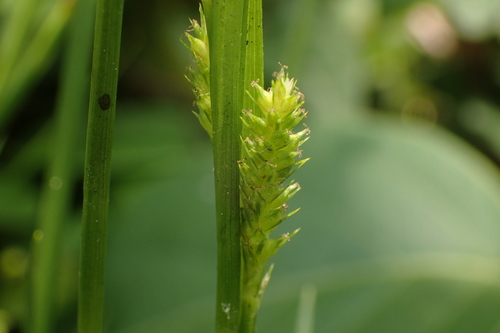
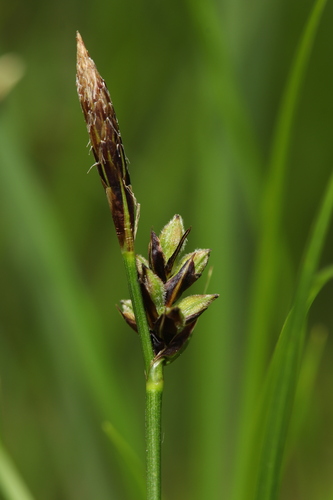
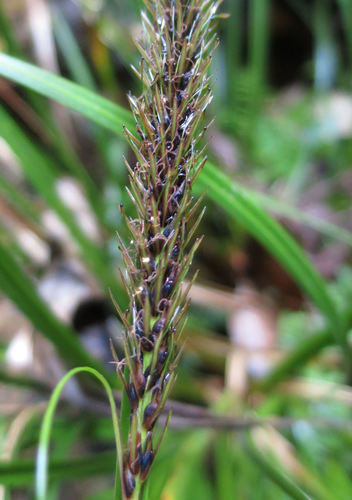
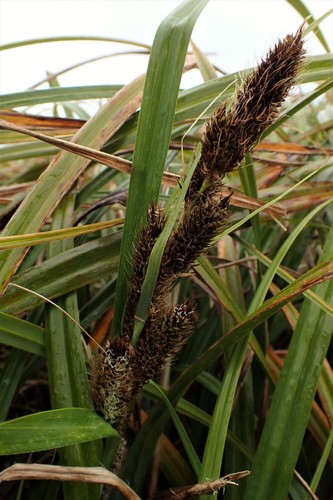
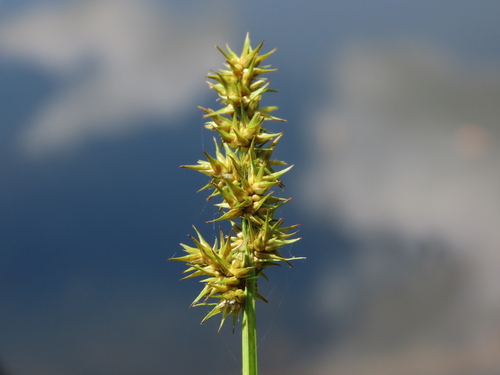
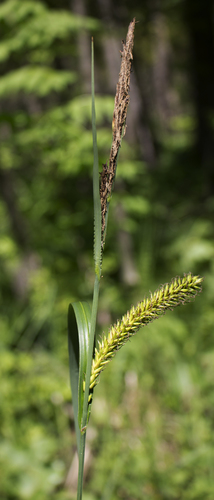
Carex lacustris Willd. typically has stems 50–150 cm (20–60 in) tall. Stems are rough to the touch, triangular in cross-section (most distinct near the base), green, and have a noticeable reddish to purplish tinge at the base. Leaf blades range from grayish blue to dark green, grow as long as or longer than the stems, and measure 8–20 mm wide. They are coarse, and have a distinctly M-shaped cross-section. The sheaths wrapping around the stem are smooth; basal (near the base) sheaths are reddened and have open, feather-like (pinnate) fibers. Flowers of C. lacustris grow along spikes or spikelets, which are elongated, tightly packed inflorescences (flower clusters) that hold many small florets. Plants usually have 4–8 green spikes: 2–4 upper spikes are male (staminate spikes), and 2–4 lower spikes are female (pistillate spikes). Male spikes are narrow, 3–4 mm wide and 1–8 cm long, and short-lived. Female spikes are thick, 10–15 mm wide and 2–10 cm long; they are either sessile (stalkless) or borne on short stalks, and hold 50–100 well-separated florets. All spikes are generally erect, though lower spikes may sometimes nod, and spikes are sometimes compound. The olive-green perigynium is 5.5–7.3 mm long, hairless, distinctly ribbed, and tapers gradually into a beak. Thin female scales are ovate (tapered at the tip) and awned, translucent to purplish or brown in color, and half the length of the perigynia. The fruit (nutlet) is a three-sided achene with three stigmas. Carex lacustris shares similar habitat and appearance with Carex atherodes (slough sedge or awned sedge), but C. atherodes typically has hairy leaf sheaths rather than smooth, and has longer teeth (1.5–3 mm) on its perigynia. This species grows in shallow marshes, marsh edges, shrub-carrs, alder thickets, wet open thickets, open swamps, wooded swamps, sedge meadows, ditches, and along the borders of lakes, ponds, bogs, fens, and streams. It forms scattered clones or beds, and sometimes forms extensive stands that lack fertile culms. It is abundant and often a dominant plant in calcareous, north-temperate wetlands. The species typically fruits from May to July. Carex lacustris is native to the United States and Canada, and almost always grows in wetlands. It is recorded in the following US states: Connecticut (CT), District of Columbia (DC), Delaware (DE), Iowa (IA), Idaho (ID), Illinois (IL), Indiana (IN), Kansas (KS), Massachusetts (MA), Maryland (MD), Maine (ME), Michigan (MI), Minnesota (MN), Missouri (MO), North Dakota (ND), Nebraska (NE), New Hampshire (NH), New Jersey (NJ), New York (NY), Ohio (OH), Pennsylvania (PA), Rhode Island (RI), South Dakota (SD), Tennessee (TN), Virginia (VA), Vermont (VT), Wisconsin (WI), and West Virginia (WV). It is found in the following Canadian provinces: Alberta (AB), Manitoba (MB), New Brunswick (NB), Newfoundland (NF), Nova Scotia (NS), Ontario (ON), Quebec (QC), and Saskatchewan (SK). For wildlife, Carex lacustris attracts waterfowl and songbirds, which eat its seeds, and butterflies, including the endangered Dukes' skipper. In the northern part of its Michigan range, Dukes' skipper larvae feed exclusively on C. lacustris. Rodents and other small animals use the stems for shelter and food during the winter. Pike and muskies use the plants as spawning habitat in the spring.