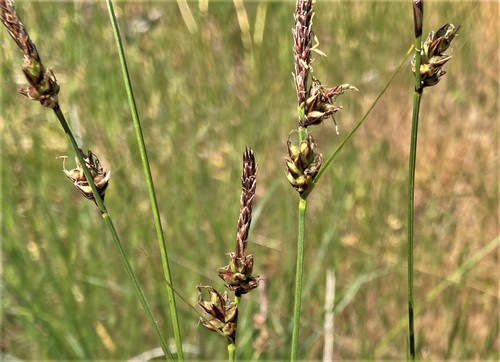
About Carex inops L.H.Bailey
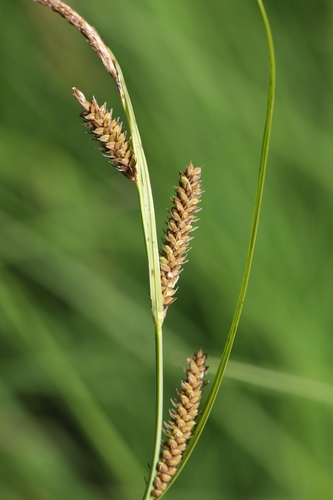
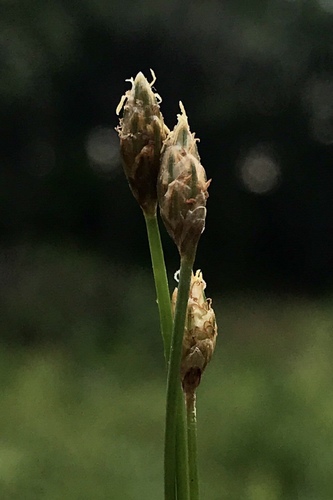
This sedge, Carex inops, grows in loose clumps with stems reaching up to 50 centimeters tall. It has persistent stiff, narrow leaves, and dead leaves remain around the plant's base. Its inflorescence typically bears pistillate spikes positioned below staminate spikes. The plant grows from rhizomes and fibrous roots, and despite its common name, it does not usually produce stolons. Ecologically, the subspecies Carex inops subsp. heliophila, commonly called sun sedge, acts as a dominant species in many types of ecosystems, including numerous grasslands. On the prairies of the northern Great Plains, it is codominant alongside grasses including western wheatgrass (Pascopyrum smithii) and other wheatgrasses, big bluestem (Andropogon gerardi) and other bluestems, needle-and-thread grass (Hesperostipa comata) and other needlegrasses, and/or blue grama (Bouteloua gracilis) and other gramas. It is common on the tallgrass prairies of Kansas, growing alongside bluestems and prairie sandreed (Calamovilfa longifolia). It can be a dominant species in Rocky Mountain meadows, woodlands in Nebraska, the Black Hills of South Dakota and Wyoming, and the plains of Saskatchewan. It occurs in all stages of ecological succession on grasslands, and can colonize blowouts, anthills, and prairie dog towns. Many types of animals eat this plant, especially the subspecies C. inops subsp. heliophila. It is regarded as good forage for livestock: it is one of the first green plants to emerge in spring, and livestock like cattle find it palatable.