About Carex bigelowii Torr. ex Schwein.
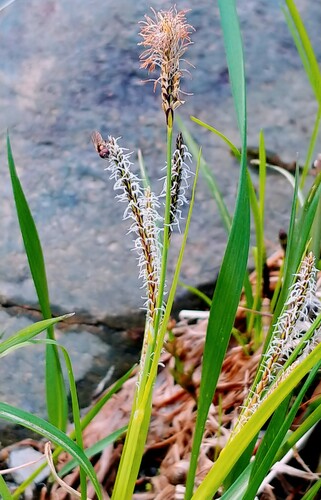
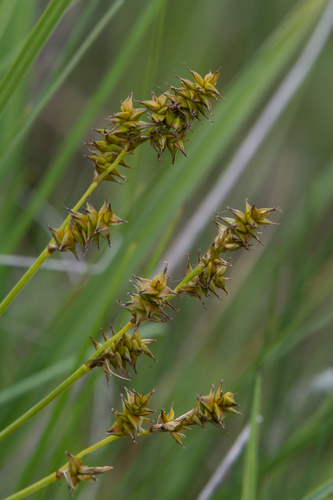
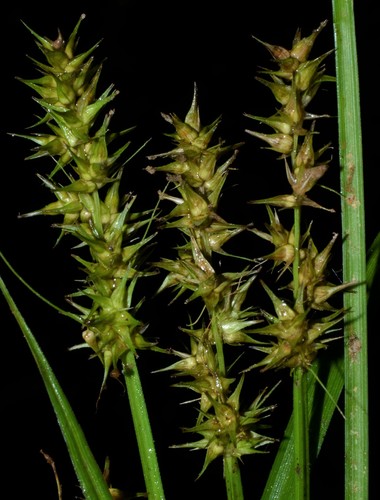
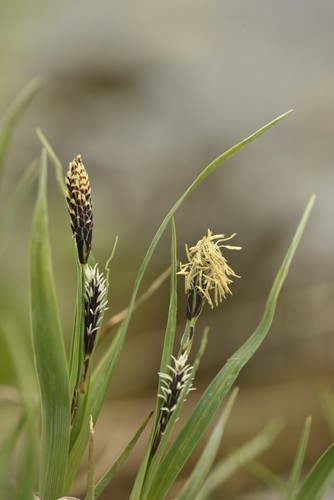
The scientific name of this plant is Carex bigelowii Torr. ex Schwein. This species produces 3-angled stems that grow up to 50 centimeters (1.6 ft) tall, and it may grow in a tuft or singly. Its leaves are stiff and dark green, and leaves from previous growing seasons may remain on the plant. Its inflorescence is accompanied by a short bract, and holds 1–3 black pistillate spikes positioned below 1–2 staminate spikes. Carex bigelowii usually reproduces vegetatively, sprouting new tillers from its rhizome, and also spreads via stolons. It has a thick root network that allows it to form turf, and its roots can grow as deep as 80 cm (2.6 ft) into the soil. The plant sometimes reproduces sexually by producing seeds, which can remain viable for up to 200 years. This species has a circumpolar or circumboreal distribution, found throughout the northern latitudes of the Northern Hemisphere. It is present in Europe, Asia, and North America, where it occurs from Alaska to Greenland, and grows in alpine climates as far south as Utah and Colorado. Carex bigelowii grows in many types of arctic and alpine habitats, including forest, bog, meadows, and tundra. It occurs alongside a wide range of other plants and non-vascular species: willows (Salix spp.), dwarf arctic birch (Betula nana), lingonberry (Vaccinium vitis-idaea), bog blueberry (V. uliginosum), crowberry (Empetrum nigrum), northern Labrador tea (Ledum palustre), American green alder (Alnus crispa), cloudberry (Rubus chamaemorus), alpine bearberry (Arctostaphylos alpina), varileaf cinquefoil (Potentilla diversifolia), elephanthead lousewort (Pedicularis groenlandica), white mountain avens (Dryas octopetala), entireleaf mountain avens (D. integrifolia), alpine timothy (Phleum alpinum), alpine rush (Juncus alpinoarticulatus), tussock cottongrass (Eriophorum vaginatum), feathermosses (Hylocomium and Aulacomium spp.), lichens (Cladonia and Cladina spp.), and sphagnum mosses. In Scotland, particularly on Glas Maol, this sedge is codominant with the moss Racomitrium lanuginosum in a heath ecosystem that corresponds to British NVC community U10. This sedge is also associated with Racomitrium lanuginosum on lava fields in Iceland. Carex bigelowii can colonize disturbed habitats. It has been recorded growing at oil spill sites within two months of the disturbance, and it grows alongside the Dempster Highway in northwestern Canada. Its long-lasting soil seed bank allows it to sprout after soil disturbance, and its rhizomes can help prevent erosion.