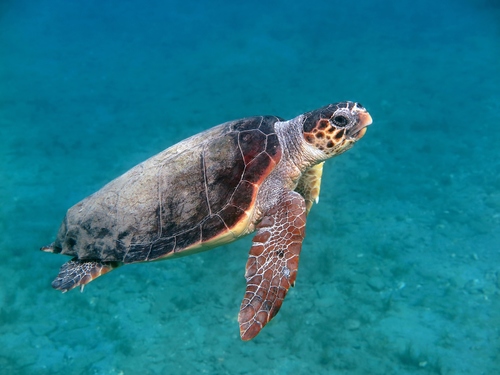
About Caretta caretta (Linnaeus, 1758)
The loggerhead sea turtle, Caretta caretta (Linnaeus, 1758), is the world's largest hard-shelled turtle. Its average and maximum mature weights are slightly larger than those of the green sea turtle and the Galapagos tortoise, and it is the world's second largest extant turtle after the leatherback sea turtle. Adult loggerheads typically weigh 80 to 200 kg (180 to 440 lb), with an average weight around 135 kg (298 lb), and have a straight-line carapace length of 70 to 95 cm (28 to 37 in). The maximum reported weight for the species is 545 kg (1,202 lb), and the maximum presumed total length is 213 cm (84 in). The head and carapace (upper shell) range in color from yellow-orange to reddish brown, while the plastron (underside) is typically pale yellow. The tops of the turtle's neck and sides are brown, and the sides and bottom are yellow. The turtle's shell is split into two main sections: the carapace and the plastron. The carapace is further divided into large plates called scutes. Most often, 11 or 12 pairs of marginal scutes form the rim of the carapace. Five vertebral scutes run down the midline of the carapace, and five pairs of costal scutes border these vertebral scutes. A nuchal scute sits at the base of the head. The carapace connects to the plastron via three pairs of inframarginal scutes that form the shell's bridge. The plastron has paired gular, humeral, pectoral, abdominal, femoral, and anal scutes. The shell acts as external armor, but loggerhead sea turtles cannot retract their heads or flippers into their shells. Sexual dimorphism in loggerhead sea turtles is only visible in adult individuals. Adult males have longer tails and claws than females. Males also have shorter plastrons than females, which is thought to make space for their larger tails. Male carapaces are wider and less domed than female carapaces, and males generally have wider heads than females. The sex of juvenile and subadult loggerheads cannot be determined from external anatomy, but can be identified through dissection, laparoscopy (an abdominal operation), histological examination (cell anatomy), and radioimmunological assays (immune studies using radiolabeling). Lachrymal glands located behind each eye let loggerheads maintain osmotic balance by excreting excess salt gained from drinking ocean water. When the turtle is on land, this salt excretion creates the false impression that the turtle is crying, and Caretta caretta tears have a high urea content. The loggerhead's skull can be most easily told apart from the skulls of other sea turtles by its maxillae, which meet at the midline of the palate. The portion of the skull behind the eyes is also relatively large and bulbous, due to the turtle's extensive jaw muscles. Loggerhead sea turtles have a cosmopolitan distribution, and have the broadest geographical nesting range of any sea turtle. They inhabit the Atlantic, Indian, and Pacific Oceans, as well as the Mediterranean Sea. In the Atlantic Ocean, the highest concentration of loggerheads is along the southeastern coast of North America and in the Gulf of Mexico, and very few loggerheads are found along the European and African coastlines. Florida is the most common nesting site, with more than 67,000 nests built each year. Nesting occurs as far north as Virginia, as far south as Brazil, and as far east as the Cape Verde Islands. The Cape Verde Islands are the only major nesting site on the eastern side of the Atlantic. Loggerheads in the Atlantic Ocean feed in waters ranging from Canada to Brazil. In the Indian Ocean, loggerheads feed along the coastlines of Africa and the Arabian Peninsula, and in the Arabian Sea. Along the African coastline, loggerheads nest from Mozambique's Bazaruto Archipelago to South Africa's St Lucia estuary. The largest Indian Ocean nesting site is Oman on the Arabian Peninsula, which hosts around 15,000 nests annually and has the second largest loggerhead nesting population in the world. Western Australia is another notable nesting area, with 1,000–2,000 nests per year. Pacific loggerheads live in temperate to tropical regions. They forage in the East China Sea, the southwestern Pacific, and along the Baja California Peninsula. Eastern Australia and Japan are the major nesting areas, and the Great Barrier Reef is considered an important nesting area. Pacific loggerheads occasionally nest in Vanuatu and Tokelau. Yakushima Island is the most important nesting site, with three nesting grounds visited by 40% of all nearby loggerheads. After nesting, females often settle in the East China Sea, while the Bifurcation region of the Kuroshio Current Extension provides important foraging habitat for juvenile turtles. Eastern Pacific populations are concentrated off the coast of Baja California, where upwelling creates rich feeding grounds for juvenile and subadult turtles. Nesting sites along the eastern Pacific Basin are rare. mtDNA sequence polymorphism analysis and tracking studies suggest that 95% of the population along the coast of the Americas hatches on the Japanese Islands in the western Pacific. The turtles are carried by prevailing currents across the entire northern Pacific, along one of the longest migration routes of any marine animal. A return journey to the natal beaches in Japan has long been suspected, even though the trip would cross unproductive clear water with few feeding opportunities. Evidence for this return came from an adult female loggerhead named Adelita, who in 1996, fitted with a satellite tracking device, completed the 14,500 km (9,000 mi) trip from Mexico across the Pacific. Adelita was the first animal of any kind ever tracked across an ocean basin. The Mediterranean Sea acts as a nursery for juvenile loggerheads, and is a common habitat for adults during the spring and summer. Almost 45% of the Mediterranean juvenile population has migrated from the Atlantic. Loggerheads feed in the Alboran Sea and the Adriatic Sea, with tens of thousands of specimens (mostly sub-adult) seasonally present in the northeastern portion of the Adriatic Sea, especially around the Po Delta. Greece is the most popular nesting site in the Mediterranean, with more than 3,000 nests per year. Zakynthos hosts the largest Mediterranean nesting colony, and the second largest is in Kyparissia Bay. Because of this, Greek authorities do not allow planes to take off or land at night in Zakynthos to protect nesting turtles. In addition to the Greek coast, the coastlines of Cyprus and Turkey are also common nesting sites. There is one recorded sighting of this turtle in Ireland, when a specimen washed ashore on Ballyhealy Beach in County Wexford in 2013. Another sighting recorded a specimen washed up on a beach in County Donegal, Ireland, in 2019. Loggerheads are not native to UK waters, but have been increasingly seen, with the most recent sighting in 2026. Loggerhead sea turtles spend most of their lives in the open ocean and in shallow coastal waters. They rarely come ashore, with the only exception being brief visits from females to construct nests and deposit eggs. Hatchling loggerhead turtles live in floating mats of Sargassum algae. Adults and juveniles live along the continental shelf and in shallow coastal estuaries. In the northwestern Atlantic Ocean, age affects habitat preference: juveniles are more often found in shallow estuarine habitats with limited ocean access, compared to non-nesting adults. During the non-nesting season, loggerheads occupy waters with surface temperatures ranging from 13.3–28 °C (56–82 °F). Temperatures of 27–28 °C (81–82 °F) are most suitable for nesting females. Juvenile loggerheads share Sargassum habitat with a wide variety of other organisms. Sargassum mats can hold up to 100 different animal species that juvenile loggerheads feed on. Prey found in these mats includes barnacles, crab larvae, fish eggs, and hydrozoan colonies. Some prey, such as ants, flies, aphids, leafhoppers, and beetles, are carried to the mats by wind. Marine mammals and commercial fishes including tuna and mahi-mahi also inhabit Sargassum mats. Female loggerheads first reproduce between the ages of 17 and 33, and their mating period can last more than six weeks. Loggerheads court their mates, but these courtship behaviors have not been fully studied. Male courtship behaviors include nuzzling, biting, and movements of the head and flippers. Research suggests females produce cloacal pheromones to signal that they are able to reproduce. Before mating, the male approaches a female and attempts to mount her, while the female resists. Next, the male and female begin circling each other. If the male has competitors, the female may allow the males to fight one another. The winning male then mounts the female, and the male's curved claws usually damage the shoulders of the female's shell during this process. Other courting males bite the mounting male while he attempts to copulate, damaging his flippers and tail and sometimes exposing bones. This damage can cause the male to dismount and may take weeks to heal. While nesting, females produce an average of 3.9 egg clutches, then enter a quiescent period where they produce no eggs for two to three years. Unlike other sea turtles, courtship and mating usually do not happen near the nesting beach, and instead occur along migration routes between feeding and breeding grounds. Recent evidence shows that ovulation in loggerheads is mating-induced: through the act of mating, the female ovulates eggs that are then fertilized by the male. This is unusual, as mating-induced ovulation is rare outside of mammals. In the Northern Hemisphere, loggerheads mate from late March to early June. The nesting season is short, running between May and August in the Northern Hemisphere and between October and March in the Southern Hemisphere. Loggerheads can have multiple paternity, which is possible thanks to sperm storage. Females can store sperm from multiple males in their oviducts until ovulation occurs, and a single clutch can have as many as seven fathers, each contributing sperm to a portion of the clutch. Multiple paternity is positively correlated with female size. Two hypotheses explain this correlation: one states that males prefer large females because they are perceived to have higher fecundity (reproductive ability), and the other states that larger females can swim more quickly to mating grounds, giving them longer mating periods. All sea turtles share similar basic nesting behaviors. During the nesting season, females return to lay eggs at intervals of 12–17 days, on or near the beach where they hatched. They exit the water, climb the beach, and scrape away surface sand to make a body pit. They use their hind limbs to excavate an egg chamber, where they deposit their eggs. Females then cover the egg chamber and body pit with sand, and finally return to the sea. This process takes one to two hours, and occurs in open sand areas or on top of sand dunes, with females preferring areas near dune grasses that can be used to camouflage the nest. Nesting areas must be selected carefully, as location affects traits including offspring fitness, emergence rate, and vulnerability to nest predators. Loggerheads have an average clutch size of 112.4 eggs.