About Carduus acanthoides L.
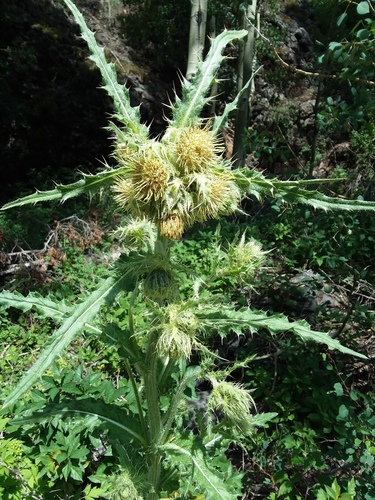
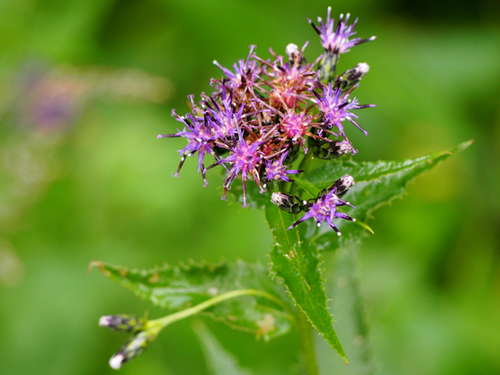
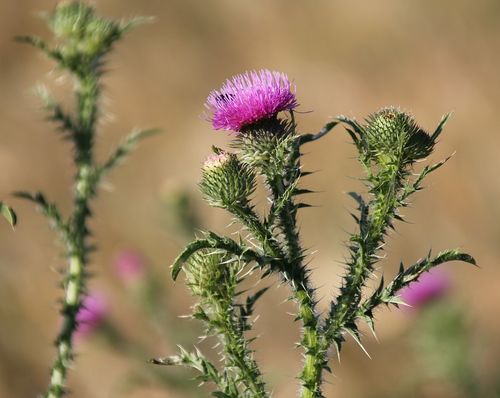
Carduus acanthoides L. may grow over 2 metres (6.6 ft) tall, and can form weedy stands made up of just this species. Its stem and foliage are spiny, and sometimes woolly. The specific epithet acanthoides refers to the plant’s spiny foliage. This species starts growth as a flat basal rosette, then sends up an erect stem that bears occasional toothed, wrinkled, spiny leaves. The leaves are 10–20 cm (4–8 in) long, with lobed or pinnately divided edges. The abaxial (underside) surface of the leaf is somewhat hairy. At the tip of each stem branch sits an inflorescence holding one to several flower heads. Each flower head is rounded, covered in spiny phyllaries, and bears many threadlike purple or pink disc florets. Each flower head measures around 13–25 mm (0.5–1 in) across. This plant flowers throughout summer and early fall. Its achenes are 2–3 mm long, four-angled, and marked with faint lengthwise stripes. Its fluffy pappus bristles are 11–13 mm long. After flowering and producing seed, the plant dies. Carduus acanthoides is native to an area extending from France, Italy, and western Turkey, through Russia and Kazakhstan, to China. Within its native range, it grows in open grasslands and disturbed areas. In non-native ranges, it grows as a weed in annual grasslands, roadsides, fields, pastures, and disturbed areas. It has been widely introduced across much of North America, where it is sometimes considered a noxious weed or invasive species. The California Department of Food and Agriculture runs an active program to control known populations of this plant. It spreads via its seeds; each individual plant produces around 1,000 seeds. However, the plant has beneficial impacts on native bees in North America. Although it was first recorded in the Chicago region in 1962, it has not been seen there since 1985. In Michigan and Wisconsin, it does not grow in undisturbed remnant native habitats, and instead occurs in sites with a history of disturbance, such as railroad right-of-ways, roadsides, and farm fields.