About Cardioderma cor (Peters, 1872)
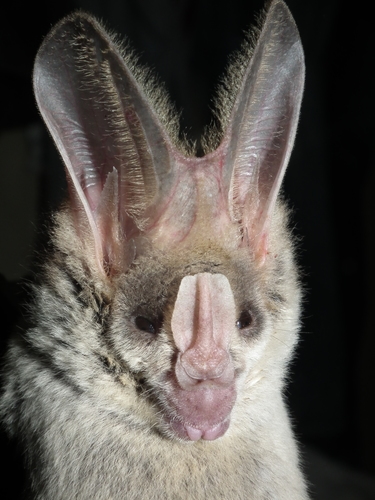
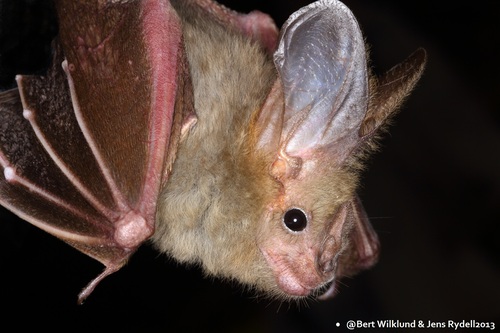
The heart-nosed bat, with the scientific name Cardioderma cor, is a bat species belonging to the family Megadermatidae. It is the only species classified in the genus Cardioderma. Its known distribution covers eastern Sudan, northern Tanzania, and southern Zambia. A 2017 experiment found that heart-nosed bats produce vocalizations, called "singing", to mark their foraging areas and actively defend these territories from other members of the same species.
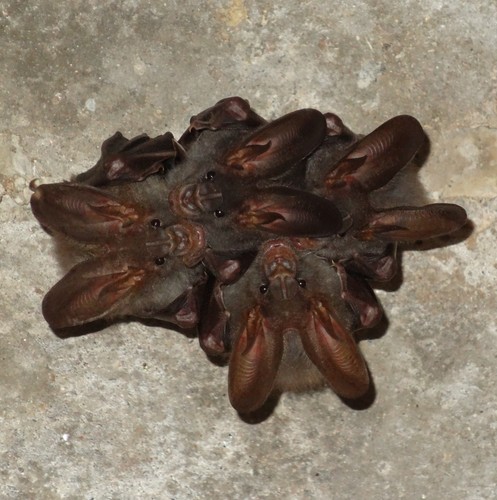
This bat species usually lives in dry lowlands, coastal strips, and river valleys. During daylight hours, these bats most often gather at abandoned buildings, dry caves, or baobab trees. Their elevation range does not go above 940 meters (3094 feet). Heart-nosed bats form large shared colonies, but they are highly territorial and do not associate with other bat species.
Heart-nosed bats are monogamous, and mated pairs will stay together across multiple mating seasons when possible. Males typically protect extremely territorial breeding sites, which are established during each breeding season and taken down after the season ends. A new breeding site is located for the next mating season.
Female heart-nosed bats have a three-month gestation period, and give birth to only one pup (baby bat) at a time. Like all mammal females, female heart-nosed bats feed their young through lactation. Females carry their newborn pups until the pups reach two months of age. By the third month, pups are weaned and begin following their mothers to learn about foraging and territory maintenance skills that support their survival later in life. The father’s specific parental behavior is mostly unknown, but it is thought that the males’ singing and territorial defense serves to protect mothers and their young. Peak reproductive activity occurs between March and June, and again between October and December; these are rainy season months, which are the most favorable mating periods for the species.