About Cardinalis sinuatus Bonaparte, 1838
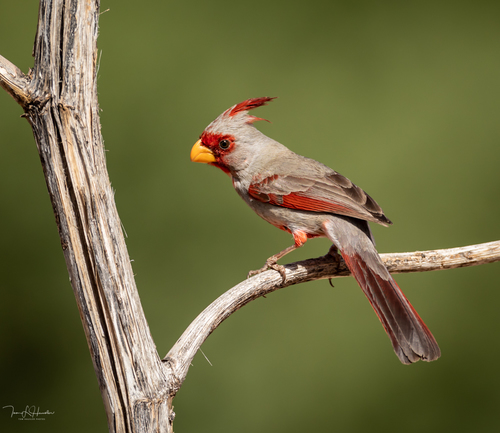
This species has two common names: pyrrhuloxia and desert cardinal. It is a medium-sized songbird, with both sexes measuring approximately 21 cm (8.3 in) in length and weighing 24–43 g (0.8–1.5 oz). The most noticeable differences between male desert cardinals and male northern cardinals are coloration. Male desert cardinals are predominantly brownish-gray, with a red breast, a red mask, and a stout, rounded yellow bill that looks parrot-like. Females of the two species look much more similar to each other, but bill shape is a reliable identifying trait. The songs of the two species are identical, although the pyrrhuloxia's song is slightly quieter. Like all cardinal species, the desert cardinal has a distinctive long, pointed red crest. Pyrrhuloxia are year-round nonmigratory residents, though they may occasionally stray a short distance north of their usual range. They are native to desert scrub, mesquite thickets, and stream-side woodland edges in the southwestern United States and Mexico. Their range covers the southwestern half of Texas, roughly the southern third of New Mexico, and southeastern Arizona. In Mexico, they live across the full width of the country north of the Sierra Madre del Sur, Trans-Mexican Volcanic Belt, and Isthmus of Tehuantepec, with the exclusion of the Sierra Madre Occidental. One individual has been reported as far outside the main range as Costa Mesa, Orange County, California. Pyrrhuloxia prefer habitats located along stream beds. Where the ranges of pyrrhuloxia and northern cardinals overlap, hybridization between the two species can occur. During the breeding season, birds use song to establish and defend territories. One common song is a sharp, clear "wha-cheer, wha-cheer", while another is a characteristic metallic "quink". Females also sing, but their notes are softer and less clear. Both sexes give a short "cheep" or "chip" contact call while foraging. The breeding season for desert cardinals usually runs from mid-March to mid-August. As the breeding season approaches, males establish and defend territories. Males defend their territory by chasing away intruders and singing from an elevated vantage point. No interspecific conflicts have been observed when desert and northern cardinal breeding territories overlap. Desert cardinals build their small, bowl or cup-shaped nests in dense shrubs, where they are typically well concealed. Nests are constructed from grass, twigs, and bits of tree bark. Most clutches contain 2 to 4 whitish eggs marked with green or gray specks. Incubation lasts around two weeks, during which the male brings food to the incubating female. When chicks hatch, they are helpless, with bright yellow bills and red lining around the mouth. Chicks typically make their first flight from the nest around 10 days after hatching, and both parents care for the young after hatching. Young birds may take up to a full month to reach full independence, after which they join large foraging flocks. Full body growth is completed during this post-fledging period.