About Cardinalis cardinalis (Linnaeus, 1758)
Description: The northern cardinal (Cardinalis cardinalis (Linnaeus, 1758)) is a mid-sized songbird. It measures 21–23.5 cm (8.3–9.3 in) in body length, has a wingspan of 25–31 cm (9.8–12.2 in), and adult individuals weigh 33.6–65 g (1.19–2.29 oz), with an average weight of 44.8 g (1.58 oz). Adult males are on average slightly larger than adult females. The oldest recorded wild northern cardinal banded by researchers lived at least 15 years and 9 months, while a captive individual of the species lived 28.5 years. Annual survival rates for adult northern cardinals have been estimated between 60% and 65%.
Distribution and habitat: Northern cardinals are abundant across the eastern United States, ranging from the southern half of Maine west to Minnesota, and south to the Texas-Mexico border. In Canada, they occur in the southern parts of Ontario, Quebec, New Brunswick, and Nova Scotia, extending east to Cape Breton Island. The species' range also stretches south through Mexico to the Isthmus of Tehuantepec, northern Guatemala, and northern Belize. An allopatric population exists on the Pacific slope of Mexico from Jalisco to Oaxaca, though this population is not marked on the range map. Northern cardinals were introduced to Bermuda in 1700, and have also been introduced to Hawaii. Their natural habitats are woodlands, gardens, shrublands, and wetlands. In 1929, Forbush described the species as rare in Massachusetts; by 1955, Griscom reported the bird was "pushing northward", with annual records at feeding stations. Data from Audubon shows that the species' population has grown rapidly in Massachusetts since 1960. In the state, the northern cardinal is most abundant in the east, especially in areas where dense cover is mixed with open spaces, such as woodland edges, brushy fields, wooded wetlands, parks, and suburban areas. Northern cardinals tend to avoid large continuous expanses of woodland.
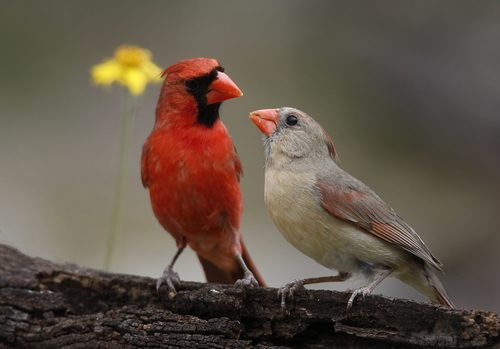
Reproduction: Pairs of northern cardinals may mate for multiple consecutive years, but some pairs "divorce" between breeding seasons, or one partner will choose a new mate if the other dies. Pairs generally remain together year-round, but are not guaranteed to be monogamous. DNA studies of two cardinal populations found that 9–35% of nestlings were not fathered by the female's social mate. Mated pairs sometimes sing together before the nesting season begins. During courtship, the pair may also take part in a bonding behavior where the male collects food and brings it to the female, feeding her beak-to-beak.
Ecology: A wide variety of North American native predators hunt northern cardinals, including falcons, all Accipiter hawks, shrikes, bald eagles, golden eagles, and multiple owl species (specifically long-eared owls and eastern screech owls). Predators of northern cardinal chicks and eggs include milk snakes, Coluber constrictors, blue jays, crows, eastern gray squirrels, fox squirrels, eastern chipmunks, and domestic cats. Cowbirds have been observed to parasitize the nests of northern cardinals.