About Cardellina rubrifrons (Giraud Jr, 1841)
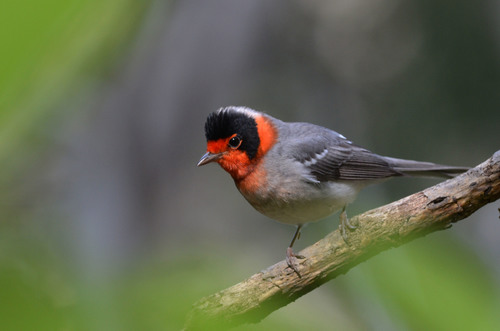
The red-faced warbler, with the scientific name Cardellina rubrifrons, is a species of New World warbler. Mature red-faced warblers are small birds, measuring 14 cm (5+1⁄2 inches) in length. Their upper bodies are light gray, with a white rump and white underparts. The face, neck, and upper breast are all bright red, while the crown and sides of the head are black. The spot at the back of the head, where the black crown meets the gray back, is sometimes speckled gray, and sometimes solid white. While feeding, they have a distinctive habit of flicking their tail sideways. Red-faced warblers are locally common in mountain forests of conifers and oak, at elevations between 2,000 and 3,000 m (6,600 and 9,800 ft) above sea level. During summer, they live in northern Mexico, ranging north into the U.S. states of Arizona and New Mexico in the region known as the Madrean sky islands. In winter, they migrate south to southern Mexico and the Central American countries of El Salvador, Guatemala, and Honduras. They are permanent residents in the central and southern mountains of western Mexico, in the range called the Sierra Madre Occidental. Their nest is a small cup-shaped structure built from leaves, grass, and pine needles. It is hidden among debris on the forest floor, buried in the ground, and sheltered under a shrub, log, or rock. The female lays between 3 and 5 eggs, which are white with brown spots. Both the incubation period and the nestling period average 12 days each.