About Cardamine angustata O.E.Schulz
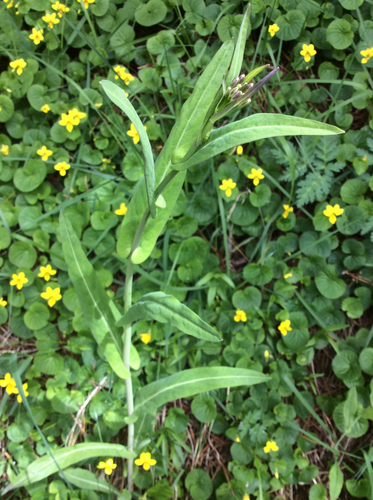
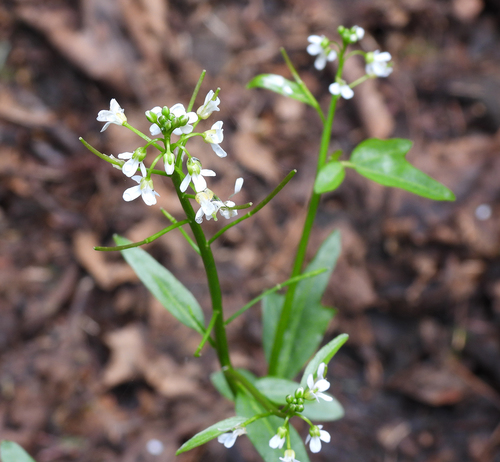
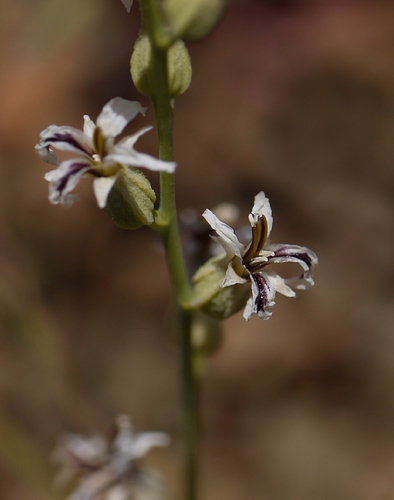
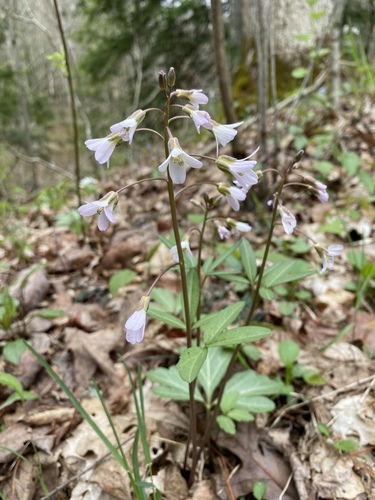
Cardamine angustata O.E.Schulz produces basal leaves that can reach up to 24 centimeters in total size, with each leaf made up of three leaflets attached to a petiole that is 3 to 16 centimeters long. Its erect, unbranched stem grows 12 to 30 centimeters tall, and may be either smooth or covered in fine hairs. The stem bears two or three leaves that have a different structure than the basal leaves; while these stem leaves are also divided into three leaflets, the leaflets measure only 2 to 7 centimeters long and 3 to 6 millimeters wide. Its flowers grow arranged in a raceme, with petals 9 to 18 millimeters long and 2 to 5 millimeters wide. The fruit it produces is linear in shape, 2.5 to 4 centimeters long and 1.5 to 2.5 millimeters wide. This species is widely distributed across the eastern United States, though its local populations may be scattered. It has been officially recorded in Alabama, Arkansas, Washington, D.C., Delaware, Georgia, Indiana, Kentucky, Maryland, Mississippi, North Carolina, New Jersey, Ohio, Oklahoma, Pennsylvania, South Carolina, Tennessee, Virginia, and West Virginia. In Virginia, it grows in two main habitat types: well-drained floodplain forests, and mesic to dry-mesic upland forests. The survival of this species relies on having access to suitable habitat, and it can be extirpated from a region by human development, changes in land use, or competition from invasive plant species.