About Cardamine angulata Hook.
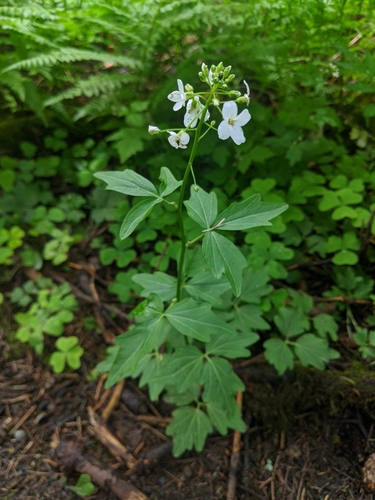
Cardamine angulata Hook., commonly called angled bittercress, grows an overall height of up to 3 feet. It produces a tall, slender stem that measures 2 to 8 mm (0.08 to 0.31 inches) in diameter. The stem may be hairless (glabrous) or covered in fine hairs (pubescent), and stiff hairs are commonly present along the base of the main stem. Its leaves are palmately divided, holding 3 to 5 toothed or lobed leaflets that are egg-shaped or lance-shaped. Full leaves range from 1.5 to 7.62 cm (0.59 to 3 inches) in length, and the terminal leaflet at the end of each leaf is the largest. The plant's flower petals measure 8 to 15 mm (0.31 to 0.6 inches) long and 4 to 8 mm (0.16 to 0.31 inches) wide, with an obovate shape and rounded or notched tips. Petal color ranges from white to pinkish. The fruits are flat and linear, growing in an erect or ascending position. They measure 1.5 to 4 cm (0.6 to 1.6 inches) long and 1.4 to 2 mm (0.06 to 0.08 inches) wide. Angled bittercress flowers between April and June each year. This species can be found throughout California, Oregon, Washington, British Columbia, and Alaska. Globally, it is listed as a secure species, but it is ranked critically imperiled in Alaska, and vulnerable in British Columbia and California. Angled bittercress is classified as a facultative wetland (FACW) species, and it occurs most commonly in riparian and wetland environments. Habitats it grows in include wetlands, stream banks, moist woods, wet meadows, and shady, shrubby forests. It prefers cool mesothermal climates.