About Carcinus maenas (Linnaeus, 1758)
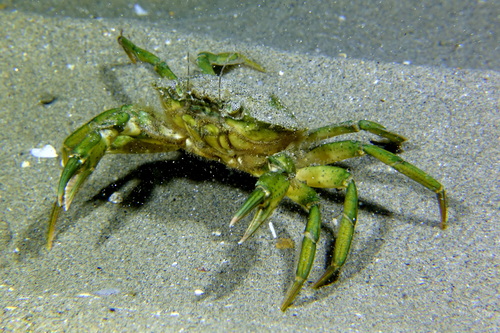
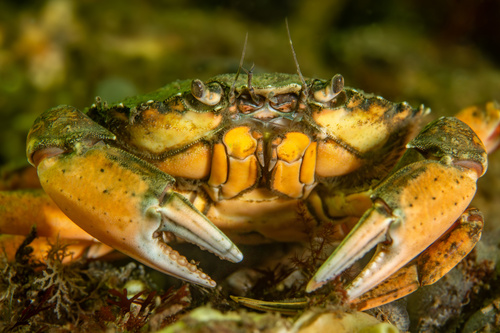
Carcinus maenas (Linnaeus, 1758) most commonly has a carapace up to 60 mm (2.4 in) long and 90 mm (3.5 in) wide, but individuals can grow larger outside of the species' native range, reaching up to 100 mm (3.9 in) wide in British Columbia. Along the rim of the carapace behind each eye, there are five short teeth, and three undulations sit between the eyes. These undulations, which protrude out past the eyes, are the simplest way to distinguish C. maenas from the closely related (and also potentially invasive) species C. aestuarii. In C. aestuarii, the carapace has no bumps and extends forward past the eyes. A second distinguishing trait between the two species is the shape of the first and second pleopods, which are collectively called gonopods: in C. aestuarii these are straight and parallel, while in C. maenas they curve outwards. The body color of C. maenas varies widely, and can range from green to brown, grey, or red. While this variation has a genetic component, it is driven mostly by local environmental factors. In particular, individuals that delay moulting develop a red color rather than green. Red individuals are stronger and more aggressive, but are less tolerant of environmental stresses like low salinity or hypoxia. On average, juvenile crabs show more distinct patterning than adult crabs. C. maenas is native to the coasts of Europe and North Africa, reaching as far east as the Baltic Sea, and as far north as Iceland and Central Norway, and it is one of the most common crab species across most of its native range. In the Mediterranean Sea, it is replaced by the closely related Mediterranean green crab C. aestuarii. The species was first recorded on the east coast of North America in Massachusetts in 1817, and can now be found from South Carolina northwards; by 2007, it had extended its range north to Placentia Bay, Newfoundland. In 1989, the species was detected in San Francisco Bay, California, on the Pacific Coast of the United States. The green crab did not start expanding its range here until 1993, after which it spread rapidly northward: it reached Oregon in 1997, Washington in 1998, and British Columbia in 1999, extending its total range by 750 km (470 mi) over 10 years. Invasive green crabs were first discovered in Alaska in 2022 by the Metlakatla Indian Community Department of Fish and Wildlife. By 2003, C. maenas had spread to South America, when specimens were discovered in Patagonia. In Australia, C. maenas was first reported "in the late 1800s" in Port Phillip Bay, Victoria, though it was likely introduced as early as the 1850s. It has since spread along the southeastern and southwestern seaboards, reaching New South Wales in 1971, South Australia in 1976 and Tasmania in 1993. One specimen was found in Western Australia in 1965, but no additional specimens have been recorded in the area since that find. C. maenas first reached South Africa in 1983, in the Table Docks area near Cape Town. Since that first detection, it has spread at least as far north as Saldanha Bay and as far south as Camps Bay, a distance of over 100 km (62 mi). Sightings of C. maenas have been recorded in Brazil, Panama, Hawaii, Madagascar, the Red Sea, Pakistan, Sri Lanka, and Myanmar; however, these have not led to established invasions, and only represent isolated individual finds. Japan has been invaded by a related crab, which is either C. aestuarii or a hybrid of C. aestuarii and C. maenas. Based on existing ecological conditions, C. maenas could eventually extend its range to colonize the Pacific Coast of North America from Baja California all the way to Alaska. Similar suitable ecological conditions exist on many of the world's coasts, with the only large uninvaded suitable area being New Zealand; the New Zealand government has taken action, including the release of a Marine Pest Guide, to prevent C. maenas from colonizing its coasts. In 2019, C. maenas was first detected in Lummi Bay, located on the Lummi Indian Reservation in Whatcom County, Washington, United States. The Lummi Nation started trapping and removing the crabs in an effort to eliminate the population. In 2020, hundreds of crabs were found in traps, so more intensive trapping is clearly needed to keep population numbers low. Full eradication is not possible. A 19-year study that concluded in 2020 found that Coos Bay, Oregon hosts an established and growing population of C. maenas. While fewer than 3,000 crabs were trapped in 2020, more than 79,000 were caught in 2021. This led the Lummi Indian Business Council to declare a disaster in November 2021, and prompted the Washington Department of Fish and Wildlife to request emergency funding from the governor. In 2025, the full genome of Carcinus maenas was sequenced, providing a valuable foundation for research into the genetic factors that contribute to this crab's global invasion success. C. maenas can live in all types of protected and semi-protected marine and estuarine habitats, including habitats with mud, sand, or rock substrates, submerged aquatic vegetation, and emergent marsh, though it prefers soft bottoms. Adult C. maenas are euryhaline, meaning they can tolerate a wide range of salinity (from 4 to 52 ‰), and can survive in temperatures between 0 and 30 °C (32 to 86 °F). The wide salinity tolerance allows C. maenas to survive in the lower salinities of estuaries, and the wide temperature tolerance allows it to survive in extremely cold climates under ice in winter. Early life stages have more constrained environmental tolerances; for example, larvae survive from hatching through metamorphosis to megalopa only at temperatures between 12 and 27 °C. A molecular study using the COI gene found genetic differentiation between populations in the North Sea and the Bay of Biscay, with even stronger differentiation between populations in Iceland and the Faroe Islands and populations elsewhere. This suggests that C. maenas is unable to cross deeper water. Different native populations of C. maenas differ in traits including larval and adult thermal tolerance, larval salinity tolerance, and body mass at hatching and at metamorphosis. Female C. maenas can produce more than 400,000 eggs, and larvae develop offshore in several stages before their final moult to become juvenile crabs in the intertidal zone. Young crabs live among seaweeds and seagrasses, such as Posidonia oceanica, until they reach adulthood. C. maenas can disperse via a variety of mechanisms, including ballast water, ship hulls, packing materials (seaweed) used to ship live marine organisms, bivalves moved for aquaculture, rafting, migration of crab larvae on ocean currents, and the movement of submerged aquatic vegetation for coastal zone management projects. In Australia, C. maenas dispersed mainly through rare long-distance events, which were likely caused by human activity. C. maenas is a predator that feeds on many organisms, particularly bivalve molluscs (such as clams — it can eat up to 40 13 mm clams per day — oysters, and mussels), polychaetes, and small crustaceans, including other crabs up to its own size. C. maenas are primarily diurnal, though activity also depends on the tide, so crabs can be active at any time of day. In California, preferential predation by C. maenas on native clams (Nutricola spp.) led to a decline in native clam populations and an increase in the population of a previously introduced clam, the amethyst gem clam (Gemma gemma). C. maenas also feeds voraciously on introduced clams such as Potamocorbula amurensis. The soft-shell clam (Mya arenaria) is a preferred prey species of C. maenas. As a result, C. maenas has been linked to the destruction of soft-shell clam fisheries on the east coast of the United States and Canada, and the reduction of populations of other commercially important bivalves including scallops (Argopecten irradians) and northern quahogs (Mercenaria mercenaria). The young of bivalves and fish are also included in C. maenas' prey, though the effect of its predation on winter flounder (Pseudopleuronectes americanus) is minimal. However, C. maenas can cause substantial negative impacts on local commercial and recreational fisheries, by preying on the young of species such as oysters (adult oyster shells are too tough for C. maenas to crack) and Dungeness crab, competing with native species for resources, and eating the Zostera marina seagrass that Dungeness crab and juvenile salmon rely on for habitat. Colder water temperatures lower the overall feeding rate of C. maenas. To protect itself from predators, C. maenas uses different camouflage strategies depending on its habitat: crabs in mudflats match their surroundings with colors similar to the mud, while crabs in rock pools use disruptive coloration. In its native range, the European green crab is mostly used as an ingredient in soups and sauces. However, the closely related Mediterranean green crab (C. aestuarii) has a thriving culinary market in Italy, where fishermen called moecante cultivate soft-shell green crabs (known as moeche in Venetian and moleche in Italian) and sell hard-shell crabs for their roe (called masinette). Several groups in New England have successfully adapted these methods to produce soft-shell green crabs from the invasive C. maenas. In New England, where invasive green crab populations are large, various groups have explored using green crabs in cuisine. In 2019, The Green Crab Cookbook was published, featuring recipes for soft-shell green crab, green crab roe, green crab stock, and green crab meat. One of the book's co-authors went on to found Greencrab.org, an organization dedicated to developing culinary markets for the invasive green crab. In addition to partnering with local chefs and wholesalers for supply chain development and market research, Greencrab.org continues to develop new green crab recipes and processing techniques. Researchers at the University of Maine have actively worked to develop value-added green crab products, with the goals of driving business interest, stimulating a commercial green crab fishery, and reducing negative predation effects. One specific study evaluated consumer acceptability of empanadas (fried stuffed pastries) that contained varying amounts of minced green crab meat. The empanadas received an overall acceptability rating between "like slightly" and "like moderately" from an 87-member consumer panel, and around two-thirds of panelists said they would "probably" or "definitely" buy the empanadas if they were available locally. The same research team also developed a patty product made from minced green crab meat using restructuring additives: transglutaminase, dried egg white, and isolated soy protein. While a successful green crab patty was developed, the restructuring additives may have worked better in a raw crab meat system, rather than the fully cooked minced meat used in the study. Results from both studies are considered promising, especially as they are the first rounds of green crab product development. In the past, Legal Sea Foods, an East Coast restaurant chain, experimented with green crabs, creating a green crab stock in their test kitchen during the winter of 2015. In June 2022, Tamworth Distilling, a New Hampshire distillery, partnered with the University of New Hampshire's NH Green Crab Project to develop House of Tamworth Crab Trapper, which is marketed as being "made with a bourbon base steeped with a custom crab, corn, and spice blend mixture".