About Carcinoscorpius rotundicauda (Latreille, 1802)
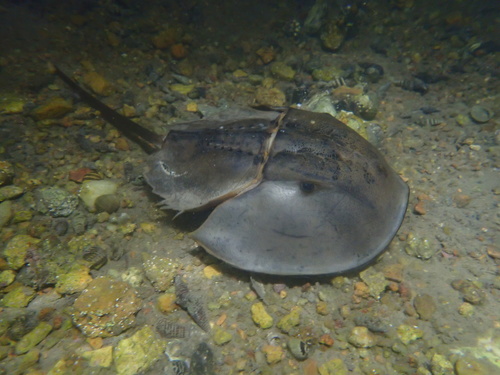
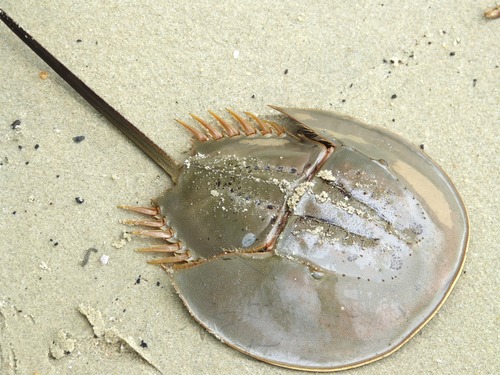
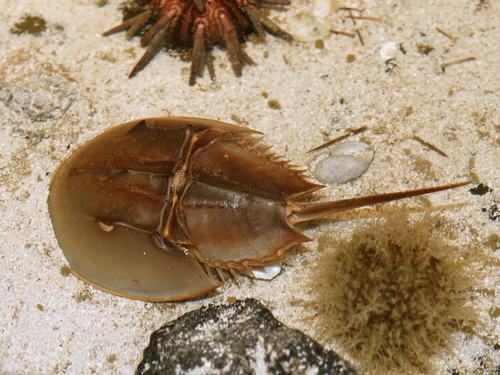
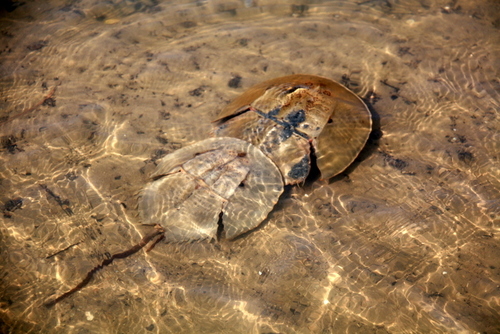
The mangrove horseshoe crab, scientifically named Carcinoscorpius rotundicauda, is also commonly called the round-tailed horseshoe crab. It is a species of chelicerate arthropod classified as a horseshoe crab, and it is the only species in the genus Carcinoscorpius. This species lives in tropical marine and brackish waters of India, Bangladesh, and Southeast Asia. Unconfirmed reports also suggest it may be present in Sri Lanka, Myanmar, and the Philippines. The biology, ecology, and breeding patterns of C. rotundicauda, along with the two other Asian horseshoe crab species Tachypleus gigas and Tachypleus tridentatus, are less well documented than those of the North American horseshoe crab Limulus polyphemus. All four living species of horseshoe crabs are very similar anatomically, but C. rotundicauda is noticeably smaller than the other three. It is also the only extant species where the cross-section of its tail, called the telson, is rounded rather than essentially triangular. This species is found only in tropical or subtropical climates of the Indo-West Pacific region in Asia. It inhabits shallow waters with soft, sandy bottoms or large mud flats across Southeast Asia. The mangrove horseshoe crab is benthopelagic, spending most of its life near or on the bottom of brackish, swampy water habitats such as mangroves – its common name comes directly from this preferred habitat. Specific studies of this species' distribution have been conducted in Hong Kong. Researchers recorded that this species was abundant on Hong Kong's beaches before experiencing a sharp population decline over the ten years prior to the study. The study also found an uneven distribution of the crabs across Hong Kong, with larger populations found in the territory's western waters. This uneven distribution is predicted to be caused by estuarine hydrography in western Hong Kong, which is influenced by the Pearl River. Researchers also found that T. tridentatus can coexist in the same habitat as the mangrove horseshoe crab. Fishermen across Southeast Asia collect mangrove horseshoe crabs for food. The crabs have very little edible flesh, but their roe is considered a prized delicacy. In Thailand, the roe is most commonly served in a salad called yam khai maeng da (ยำไข่แมงดา). Unlike the edible Tachypleus gigas, the flesh of C. rotundicauda is known to contain lethal tetrodotoxin, or TTX. Several cases of food poisoning from consuming this species have been recorded, some of which have resulted in death. Poisoning typically occurs when C. rotundicauda is misidentified as the non-toxic T. gigas.