About Carcharodon carcharias (Linnaeus, 1758)
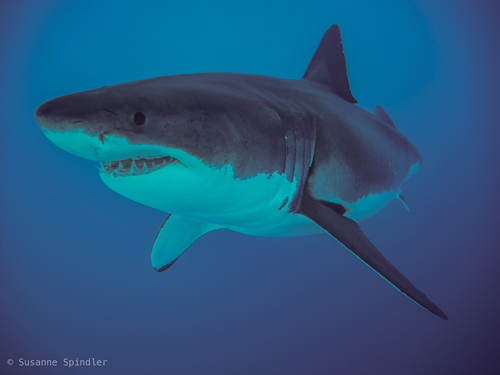
The great white shark, with the scientific name Carcharodon carcharias (Linnaeus, 1758), is also called the white shark, white pointer, or simply great white. It is the largest living macropredatory shark and fish, and a member of the mackerel shark family, closely related to mako sharks, the porbeagle, and the salmon shark. This species has a robust build, with a grayish upper body and white underside. Adult females average 4.6 to 4.9 m (15 to 16 ft) in length and weigh 1,000–1,900 kg (2,200–4,200 lb), while adult males average 3.4 to 4.0 m (11 to 13 ft) and weigh 680–1,000 kg (1,500–2,200 lb). Great white sharks are estimated to reach lengths close to 6.1 m (20 ft) and weights over 2,495 kg (5,501 lb). They have roughly 300 continuously replaced, triangular, serrated teeth. Their large, fatty liver can make up more than a quarter of their total body weight; it provides buoyancy and stores energy. Great white sharks are partially warm-blooded, an adaptation that lets them stay active in colder waters. This species lives in tropical and temperate ocean waters across the globe, found both along coastlines and further out to sea. Populations are most concentrated off the Pacific and Atlantic coasts of North America, and in waters surrounding southern Africa and Oceania. It is a highly migratory species, traveling between coastal areas and open ocean, and even between continents. The great white shark preys on marine mammals like pinnipeds and dolphins, as well as fish (including other sharks) and cephalopods. It is also a prolific scavenger that feeds on whale carcasses. Though it is an apex predator, great white sharks are sometimes preyed on by orcas. Great white sharks are generally solitary, but gather in groups, especially at feeding sites. They may communicate and establish dominance hierarchies through body language. Reproduction in this species is not well understood, but it is confirmed to be ovoviviparous: pups hatch from eggs inside the female's body before being born live. Juvenile great white sharks typically live in shallower water and cannot hunt marine mammals until they reach approximately 3 m (9.8 ft) in length. The great white shark has a long-held fearsome reputation among the general public. It was the central subject of the 1974 novel Jaws and its 1975 film adaptation, which both depict it as a ferocious man-eater. In reality, great white sharks do not normally target humans as prey, and most unprovoked bites on people are caused by curiosity or possible mistaken identity. Many attempts have been made to keep the species in captivity, but all kept specimens have either died or been released, and no public aquarium currently houses a great white shark. Groups of great white sharks attract tourist activity, with visitors viewing the sharks from boats or inside protected shark cages. The International Union for Conservation of Nature lists the great white shark as a vulnerable species globally, and as critically endangered in regional European and Mediterranean waters. As of 2025, the species' global population is estimated to have declined by 30–49% over the past 159 years. Major threats to the species include bycatch in commercial fisheries, recreational fishing, and entrapment in protective beach drum-lines and gillnets. Several national governments have passed protective regulations for great white sharks, including bans on catching and killing the species. Great white sharks range from tropical to temperate, and even colder, waters around the world, with major established populations in the northwestern and northeastern Pacific, western North Atlantic, the Mediterranean, southern African waters, and Oceania. They are also found off the coasts of South America, but are uncommon there. Shark expert Greg Skomal names the Farallon Islands (California), Guadalupe Island (Mexico), Cape Cod (Massachusetts), Western Cape (South Africa), Neptune Islands (Australia), and Stewart Island and the Chatham Islands (New Zealand) as major coastal feeding aggregations. Researchers have also identified an offshore feeding aggregation between western North America and Hawaii, named the White Shark Café. Great white sharks can be found both along coastlines and in the open ocean, and can dive to depths of up to 1,300 m (4,300 ft), though they typically stay closer to the surface; deeper dives are more common in open ocean environments. Coastal habitats they use include nearshore archipelagos, offshore reefs, banks, shoals, and headlands. A 2018 study found that great white sharks congregate in anticyclonic eddies in the open ocean. Juvenile great white sharks are mostly restricted to shallow coastal waters with temperatures between 14 and 24 °C (57 and 75 °F). Increased sightings of young sharks in areas where they were not previously common, such as Monterey Bay on California's central coast, suggests climate change may be pushing juvenile sharks toward the poles. Great white sharks typically swim at speeds of 2.88–4.86 km/h (1.79–3.02 mph), but can reach sprint speeds of around 24.12 km/h (14.99 mph). One migrating individual was recorded cruising at a sustained speed of 4.7 km/h (2.9 mph), which is fast for a shark and more similar to the speed of fast-swimming tuna. Great white sharks display a range of surface behaviors, including poking their heads above water (called spyhopping) to observe objects above the surface, and 'Repetitive Aerial Gaping', where a spyhopping shark repeatedly opens its mouth while belly-up; this behavior may signal frustration after missing bait. How great white sharks sleep is not well understood. One individual was recorded swimming slowly in a single direction along a current with its mouth open at night. The great white shark is generally considered a solitary species, though aggregations do occur. A 2016 study of great white sharks around Mossel Bay, South Africa, concluded that associations between individuals are generally random, with very few social interactions. A 2019 study reached a different conclusion, finding that great white sharks around the Neptune Islands gather in non-random groups. Similarly, a 2022 study of great white sharks at Guadalupe Island suggests that individuals may associate to learn from others about locations of prey or scavenging carcasses. Great white shark aggregations can also vary in their composition based on individual age and sex. At the Neptune Islands, sightings of subadult females peak in April and May, subadult males peak in February and again in September, adult females peak in June, and adult males peak in September. Little is known about the reproductive behavior of the great white shark. There are only two anecdotal accounts of possible great white shark mating, both recorded off New Zealand: one in 1991 and one in 1997. Both accounts describe belly-to-belly rolling during copulation. As is the case in other shark species, it is assumed that the male bites the female's head or fin while inserting one of his claspers to mate. The accounts also suggest great white sharks mate in shallow water away from feeding areas. Females observed at Guadalupe Island and Cape Cod have scarring that may result from copulation, which serves as possible evidence these areas are used for mating. Other studies have reached the opposite conclusion that great white sharks may mate offshore; males were found to gather in the White Shark Café during spring, followed by some females, suggesting a lek mating system where females move through the area and choose their partners. In 2013, researchers proposed that whale carcasses are an important meeting location for sexually mature great white sharks to mate. A small number of pregnant females have been caught, providing insight into the species' reproductive biology. The great white shark is ovoviviparous: fertilized eggs hatch inside the female, and embryos continue developing inside each uterus. Embryos receive nourishment in three stages: they first feed on their yolk sacs, then consume a milky uterine secretion called lipid histotrophy, and finally switch to eating unfertilized eggs. After roughly 12 months of development, the female gives live birth to two to ten pups. Females give birth at two or three year intervals. A 2024 metastudy concluded that great white sharks give birth during spring and summer in shallow waters surrounding islands, with water temperatures between 15.7 and 23.1 °C (60 and 74 °F). Great white shark pups are born 1–1.6 m (3.3–5.2 ft) long. In July 2023, a possible newborn great white shark was filmed for the first time off the coast of southern California, near Carpinteria. The newborn was estimated to measure 1.5 m (4.9 ft) and had a pale complexion that was initially attributed to histotrophy. A follow-up study confirmed the Carpinteria shark was a newborn, but found the paleness comes from embryonic epithelium that covers the shark's skin denticles; this feature is also seen in the related salmon shark, and rubs off shortly after birth. Bands in the shark's vertebrae are used to determine the animal's age and growth rate. Early studies found the species grows relatively quickly: a 1985 study concluded that great white sharks reach sexual maturity at nine to ten years of age, when they reach 3.7–4.3 m (12–14 ft) in length. A 2015 study reached the opposite conclusion that great white sharks are slow-growing and long-lived. Males reach sexual maturity at approximately 26 years of age, when they reach around 3.5 m (11 ft) in length, while females take 33 years to reach maturity at around 4.5–5 m (15–16 ft) in length. Their growth rate levels off after they reach 40 years of age.