About Carcharhinus plumbeus (Nardo, 1827)
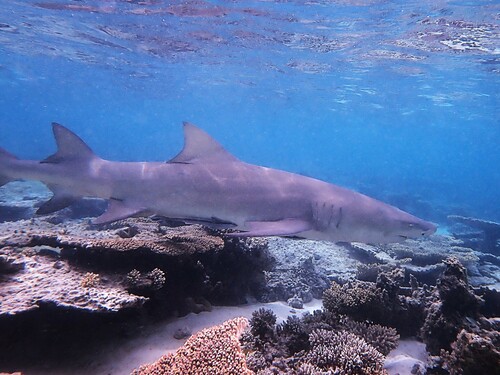
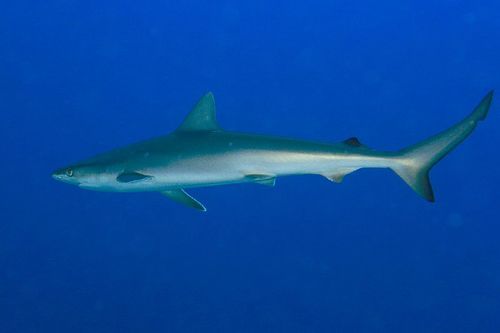
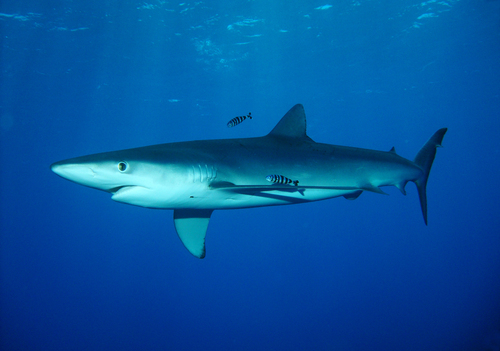
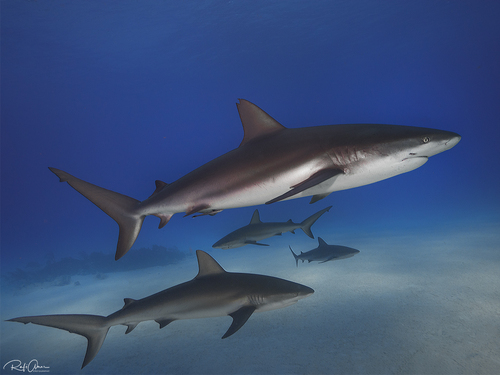
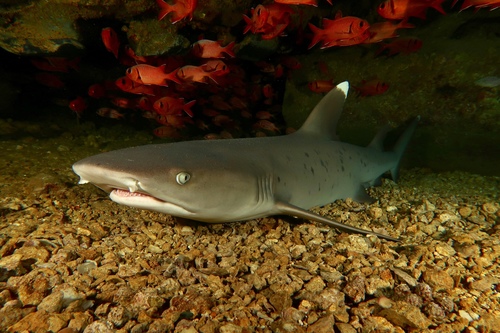
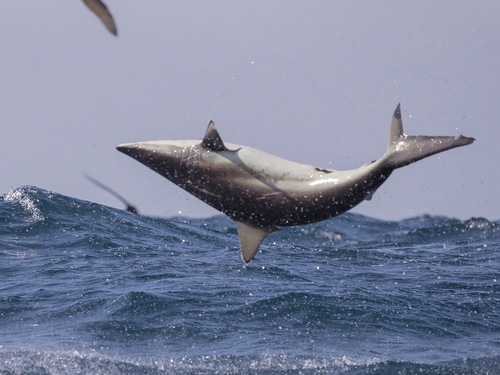
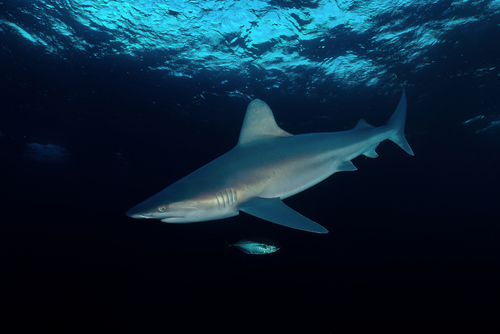
The sandbar shark, with the scientific name Carcharhinus plumbeus (Nardo, 1827), is one of the world’s largest coastal sharks, and is closely related to the dusky shark, bignose shark, and bull shark. It has a triangular, very high dorsal fin and very long pectoral fins. Most sandbar sharks have heavy-set bodies and rounded snouts that are shorter than the average shark’s snout. Their upper teeth have broadly uneven cusps with sharp edges, and their second dorsal fin and anal fin are nearly the same height. Adult females grow to 2–2.5 m (6.6–8.2 ft), while males grow up to 1.8 m (5.9 ft). The maximum recorded weight for this species is 240 kg (530 lb). On average, female sandbar sharks have a fork-length (measured from the tip of the nose to the fork in the tail) of 154.9 cm, while males have an average fork-length of 151.6 cm. Body color ranges from bluish brown, grey, or bronze, with a white or pale underside. Sandbar sharks may swim alone, or gather in sex-segregated schools of varying sizes. As their common nickname suggests, sandbar sharks are most commonly found over muddy or sandy bottoms in shallow coastal waters including bays, estuaries, harbors, and river mouths. They also inhabit deeper waters of 200 m or more, as well as intertidal zones. This species occurs worldwide in tropical to temperate waters; in the western Atlantic, its range extends from Massachusetts to Brazil. Juveniles are common to abundant in the lower Chesapeake Bay, and nursery grounds are located from Delaware Bay to South Carolina. Additional documented nursery grounds include Bonjuk Bay in Marmaris, Muğla, Turkey, and the Florida Keys. There is ongoing disagreement over the exact age at which sandbar sharks reach sexual maturity, but most studies find that females reach maturity around 13 years of age, while males reach maturity around 12 years of age. Sandbar sharks are viviparous: embryos develop inside the mother, supported by a placental yolk sac. Females exhibit two different patterns of migration and gestation: some are biennial, reproducing every two years and returning to the same location to give birth, while others are triennial, reproducing every three years and returning to the same delivery location. Females ovulate in early summer, carry developing pups for one year, and give birth to an average of eight pups per litter. The typical lifespan of a sandbar shark is 35–41 years.