About Carcharhinus perezii (Poey, 1876)
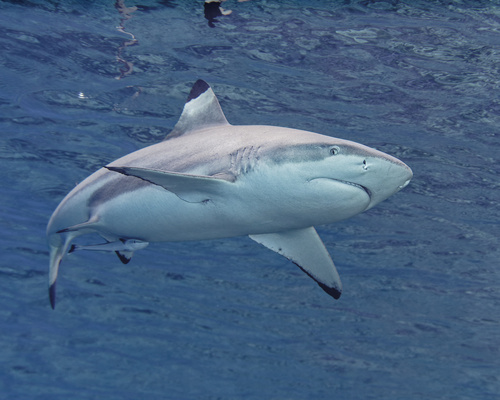
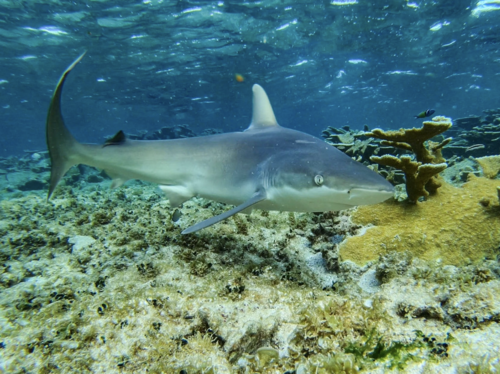
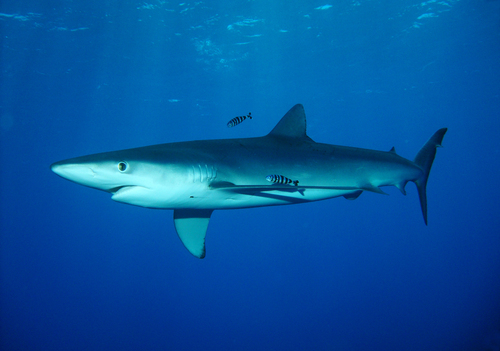
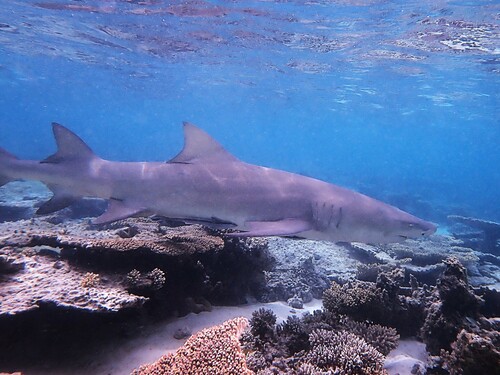
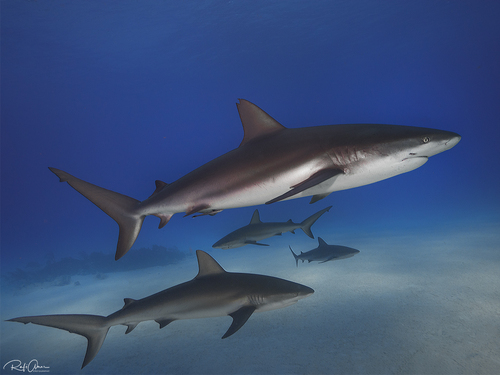
Carcharhinus perezii (Poey, 1876), commonly called the Caribbean reef shark, is a heavy-bodied requiem shark with a standard streamlined body shape, and it is hard to tell apart from other large requiem shark species. Most adult Caribbean reef sharks measure 2–2.5 m (6.6–8.2 ft) long; the longest reliably recorded individual is 3 m (9.8 ft), and the heaviest recorded individual weighs 70 kg (150 lb). Its upper body is dark gray or gray-brown, while its underside is white or pale yellow-white, with a faint white band running along its flanks. Its fins do not have distinct bold markings, and the undersides of its paired fins, anal fin, and lower lobe of the caudal fin are dark dusky in color. Its snout is relatively short, broad, and rounded, with no large skin flaps beside the nostrils. It has large, circular eyes fitted with nictitating membranes, which are protective third eyelids. Each half of both the upper and lower jaw holds 11 to 13 tooth rows. Its teeth have broad bases, serrated edges, and narrow pointed cusps; the first 2 to 4 teeth on each side of the jaw stand straight, while the teeth further back angle more obliquely. It has five pairs of moderately long gill slits, with the third gill slit positioned over the base where the pectoral fins attach. The first dorsal fin is tall and sickle-shaped (falcate). A low raised ridge runs between the first dorsal fin and the second dorsal fin, which is relatively large and has a short free rear tip. The leading edge of the first dorsal fin sits over or just forward of the free rear tips of the pectoral fins, and the leading edge of the second dorsal fin sits over or just forward of the anal fin. Its pectoral fins are long and narrow, tapering to a sharp point. Its dermal denticles are tightly packed and overlapping; each denticle has five low horizontal ridges that end in small marginal teeth, though large individuals may sometimes have seven ridges instead. This shark is found across the tropical western Atlantic Ocean, ranging from North Carolina in the north to Brazil in the south, including Bermuda, the northern Gulf of Mexico, and the Caribbean Sea. It is extremely uncommon in areas north of the Florida Keys. It favors shallow waters on or near coral reefs, and is often spotted near the drop-offs at the outer edges of reefs. It is most frequently found in water less than 30 m (98 ft) deep, but has been recorded diving as deep as 378 m (1,240 ft). Even though it is abundant in some regions, the Caribbean reef shark is one of the least studied large requiem sharks. Researchers believe it plays a major role in structuring marine communities on Caribbean reefs. It is more active during the night, and there is no evidence of seasonal changes in its activity or regular migration. Juvenile sharks generally stay within a small localized area year-round, while adult sharks range across a much wider territory. Caribbean reef sharks have sometimes been observed resting completely still on the seabed or inside caves; this species was the first active shark species recorded to show this behavior. In 1975, researcher Eugenie Clark studied the so-called "sleeping sharks" in caves off Isla Mujeres on the Yucatan Peninsula, and found that the sharks were not actually asleep, as their eyes would follow moving divers. Clark guessed that freshwater upwellings inside the caves might loosen parasites on the sharks' bodies and create a pleasant narcotic effect. When threatened, Caribbean reef sharks sometimes perform a threat display: they swim in short, jerky movements with frequent direction changes, and repeatedly drop their pectoral fins for brief 1–1.2 second intervals. This display is less pronounced than the well-known threat display of the grey reef shark (C. amblyrhynchos). Juvenile Caribbean reef sharks are hunted by larger sharks, including the tiger shark (Galeocerdo cuvier) and the bull shark (C. leucas). Few parasites have been documented for this species; one known parasite is a dark variegated leech that is often seen trailing from the shark's first dorsal fin. Off the coast of northern Brazil, juvenile sharks visit cleaning stations run by yellownose gobies (Elacatinus randalli); the gobies remove parasites from the sharks while the sharks lie still on the seabed. Horse-eye jacks (Caranx latus) and bar jacks (Carangoides ruber) regularly swim in schools around Caribbean reef sharks.