About Carcharhinus obscurus (Lesueur, 1818)
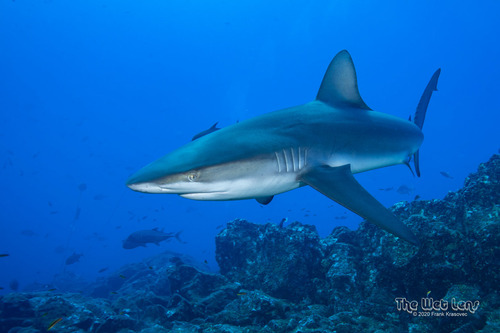
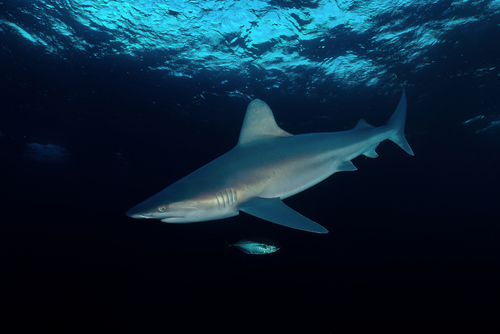
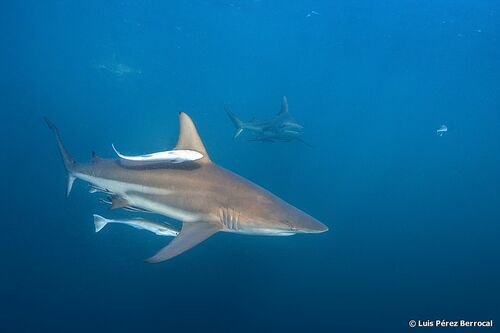
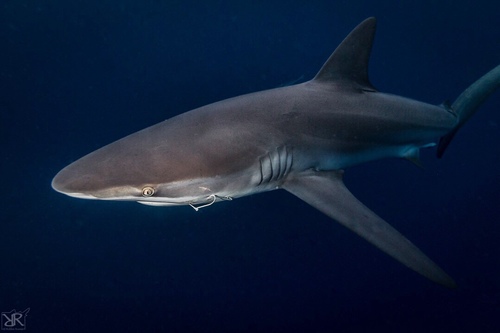
Alongside the bull shark, the dusky shark (Carcharhinus obscurus) is one of the largest members of its genus. It commonly reaches 3.2 m (10 ft) in length and 160–180 kg (350–400 lb) in weight; the maximum recorded length and weight are 4.2 m (14 ft) and 372 kg (820 lb) respectively, though maximum reported size reaches 4.5 m (15 ft) with a maximum reported weight of up to 500 kg (1,100 lb). Females grow larger than males. This shark has a slender, streamlined body with a broadly rounded snout that is no longer than the width of its mouth. Barely developed flaps of skin sit in front of the nostrils. Its medium-sized, circular eyes have nictitating membranes, or protective third eyelids. Very short, subtle furrows mark the corners of the mouth, which holds 13–15 (typically 14) tooth rows on either side of both jaws. The upper teeth are distinctly broad, triangular, and slightly oblique, with strong, coarse serrations, while the lower teeth are narrower and upright, with finer serrations. The species has five pairs of fairly long gill slits. Its large pectoral fins are roughly one-fifth as long as the body, with a falcate (sickle-like) shape that tapers to a point. The first dorsal fin is moderately sized and somewhat falcate, with a pointed apex and a strongly concave rear margin; its origin lies over the free rear tips of the pectoral fins. The second dorsal fin is much smaller and positioned roughly opposite the anal fin. A low dorsal ridge runs between the two dorsal fins. The caudal fin is large and high, with a well-developed lower lobe and a ventral notch near the tip of the upper lobe. The dermal denticles are diamond-shaped and closely spaced, each bearing five horizontal ridges that lead to teeth on the posterior margin. This species is bronzy to bluish gray on its upper side and white below, with the pale color extending onto the flanks as a faint lighter stripe. The fins, particularly the underside of the pectoral fins and the lower caudal fin lobe, darken toward the tips; this darkening is more obvious in juveniles. The dusky shark can be found from Redondo Beach, southern California to the Gulf of California, and down to Ecuador, though it only occurs rarely off southern California; it is common in tropical areas. At birth, dusky sharks measure around 70–100 cm (27.6-39.3 in) in length. The species has been recorded swimming from the surf zone down to a depth of 573 m (1,879 ft), and is generally gray or beige in color. The range of the dusky shark extends worldwide discontinuously across tropical and warm-temperate waters. In the western Atlantic Ocean, it occurs from Massachusetts and Georges Bank to southern Brazil, including the Bahamas and Cuba. In the eastern Atlantic Ocean, it has been recorded from the western and central Mediterranean Sea, the Canary Islands, Cape Verde, Senegal, and Sierra Leone, and may also occur elsewhere including Portugal, Spain, Morocco, and Madeira. In the Indian Ocean, it is found off South Africa, Mozambique, and Madagascar, with sporadic records in the Arabian Sea, the Bay of Bengal, and possibly the Red Sea. In the Pacific Ocean, it occurs off Japan, mainland China and Taiwan, Vietnam, Australia, and New Caledonia in the west, and from southern California to the Gulf of California, around Revillagigedo, and possibly off northern Chile in the east. Some records of dusky sharks from the northeastern and eastern central Atlantic, and around tropical islands, actually belong to Galapagos sharks. Mitochondrial DNA and microsatellite evidence indicates that Indonesian and Australian dusky sharks represent distinct populations. The dusky shark resides off continental coastlines, ranging from the surf zone to the outer continental shelf and adjacent oceanic waters. It occupies an intermediate habitat that overlaps with that of more specialized relatives: the inshore sandbar shark, the pelagic silky shark (C. falciformis) and oceanic whitetip shark, the deepwater bignose shark, and the island-dwelling Galapagos shark and silvertip shark (C. albimarginatus). One tracking study conducted in the northern Gulf of Mexico found that the dusky shark spends most of its time at depths of 10–80 m (33–262 ft), and makes occasional dives below 200 m (660 ft); the species is known to dive as deep as 400 m (1,300 ft). It prefers water temperatures between 19–28 °C (66–82 °F), and avoids low-salinity areas such as estuaries. The dusky shark is nomadic and strongly migratory, with recorded movements of up to 3,800 km (2,400 mi); adults generally travel longer distances than juveniles. Sharks along both coasts of North America shift northward as summer temperatures warm, and retreat back toward the equator in winter. Off South Africa, young males and females over 0.9 m (3.0 ft) long disperse southward and northward respectively (with some overlap) from the nursery area off KwaZulu-Natal; they join the adult population several years later via a route that has not yet been identified. Juveniles spend spring and summer in the surf zone and fall and winter in offshore waters. As they approach 2.2 m (7.2 ft) in length, they begin to conduct an annual north–south migration between KwaZulu-Natal in winter and the Western Cape in summer. Larger sharks, over 2.8 m (9.2 ft) long, migrate as far as southern Mozambique. Off Western Australia, adult and juvenile dusky sharks migrate toward the coast in summer and fall, though they do not enter the inshore nurseries used by newborns. As an apex predator at the highest trophic level of the food web, the dusky shark is generally less abundant than other sharks that share its range, though high concentrations of individuals, especially juveniles, can occur at specific locations. Adults are often found following ships far from land, such as in the Agulhas Current. A tracking study off the mouth of the Cape Fear River in North Carolina recorded an average swimming speed of 0.8 km/h (0.50 mph). The sharksucker (Echeneis naucrates) uses the dusky shark as a host. Known parasites of this species include the tapeworms Anthobothrium laciniatum, Dasyrhynchus pacificus, Platybothrium kirstenae, Floriceps saccatus, Tentacularia coryphaenae, and Triloculatum triloculatum; the monogeneans Dermophthirius carcharhini and Loimos salpinggoides; the leech Stibarobdella macrothela; the copepods Alebion sp., Pandarus cranchii, P. sinuatus, and P. smithii; the praniza larvae of gnathiid isopods; and the sea lamprey (Petromyzon marinus). Full-grown dusky sharks have no significant natural predators. Major predators of young dusky sharks include the ragged tooth shark (Carcharias taurus), the great white shark (Carcharodon carcharias), the bull shark (C. leucas), and the tiger shark (Galeocerdo cuvier). Off KwaZulu-Natal, the use of shark nets to protect beaches has reduced the populations of these large predators, leading to a dramatic increase in the number of juvenile dusky sharks (a phenomenon called "predator release"). In turn, these juvenile sharks have decimated populations of small bony fishes, causing negative consequences for the biodiversity of the local ecosystem.