About Carcharhinus melanopterus (Quoy & Gaimard, 1824)
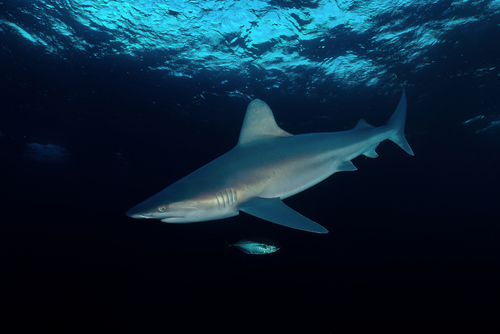
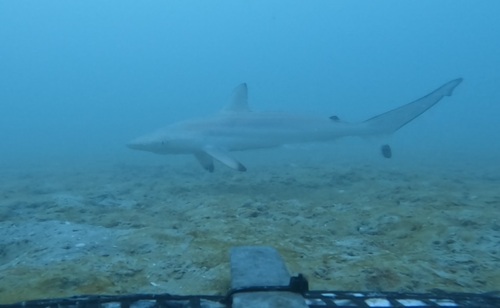
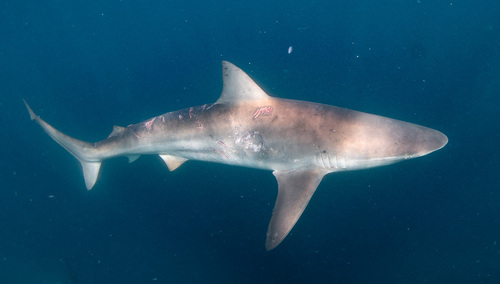
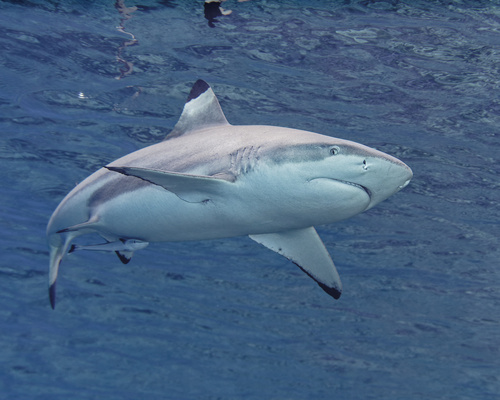
The blacktip reef shark has the scientific name Carcharhinus melanopterus (Quoy & Gaimard, 1824). This is a robustly built shark with a streamlined, typical shark body form. It has a short, wide, rounded snout, and moderately large, oval eyes. A flap of skin sits in front of each nostril, expanded into a distinct nipple-shaped lobe. Excluding small central symphysial teeth, the upper jaw has 11–13 (most often 12) tooth rows on each side, and the lower jaw has 10–12 (most often 11) tooth rows on each side. Upper teeth are upright to angled, narrowly triangular, and have serrations that are coarser near the base. Lower teeth have a similar shape, but their serrations are much finer. Adult males have teeth that are more abruptly curved than those of adult females. The pectoral fins are large and narrowly sickle-shaped (falcate), tapering to sharp points. The sizable first dorsal fin is tall with a curved S-shaped rear margin, and it originates above the free rear tips of the pectoral fins. The second dorsal fin is relatively large with a short rear margin, and is positioned opposite the anal fin. No ridge runs between the two dorsal fins. The shark’s dorsal body is pale grayish-brown, while its ventral body is white, with a distinct white band along the sides that extends forward from above the anal fin. All of its fins have black tips bordered by lighter-colored edges; this contrast is especially noticeable on the first dorsal fin and the lower lobe of the caudal fin. Most adult blacktip reef sharks do not exceed 1.6 m (5.2 ft) in length. Rarely, individuals may grow to 1.8 m (5.9 ft), and possibly up to 2.0 m (6.6 ft). The maximum confirmed weight on record with the International Game Fish Association is 13.6 kg (30 lb). The blacktip reef shark inhabits nearshore tropical and subtropical waters across the Indo-Pacific. In the Indian Ocean, its range extends from South Africa to the Red Sea, including Madagascar, Mauritius, and the Seychelles, and eastward along the Indian subcontinent coast to Southeast Asia, including Sri Lanka, the Andaman Islands, and the Maldives. In the Pacific Ocean, it occurs from southern China and the Philippines to Indonesia, northern Australia, and New Caledonia. It also lives around numerous oceanic islands, including the Marshall Islands, Gilbert Islands, Society Islands, Hawaiian Islands, and Tuamotu. Contrary to most existing sources, one report suggests that C. melanopterus specimens recorded from Japanese waters may actually originate from Taiwan. However, multiple confirmed sightings and captures of the species have been reported from inshore waters off Ishigaki Island, Okinawa Prefecture in southern Japan. This shark is a Lessepsian migrant, and has successfully colonized the eastern Mediterranean Sea by traveling through the Suez Canal. While it has been recorded at a depth of 75 m (246 ft), it most commonly occurs in water only a few meters deep, and is often seen swimming close to shore with its dorsal fin visible above the surface. Younger sharks prefer shallow, sandy flats, while older sharks are most common around reef ledges, and can also be found near reef drop-offs. The species has also been recorded in brackish estuaries and lakes in Madagascar, and in freshwater environments in Malaysia, though it cannot tolerate low salinity as well as the bull shark Carcharhinus leucas. At Aldabra in the Indian Ocean, blacktip reef sharks gather in the channels between reef flats during low tide, and move into mangrove areas when the tide rises. There is only uncertain, mixed evidence that sharks at the northern and southern extremes of the species’ range undertake seasonal migrations. Alongside the grey reef shark (Carcharhinus amblyrhinchos) and the whitetip reef shark (Triaenodon obesus), the blacktip reef shark is one of the three most common shark species found on Indo-Pacific coral reefs. This species dominates shallow reef habitats, while the other two common reef shark species are mostly found in deeper water. Blacktip reef sharks are fast-swimming and active. They can be found alone, in small groups, and occasionally in large social aggregations. For the most part, juvenile and adult sharks of different sexes do not occupy separate areas, except when pregnant females move to specific locations to give birth. Individual blacktip reef sharks show strong site fidelity, and may remain in the same local area for several years. A tracking study conducted off Palmyra Atoll in the central Pacific found that this species has an average home range of around 0.55 km2 (0.21 mi2), which is among the smallest recorded home ranges of any shark species. The size and location of an individual’s home range does not change between day and night. Between 3% and 17% of a shark’s home range consists of favored hunting patches that the resident shark occupies disproportionately more often. Sharks spend most of their time swimming back and forth along reef ledges, and make occasional short trips onto adjacent sandy flats. Their average swimming speed slows when the tide rises at night. This may occur because incoming cooler water reduces their metabolic rate, or because rising tide brings prey fish into shallow areas, making foraging more energy efficient. Blacktip reef sharks at Aldabra tend to be more mobile than those at Palmyra; one individual was recorded moving up to 2.5 km (1.6 mi) over a 7-hour period. Smaller blacktip reef sharks, especially, are preyed on by larger fishes, including groupers, grey reef sharks, tiger sharks (Galeocerdo cuvier), and other members of their own species. At Palmyra Atoll, adult blacktip reef sharks avoid patrolling tiger sharks by staying out of the central, deeper lagoon. Documented parasites of this species include the tapeworms Anthobothrium lesteri, Nybelinia queenslandensis, Otobothrium alexanderi, and Platybothrium jondoeorum, a myxosporidian from the genus Unicapsula, and the monogenean Dermophthirius melanopteri. One of the few confirmed documented cases of infectious disease in sharks is a fatal case of hemorrhagic septicemia in a blacktip reef shark, caused by the bacterium Aeromonas salmonicida subsp. salmonicida.