About Carcharhinus longimanus (Poey, 1861)
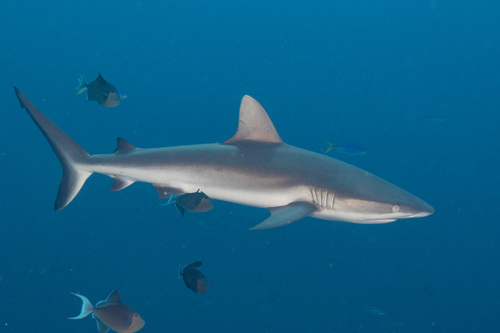
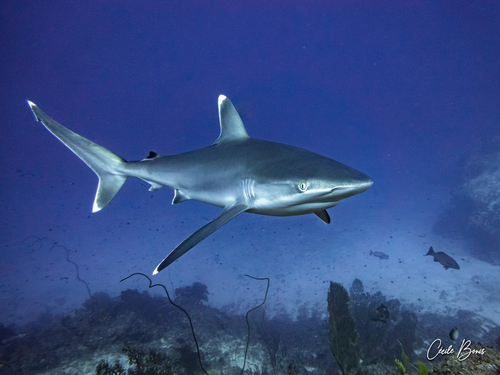
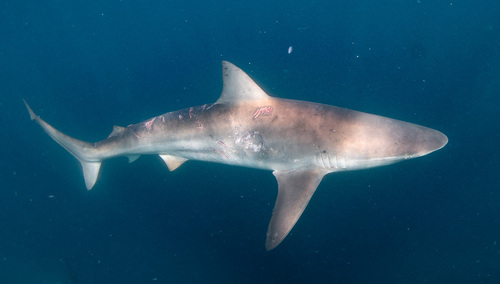
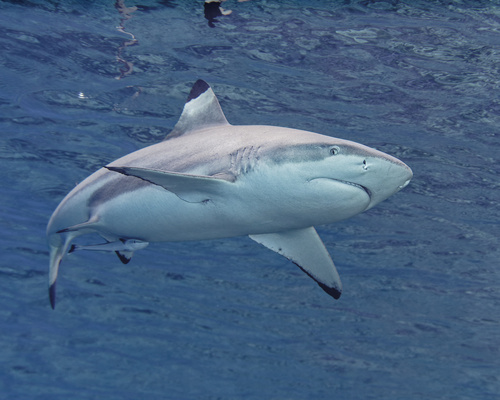
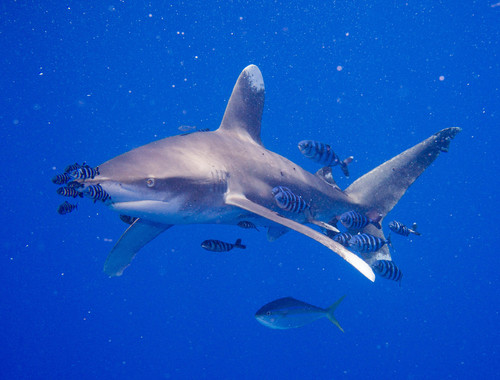
The oceanic whitetip shark, scientific name Carcharhinus longimanus, has several key distinguishing physical features. Its most notable traits are its long, wing-shaped pectoral and dorsal fins, which are much larger than those of most other shark species and have clearly rounded tips. This shark has a rounded snout, circular eyes fitted with nictitating membranes, and a countershaded coloration: it is grey-bronze on its dorsal (upper) side and white on its ventral (lower) side. As its common name suggests, most of its fins including the dorsal, pectoral, pelvic, and caudal fins have white tips. Fins may also have mottled markings, and young individuals can have black spots. A saddle-shaped dark patch is often visible between the first and second dorsal fins. This species has two distinct forms of teeth. Teeth in the lower jaw (mandible) are thinner with a serrated tip, while upper jaw teeth are triangular, much larger and wider, with fully serrated edges. Each half of the lower jaw holds between 13 and 15 teeth, and each half of the upper jaw holds 14 or 15 teeth. Its dermal denticles are nearly flat and wide, and most have between five and seven ridges. There is very little overlap between adjacent denticles, leaving some areas of bare skin exposed. The oceanic whitetip shark is a robust, large-bodied shark. The largest recorded specimen measured over 4 meters (13 feet) in length, but most adults grow up to 3 meters (10 feet) long and weigh up to 150 kg (330 lb). The International Game Fish Association (IGFA) all-tackle record for the species is a 2.2-meter (7.2-foot) individual weighing 167 kg (368 lb), indicating that larger individuals can reach much higher weights. Females are typically around 10 cm (3.9 in) larger than males. In the 1950s, the average weight of oceanic whitetip sharks caught in the Gulf of Mexico was 86.4 kg (190 lb); by the 1990s, average weight of individuals from the same area was only 56.1 kg (124 lb). This shark occurs globally between 45°N and 43°S latitude. It inhabits deep open oceans where water temperature exceeds 18 °C (64 °F); it prefers temperatures between 20 °C (68 °F) and 28 °C (82 °F), but can survive in water as cool as 15 °C (59 °F), and avoids temperatures lower than this threshold. It was once extremely common and widespread across its broad global range, but recent studies indicate that its population has declined drastically. The oceanic whitetip shark spends most of its time in the upper 150 m (490 ft) of the ocean, and favors offshore deep-ocean habitats. Longline capture data shows that shark population density increases with greater distance from land. It is occasionally found close to land, in water as shallow as 37 m (120 ft), mostly near oceanic islands and narrow continental shelves. Mating and birthing typically take place in early summer in the northwest Atlantic Ocean and southwest Indian Ocean. However, females captured in the Pacific have been found carrying embryos year-round, indicating a longer mating season in that region. The oceanic whitetip shark is viviparous: embryos develop inside the mother's uterus and receive nutrition from a placental sac. Its gestation period lasts from nine months to one year. Newborn pups measure 65–75 cm (26–30 in) long at birth in the northwest Atlantic, 60–65 cm (24–26 in) long off South Africa, and average 45–55 cm (18–22 in) long in the Pacific Ocean. Litter size ranges from two to fourteen pups. For a population off Brazil, sharks grew an average of 25.2 cm (9.9 in) per year in their first year of life, with annual growth dropping to 13.6 cm (5.4 in) through their first four years, and reaching 9.7 cm (3.8 in) in their fifth year. Both sexes reach sexual maturity at a length of 180–190 cm (71–75 in) between the ages of six and seven years, after which they continue growing an average of 9.10 cm (3.58 in) per year. Across the broader equatorial and southwestern Atlantic, the average length at maturity is 170 cm (67 in) for females and 170–190 cm (67–75 in) for males. In the Pacific, sharks reach maturity at four to five years of age. One individual oceanic whitetip shark has been estimated to live 22 years.