About Carcharhinus limbatus (Müller & Henle, 1839)
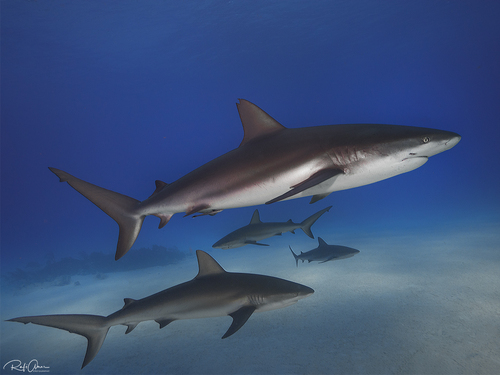
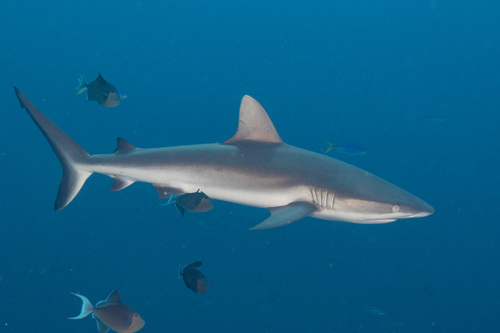
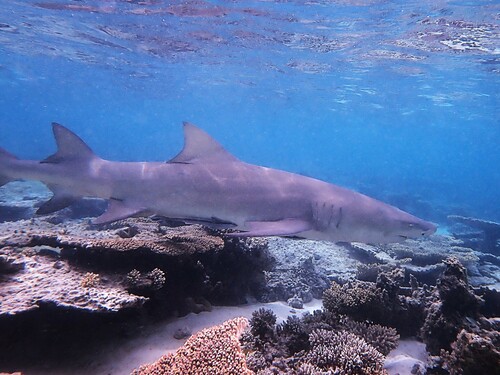
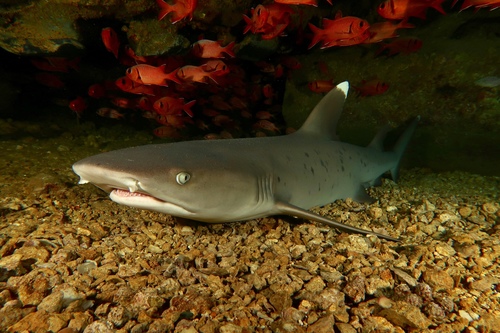
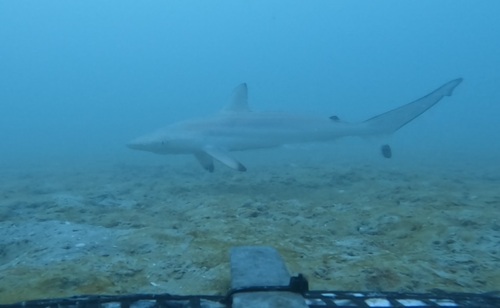
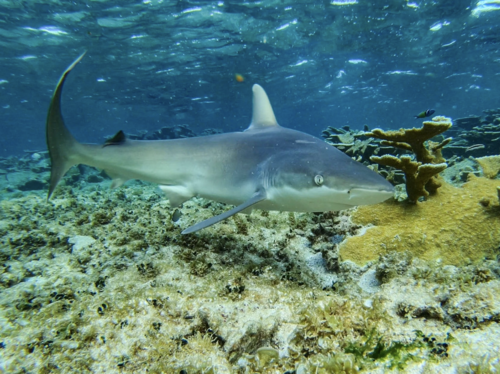
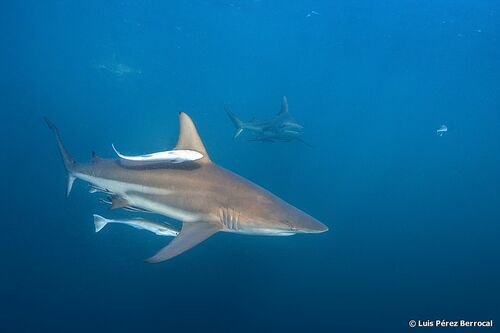
Description: The blacktip shark (Carcharhinus limbatus) has a robust, streamlined body with a long, pointed snout and relatively small eyes. It has five pairs of gill slits that are longer than those of similar requiem shark species. Each jaw holds 15 tooth rows on either side; the upper jaw has two symphysial teeth at the jaw midline, while the lower jaw has one symphysial tooth. Its teeth are broad-based, with a high, narrow cusp and serrated edges. The first dorsal fin is tall and sickle-shaped (falcate) with a short free rear tip, and there is no ridge between the first and second dorsal fins. The large pectoral fins are also falcate and pointed. This shark is gray to brown on its upper side and white on its underside, with a distinct white stripe running along its sides. The pectoral fins, second dorsal fin, and lower lobe of the caudal fin usually have black tips. The pelvic fins, and rarely the anal fin, may also be black-tipped. The first dorsal fin and the upper lobe of the caudal fin typically have black edges. Some larger individuals have unmarked or nearly unmarked fins. Blacktip sharks can temporarily lose almost all of their color during coccolithophore blooms, called "whitings". This species reaches a maximum known length of 2.8 m (9.2 ft), with 1.5 m (4.9 ft) being more typical, and a maximum known weight of 123 kg (271 lb). Distribution and habitat: The blacktip shark has a worldwide distribution across tropical and subtropical waters. In the Atlantic, it occurs from Massachusetts to Brazil (including the Gulf of Mexico and the Caribbean Sea), and from the Mediterranean Sea, Madeira, and the Canary Islands to the Democratic Republic of the Congo. It is found all around the edge of the Indian Ocean, ranging from South Africa and Madagascar to the Arabian Peninsula, the Indian subcontinent, and Southeast Asia. In the western Pacific, it is found from the Ryukyu Islands of Japan to northern Australia, including southern China, the Philippines, and Indonesia. In the eastern Pacific, it occurs from Southern California to Peru. It has also been recorded at a number of Pacific islands, including New Caledonia, Tahiti, the Marquesas, Hawaii, Revillagigedo, and the Galápagos. Most blacktip sharks live in water less than 30 m (98 ft) deep over continental and insular shelves, though they can dive as deep as 64 m (210 ft). Their preferred habitats are muddy bays, island lagoons, and drop-offs near coral reefs; they are also tolerant of low salinity and enter estuaries and mangrove swamps. While individual sharks may be found some distance offshore, blacktip sharks do not live in open oceanic waters. Seasonal migration has been recorded for the population off the East Coast of the United States: these sharks move north to North Carolina in the summer and south to Florida in the winter. Biology and ecology: The blacktip shark is an extremely fast, energetic predator that is usually found in groups of varying sizes. It does not have general segregation by sex and age; instead, adult males and nonpregnant females live apart from pregnant females, and both groups are separated from juveniles. In Terra Ceia Bay, Florida, a nursery area for this species, juvenile blacktips gather in groups during the day and disperse at night. They aggregate most strongly in early summer when the sharks are youngest, which suggests they use grouping to seek refuge from predators, mostly larger sharks. Predator avoidance may also explain why juvenile blacktips do not congregate in the areas of the bay with the highest prey density. Adults have no known predators. Known parasites of the blacktip shark include copepods Pandarus sinuatus and P. smithii, and monogeneans Dermophthirius penneri and Dionchus spp., which attach to the shark's skin. This species is also parasitized by nematodes from the family Philometridae (genus Philometra), which infest its ovaries.