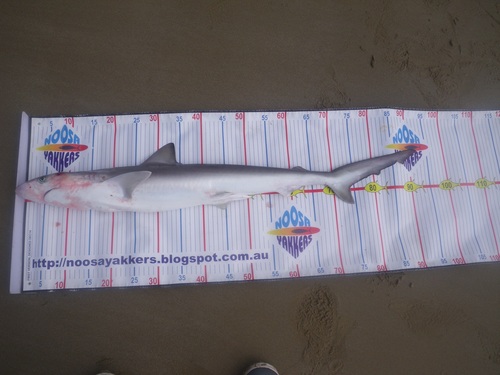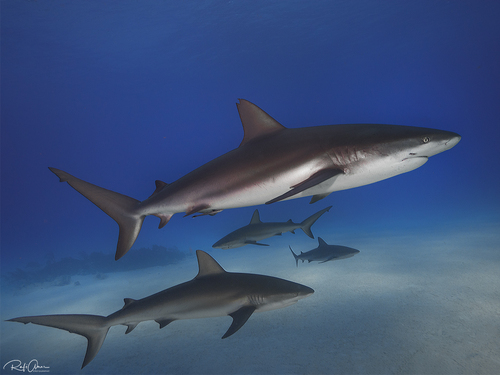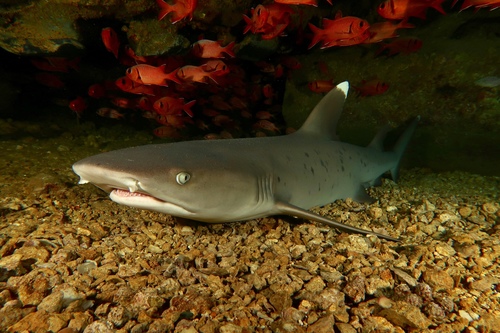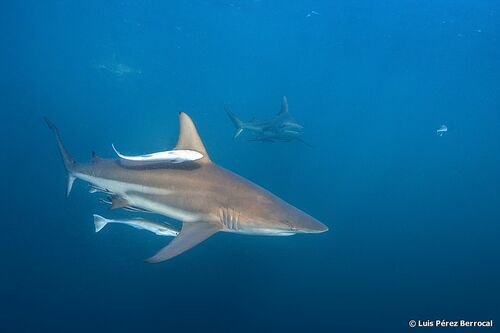
About Carcharhinus leucas (Müller & Henle, 1839)
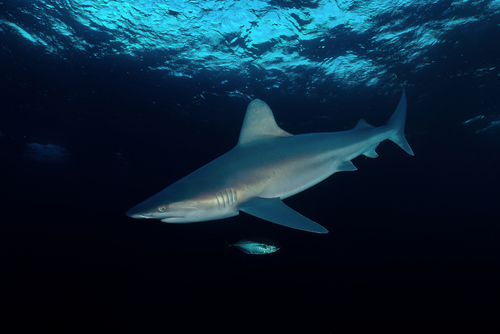
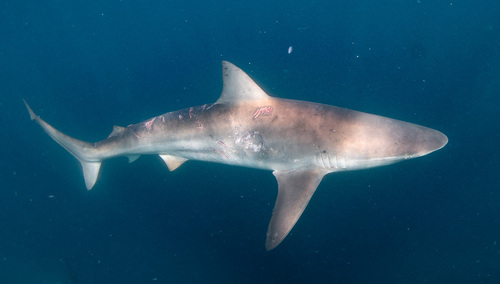
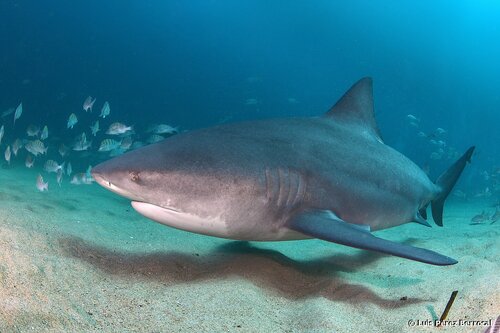
The bull shark, with the scientific name Carcharhinus leucas, is informally called the zambi or Zambezi shark in Africa, and the Lake Nicaragua shark in Nicaragua. It is a species of requiem shark found globally in warm, shallow waters along coasts and in rivers. It is well known for its aggressive nature, and occurs mainly in warm, shallow brackish and freshwater systems, including estuaries and usually the lower reaches of rivers. Ongoing shark culling near beaches to protect beachgoers, carried out because of the species' aggressive nature, is one cause of continuing bull shark population declines. Bull sharks are currently listed as Vulnerable on the IUCN Red List. Bull sharks are euryhaline, meaning they can thrive in both salt water and fresh water. They are known to travel far up rivers; individuals have been recorded traveling up the Mississippi River as far as Alton, Illinois, around 1100 kilometres (700 miles) from the ocean, though few interactions between bull sharks and humans in freshwater have been recorded. Larger bull sharks are responsible for a large share of nearshore shark attacks on humans, and may be the perpetrator of many attacks where the attacking species was not identified. Despite their ability to survive in freshwater habitats, bull sharks are not true freshwater sharks, unlike the river sharks of the genus Glyphis. This species appears on the image of Costa Rica's 2000 colones banknote. The bull shark is commonly found worldwide in warm ocean coastal areas, as well as in rivers and lakes, and occasionally in sufficiently deep saltwater and freshwater streams. It can be found at depths up to 150 m (490 ft), but usually does not swim deeper than 30 m (98 ft). In the Atlantic Ocean, it occurs from Massachusetts to southern Brazil, and from Morocco to Angola. Populations of bull sharks live in several major rivers, with more than 500 individuals thought to reside in the Brisbane River. One bull shark was reportedly seen swimming through flooded Brisbane, Queensland, Australia streets during the 2010–11 Queensland floods, and several were sighted in one of the main streets of Goodna, Queensland shortly after the January 2011 flood peak. A large bull shark was caught in the canals of Scarborough, which lies just north of Brisbane within Moreton Bay, and even larger numbers of bull sharks occupy the canals of Queensland's Gold Coast. In the warmer months of the year, bull sharks regularly visit Sydney Harbour. In the Pacific Ocean, the bull shark can be found from Baja California to Ecuador. Individuals have traveled 4000 km (2500 mi) up the Amazon River to Iquitos in Peru and northern Bolivia. The species also lives in freshwater Lake Nicaragua, the Ganges and Brahmaputra Rivers of West Bengal and Assam in eastern India, and adjacent Bangladesh. It can survive in high-salinity water such as that of South Africa's St. Lucia Estuary. Bull sharks have been recorded in the Tigris River since at least 1924, as far upriver as Baghdad, and there are unconfirmed rumors that they also inhabit Cahora Bassa lake upstream of the Zambezi. The species has a clear preference for warm currents. After Hurricane Katrina, many bull sharks were sighted in Lake Pontchartrain. In July 2023, local fishermen on the Atchafalaya River reported increasing numbers of bull sharks. Occasionally, bull sharks have traveled as far upstream in the Mississippi River as Alton, Illinois. They have also been found in the Potomac River in St. Mary's County, Maryland. From 1996 to 2013, several bull sharks lived in a golf course lake at Carbrook, Logan City, Queensland, Australia. They became trapped in the 21-hectare (51-acre) lake after the 1996 flood of the Logan and Albert Rivers, and remained there until 2013, when they disappeared following another series of floods. The golf course profited from the novelty, changing its logo to feature the sharks and hosting a monthly tournament called the "Shark Lake Challenge". Bull sharks mate during late summer and early autumn, most often in bays and estuaries. After a 12-month gestation period, a female bull shark gives birth to 1 to 13 live young. The species is viviparous, with young born live and already free-swimming. Newborn bull sharks are around 70 cm (27.6 in) long. Adult bull sharks do not rear their young; young are born into flat, protected areas, and common nursery habitats include coastal lagoons, river mouths, and other low-salinity estuaries. Male bull sharks reach sexual maturity around 15 years of age, while females do not begin reproducing until they are 18 years old. Fully mature female bull sharks that produce viable eggs for fertilization typically measure between 175 cm and 235 cm in length. As of yet, the full courting routine of bull sharks has not been observed in detail. It is thought that the male likely bites the female's tail until she can turn upside down to allow copulation, and mature females commonly have scratches left from the mating process. Humans are the greatest threat to bull sharks. Larger shark species such as the tiger shark and great white shark may attack bull sharks, though they typically only target juvenile individuals. Crocodiles can pose a threat to bull sharks in rivers. Saltwater crocodiles have been observed preying on bull sharks in the rivers and estuaries of Northern Australia, and a Nile crocodile was reportedly seen consuming a bull shark in South Africa.