About Carcharhinus isodon (Müller & Henle, 1839)
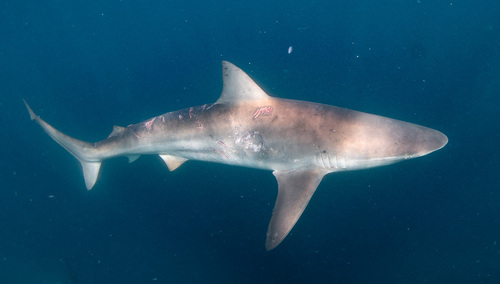
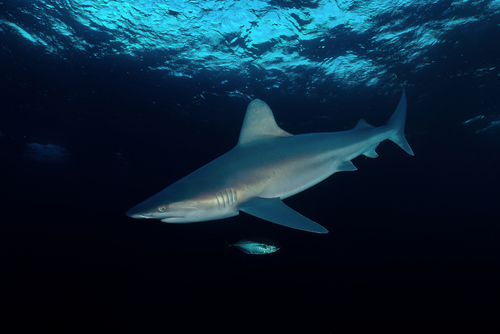
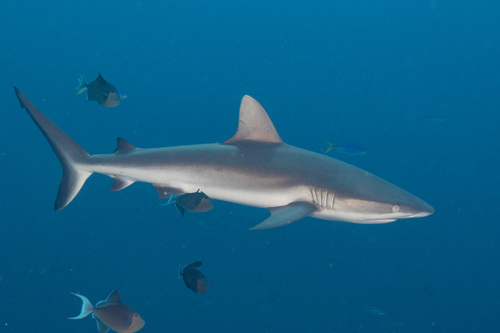
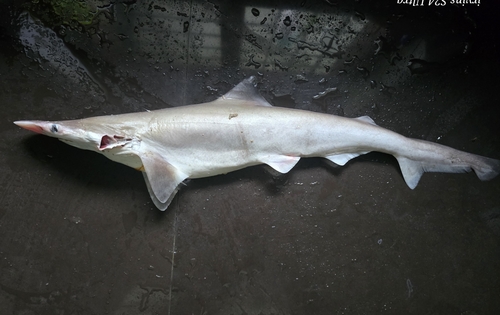
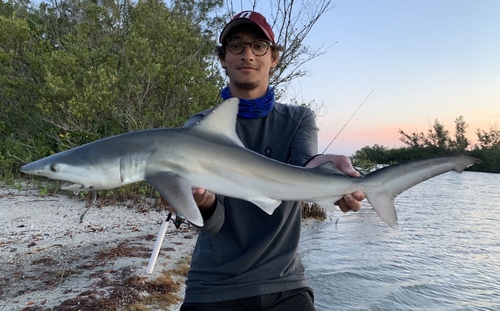
This species is the finetooth shark, with the scientific name Carcharhinus isodon (Müller & Henle, 1839). The finetooth shark has a slender, streamlined body. Its snout is long and pointed, with short, broadly triangular skin flaps sitting in front of the nostrils. It has large, round eyes equipped with nictitating membranes, which are protective third eyelids. Its mouth is broad, with distinct furrows at the corners. There are 12 to 15 tooth rows on each side of the upper jaw, and 13 to 14 tooth rows on each side of the lower jaw. Each tooth is small and needle-like, with a narrow central cusp and edges that range from smooth to minutely serrated. It has five pairs of long gill slits, each measuring about half the length of the first dorsal fin base. The first dorsal fin is high, triangular, and has a pointed apex, and it originates forward of the free rear tips of the pectoral fins. The second dorsal fin is relatively large and originates above the anal fin. There is no ridge between the two dorsal fins. The pectoral fins are small, sickle-shaped, and have pointed tips. Its dermal denticles are small and overlapping, with each denticle bearing three horizontal ridges that lead to marginal teeth. Living finetooth sharks have a distinctive dark bluish-gray color on their upper body and white on their underside, with a faint pale stripe along the flanks and no prominent markings on the fins. Some individual finetooth sharks found in Florida have green eyes. Males average 1.6 m (5.2 ft) in length, while females average 1.7 m (5.4 ft); the largest recorded individual was 1.9 m (6.2 ft) long. In North American waters, the finetooth shark is common, ranging from North Carolina to the northern Gulf of Mexico, and very occasionally strays as far north as New York. In Central and South American waters, it is rare, though it may occur more widely than currently known. It has been reported off Trinidad and Guyana, found infrequently in the Caribbean Sea, and occurs off southern Brazil from São Paulo to Santa Catarina. The populations in the northwestern Atlantic, Gulf of Mexico, and South America are distinct, with very little interchange between them. There are old records of this species from the eastern Atlantic off Senegal and Guinea-Bissau, but these are likely misidentifications of spinner sharks (C. brevipinna). Finetooth sharks are often found near beaches, in bays, and in estuaries. They inhabit very shallow waters, staying no deeper than 10 m (33 ft) in the summer and no deeper than 20 m (66 ft) in the winter. Historically, they were known to enter rivers in the Gulf Coastal Plain of Texas, though most access routes to this area are now blocked by dams. The northwestern Atlantic population of finetooth sharks is strongly migratory: juveniles, followed by adults, arrive off South Carolina from late March to early May, when water temperatures rise above 20 °C (68 °F). They remain there until September to mid-October, when water temperatures drop, and then move south to Florida. The movement patterns of other finetooth shark populations are unknown. Adult and juvenile finetooth sharks form large schools. This energetic, fast-moving predator feeds mainly on small bony fishes, and often enters the surf zone during the day to hunt. In the northwestern Atlantic, the most important prey for this species is Atlantic menhaden (Brevoortia tyrannus); finetooth sharks of all ages off northwestern Florida eat almost nothing else. Finetooth sharks remove the head of the menhaden before swallowing the fish whole. Other documented prey species include spot croaker (Leiostomus xanthurus), Spanish mackerel (Scomberomorus maculatus), mullet (Mugil spp.), and shrimp. There is one recorded case of a finetooth shark preying on a juvenile Atlantic sharpnose shark (Rhizoprionodon terraenovae), which may have been scavenged from the bycatch discarded by a shrimp trawler. Larger sharks may prey on finetooth sharks. Documented parasites of the finetooth shark include the tapeworm Triloculatum geeceearelensis, and unidentified species from the genera Anthobothrium, Paraorygmatobothrium, and Phoreiobothrium.