About Carcharhinus galapagensis (Snodgrass & Heller, 1905)
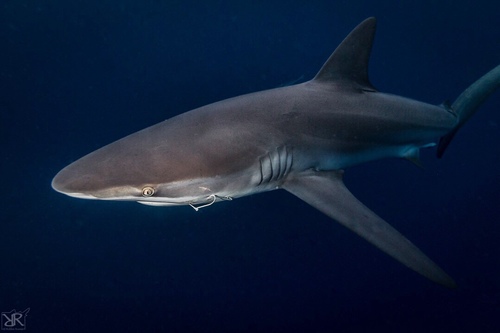
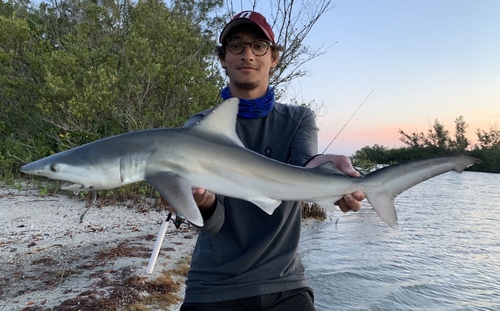
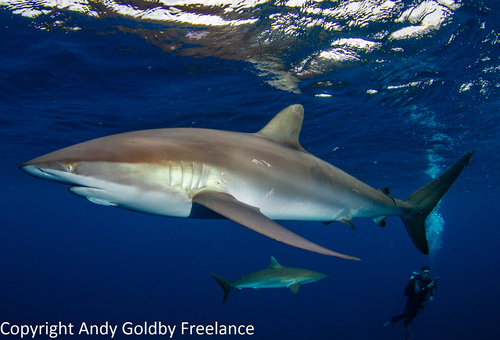
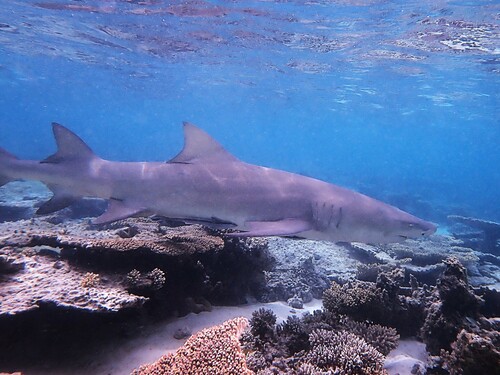
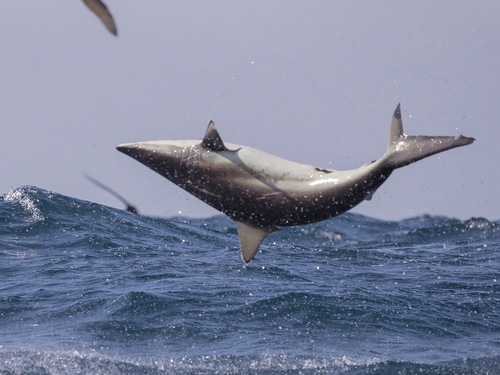
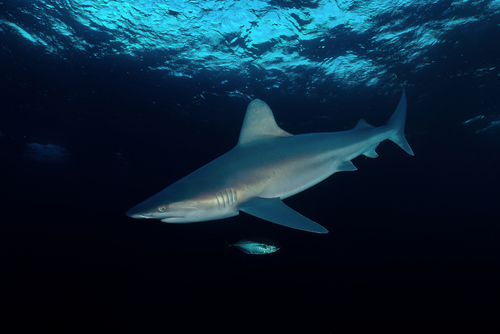
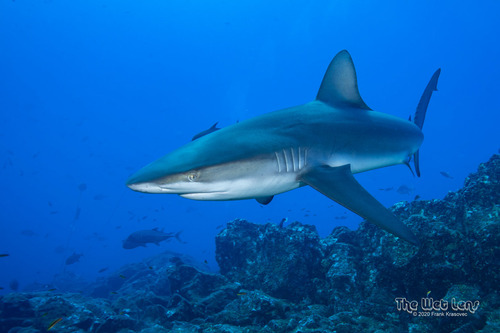
Carcharhinus galapagensis, commonly called the Galapagos shark, is one of the largest species in its genus. Adults commonly reach 3.0 m (9.8 ft) in length, with maximum recorded lengths ranging from 3.3 m (11 ft) to 3.7 m (12 ft). The highest confirmed weight is 195 kg (430 lb), recorded from a 3.0 m (9.8 ft) long female; longer specimens have apparently never been weighed. This species has a slender, streamlined body that fits the typical form of requiem sharks. It has a wide, rounded snout with indistinct anterior nasal flaps, and medium-sized round eyes. Its mouth usually holds 14 tooth rows on either side of both jaws, with a count range of 13 to 15, plus one additional tooth at the symphysis where the two jaw halves meet. Upper teeth are stout and triangular, while lower teeth are narrower; both upper and lower teeth have serrated edges. The first dorsal fin is tall and moderately falcate (sickle-shaped), and its origin sits over the rear tips of the pectoral fins. A low midline ridge runs from the first dorsal fin to the second dorsal fin, and the second dorsal fin originates over the anal fin. Pectoral fins are large with pointed tips. The species is brownish gray on its upper body and white below, with a faint white stripe running along its sides. Fin edges are darker, but do not have prominent contrasting markings. The Galapagos shark can be told apart from the dusky shark by its taller first and second dorsal fins and larger teeth, and from the grey reef shark by its less robust body and less pointed first dorsal fin tip. Even so, these distinguishing traits can be hard to make out when observing the shark in the field. These three similar species also differ in their count of precaudal vertebrae, which are vertebrae located before the tail: the Galapagos shark has 58, the dusky shark has 86 to 97, and the grey reef shark has 110 to 119. The Galapagos shark occurs mainly off tropical oceanic islands. In the Atlantic Ocean, it is found around Bermuda, the Virgin Islands, Madeira, Cape Verde, Ascension Island, Saint Helena, and São Tomé Island. In the Indian Ocean, it is recorded from Walter's Shoal off southern Madagascar. In the Pacific Ocean, it occurs around Lord Howe Island, the Marianas Islands, the Marshall Islands, the Kermadec Islands, Tupai, the Tuamotu Archipelago, the Juan Fernández Islands, the Hawaiian Islands, the Galapagos Islands, Cocos Island, the Revillagigedo Islands, Clipperton Island, and Malpelo. There are a small number of reports of this species from continental waters off the Iberian Peninsula, Baja California, Guatemala, Colombia, and eastern Australia. Galapagos sharks are generally found over continental and insular shelves close to the coast. They prefer rugged reef habitats with clear water and strong converging currents, and are known to form groups around rocky islets and seamounts. This species can cross open ocean between islands, and has been observed at least 50 km (31 mi) from land. Juveniles seldom go deeper than 25 m (82 ft), while adults have been recorded at depths as great as 180 m (590 ft). The Galapagos shark is often the most abundant shark species in shallow island waters. In their original 1905 description of the species, Snodgrass and Heller noted that their schooner caught several hundred adult Galapagos sharks, and that thousands more could be seen swimming in the water. At the isolated Saint Peter and Paul Rocks along the Mid-Atlantic Ridge, the local Galapagos shark population has been described as one of the densest shark populations in the Atlantic Ocean. At some sites they form large aggregations, though these are not true structured schools. During group interactions, Galapagos sharks are dominant over blacktip sharks (C. limbatus), but defer to equal-sized silvertip sharks (C. albimarginatus). When confronted or cornered, the Galapagos shark may perform a threat display similar to that of the grey reef shark: it swims with an exaggerated, rolling motion while arching its back, lowering its pectoral fins, puffing its gills, and gaping its jaw. It may also swing its head from side to side to keep the perceived threat within its field of vision. A documented parasite of the Galapagos shark is the flatworm Dermophthirius carcharhini, which attaches to the shark’s skin. In one observation, a bluefin trevally (Caranax melampygus) rubbed against the rough skin of a Galapagos shark to remove its own parasites.