About Carcharhinus falciformis (Müller & Henle, 1839)
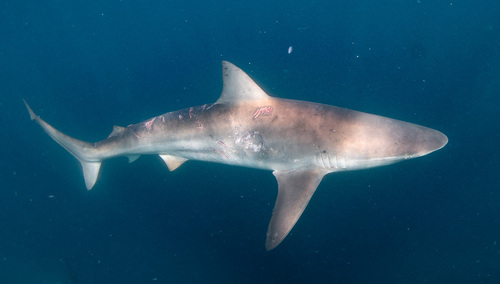
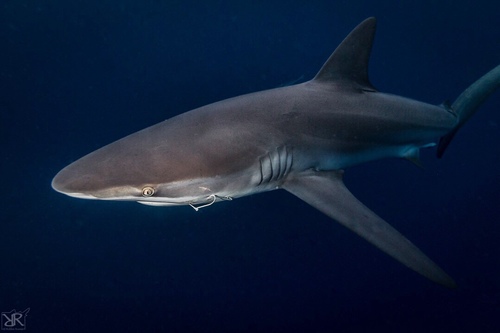
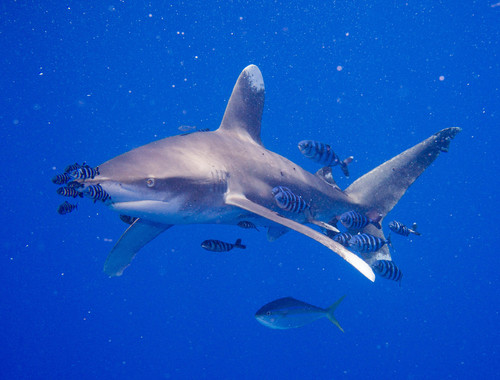
The silky shark (Carcharhinus falciformis) has a slim, streamlined body with a fairly long, rounded snout, and only barely developed skin flaps in front of its nostrils. Its circular, medium-sized eyes have nictitating membranes, which are protective third eyelids. Short, shallow furrows sit at the corners of its mouth. There are 14–16 tooth rows on each side of the upper jaw, and 13–17 tooth rows on each side of the lower jaw, with 15 being the typical count for both jaws. Upper teeth are triangular, strongly serrated, and have a notch on the posterior edge; they are erect at the jaw center and become more oblique toward the jaw sides. Lower teeth are narrow, erect, and have smooth edges. This species has five pairs of gill slits of moderate length. The dorsal and pectoral fins of the silky shark are distinctive, and help separate it from similar shark species. The first dorsal fin is relatively small, measuring less than one-tenth the height of the shark's total length, and originates behind the free rear tips of the pectoral fins. It has a rounded apex, an S-shaped rear margin, and a free rear tip around half as long as the fin is tall. The second dorsal fin is very small, smaller than the anal fin, with an elongated free rear tip that can reach up to three times the height of the fin. A narrow dorsal ridge runs between the two dorsal fins. Pectoral fins are narrow, sickle-shaped, and particularly long in adult individuals. The anal fin originates slightly ahead of the second dorsal fin and has a deep notch in its posterior margin. The caudal fin is fairly tall, with a well-developed lower lobe. The shark's skin is densely covered by tiny, overlapping dermal denticles. Each denticle is diamond-shaped, with horizontal ridges that lead to posterior marginal teeth; the number of these teeth increases as the shark grows. The silky shark's back is metallic golden-brown to dark gray, while its belly is bright snowy white; the white belly color extends onto the flank as a faint lighter stripe. All fins except the first dorsal have darkening at their tips, and this darkening is more noticeable in young sharks. After death, the shark's coloration quickly fades to a dull gray. As one of the largest members of its genus, the silky shark usually grows up to 2.5 m (8.2 ft) long. The maximum recorded length is 3.5 m (11 ft), and the maximum recorded weight is 346 kg (763 lb). Females of this species grow larger than males. The silky shark has a cosmopolitan distribution in marine waters warmer than 23 °C (73 °F). In the Atlantic Ocean, it occurs from Massachusetts (USA) to Spain in the northern part of its range, and from southern Brazil to northern Angola in the south, including the Gulf of Mexico and the Caribbean Sea. It was first recorded in the Mediterranean Sea in the Alboran Sea, and has since been found in Algerian waters, the Gulf of Gabes (Tunisia), and more recently the Ligurian Sea. It is found across the entire Indian Ocean, ranging as far south as Mozambique in the west and Western Australia in the east, including the Red Sea and the Persian Gulf. In the Pacific Ocean, the northern limit of its range runs from southern China and Japan to southern Baja California and the Gulf of California, while the southern limit runs from Sydney, Australia, to northern New Zealand to northern Chile. Four distinct populations of silky sharks have been identified across global ocean basins, separated by life history differences: one in the northwestern Atlantic, one in the western and central Pacific, one in the eastern Pacific, and one in the Indian Ocean. The silky shark is primarily an open-ocean species, and is most common between the surface and a depth of 200 m (660 ft), though it can dive to 500 m (1,600 ft) or deeper. Tracking studies in the tropical eastern Pacific and northern Gulf of Mexico found that cruising silky sharks spend 99% of their time within 50 m (160 ft) of the surface, and 80–85% of their time in water between 26–30 °C (79–86 °F); this pattern stays the same regardless of whether it is day or night. This species favors the edges of continental and insular shelves, and is often found over deepwater reefs and around islands. Its range extends farther north and south along continental margins than it does in open ocean waters. On rare occasions, it may enter coastal waters as shallow as 18 m (59 ft). Silky sharks are highly mobile and migratory, though the full details of their movements are not well understood. Tagging data has recorded individual sharks moving up to 60 km (37 mi) per day, and traveling total distances of up to 1,339 km (832 mi). Larger silky sharks generally travel longer distances than smaller ones. In the Pacific Ocean and possibly other regions, the species spends summer at slightly higher latitudes, especially during warmer El Niño years. In the northern Atlantic, most silky sharks follow the Gulf Stream northward along the U.S. East Coast. In the Gulf of Aden, it is most common in late spring and summer. Biologically and ecologically, the silky shark is one of the three most common pelagic sharks alongside the blue shark and oceanic whitetip shark. It is among the most numerous large oceanic animals in the world, with a global population of at least tens of millions. Compared to blue and oceanic whitetip sharks, it is less strictly pelagic, with the largest numbers found in offshore waters near land, where food is more accessible than in the far open ocean. The silky shark is an active, inquisitive, and aggressive predator, though it will give way to the slower but more powerful oceanic whitetip shark in competitive situations. When approaching something it finds interesting, it may seem inattentive, circling slowly and sometimes swinging its head from side to side. However, it can react with surprising speed to any change in its immediate surroundings. This shark is often found near floating objects such as logs or tethered naval buoys. Younger silky sharks are known to form large, loosely organized groups, which may function for mutual defense. During migration events, groups of over one thousand individuals may gather. These groups are generally sorted by size, and possibly by sex in the Pacific. Silky sharks in a group have been observed performing "tilting", where they show their full lateral profile to other group members, along with opening their jaws or puffing out their gills. Occasionally, individual sharks have been seen suddenly charging straight upward, then veering away just before reaching the surface and gliding back down to deeper water. The purpose of these behaviors is not known. When confronted, the silky shark may perform a threat display: it arches its back, lowers its tail and pectoral fins, raises its head, then swims in tight loops with stiff, jerky motion, often turning to face the perceived threat broadside. Potential predators of the silky shark include larger sharks and killer whales (Orcinus orca). Documented parasites of this species include the isopod Gnathia trimaculata, the copepod Kroeyerina cortezensis, and the tapeworms Dasyrhynchus variouncinatus and Phyllobothrium sp. Silky sharks often mix with schools of scalloped hammerheads (Sphyrna lewini), and have been recorded following marine mammals. One observation from the Red Sea documented 25 silky sharks following a large pod of bottlenose dolphins (Tursiops sp.), alongside 25 grey reef sharks (C. amblyrhynchos) and a single silvertip shark (C. albimarginatus). Silky sharks themselves are accompanied by juvenile pilot fish (Naucrates ductor), which ride the pressure wave ahead of the shark, as well as by jacks, which snatch food scraps and rub against the shark's skin to remove parasites.