About Carcharhinus brevipinna (Müller & Henle, 1839)
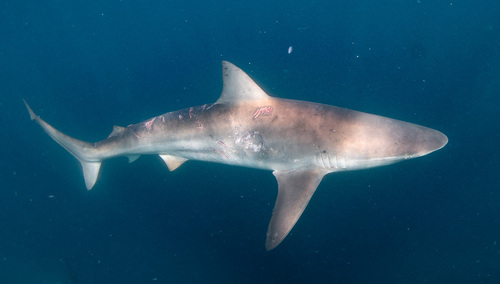
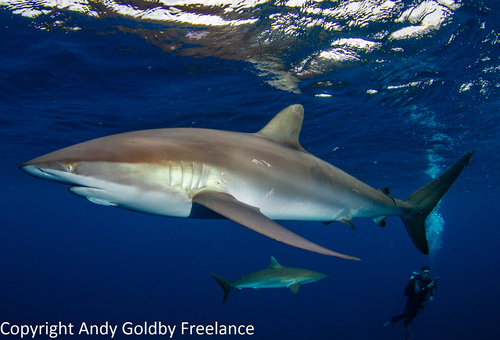
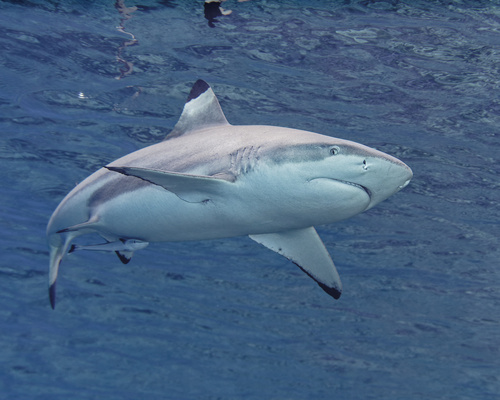
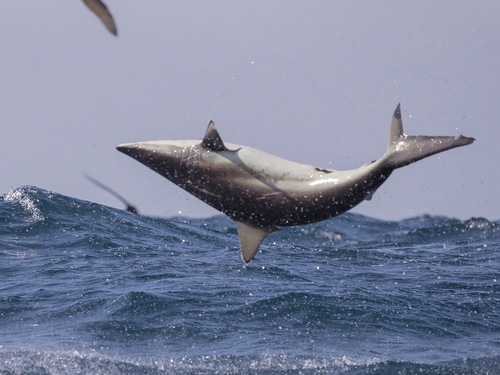
The spinner shark, with the scientific name Carcharhinus brevipinna (Müller & Henle, 1839), averages 2 m (6.6 ft) long and weighs 56 kg (123 lb). The maximum known size this species reaches is 3 m (9.8 ft) long and 90 kg (200 lb) in weight. Individuals from the Indo-Pacific are generally larger than those found in the northwest Atlantic. This shark species has a slim, streamlined body with a distinctive long, pointed snout. Its eyes are small and circular, and prominent forward-pointing furrows are present at the corners of its mouth. There are 15–18 tooth rows in each half of the upper jaw, 14–17 tooth rows in each half of the lower jaw, and two and one tiny central (symphysial) teeth respectively. The teeth have long, narrow central cusps; upper jaw teeth are finely serrated, while lower jaw teeth are smooth. This species has five pairs of long gill slits. The first dorsal fin is relatively small, and usually originates behind the free rear tip of the pectoral fins. There is no ridge between the first and second dorsal fins. The pectoral fins are moderately short, narrow, and sickle-shaped (falcate). The body is densely covered in diamond-shaped dermal denticles that have seven, or rarely five, shallow horizontal ridges. Its upper body is gray, sometimes with a bronze sheen, while its underside is white, and there is a faint white band along its sides. Young spinner sharks have unmarked fins; in larger individuals, the tips of the second dorsal fin, pectoral fins, anal fin, and lower caudal fin lobe are black, and this marking may sometimes appear on other fins as well. The spinner shark differs from the blacktip shark in that its first dorsal fin is slightly more triangular and positioned further back on the body, and adult spinner sharks can also be distinguished by the black tip on their anal fin. There is some uncertainty about the spinner shark's distribution, because it is often confused with the blacktip shark. In the Western Atlantic Ocean, it occurs from North Carolina to the northern Gulf of Mexico (including the Bahamas and Cuba), and from southern Brazil to Argentina. In the Eastern Atlantic, it occurs from off the coast of North Africa to Namibia. In the Indian Ocean, it ranges from South Africa and Madagascar, to the Red Sea and the Gulf of Aden, to India and nearby islands, to Java and Sumatra. In the Pacific Ocean, it is found off the coasts of Japan, Vietnam, and Australia, and possibly the Philippines. Parasitological evidence suggests that Indian Ocean spinner sharks have moved through the Suez Canal into the Mediterranean Sea, becoming Lessepsian migrants. Spinner sharks have been recorded from the ocean surface down to a depth of 100 m (330 ft), though they prefer water less than 30 m (98 ft) deep, and occupy all levels of the water column. This species can be found from coastal waters well offshore, over continental and insular shelves. Juveniles are known to enter bays, but avoid brackish environments. The northwest Atlantic subpopulation is migratory: in spring and summer, they occupy warm inshore waters, and in winter they move south to deeper water. The spinner shark is a fast, active swimmer that sometimes forms large schools which are segregated by age and sex. Young individuals prefer cooler water temperatures than adults. Off the coast of South Africa, females stay close to shore year-round, while males only appear close to shore during the summer. Larger sharks may prey on smaller spinner sharks. Known parasites of the spinner shark include the copepods Kroyeria deetsi, Nemesis pilosus, and N. atlantica, which infest the shark's gills; Alebion carchariae, which infests the skin; Nesippus orientalis, which infests the mouth and gill arches; and Perissopus dentatus, which infests the nares and the rear margins of the fins.