About Carcharhinus brachyurus (Günther, 1870)
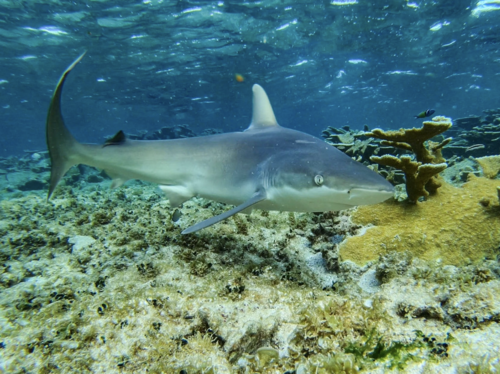
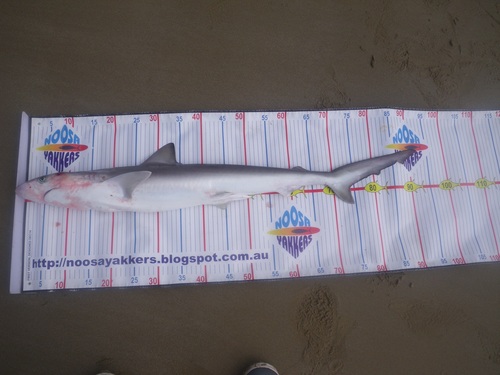
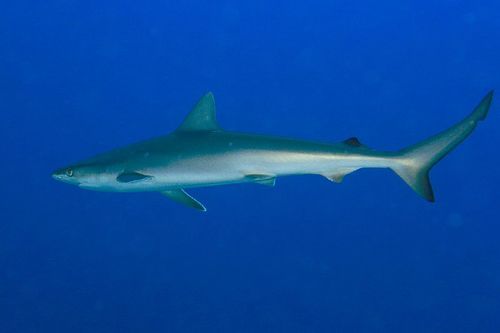
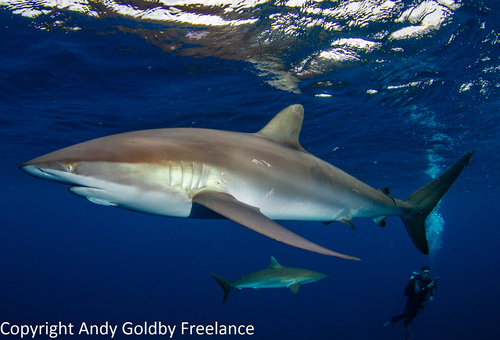
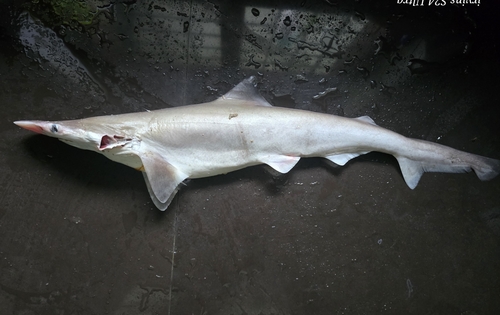
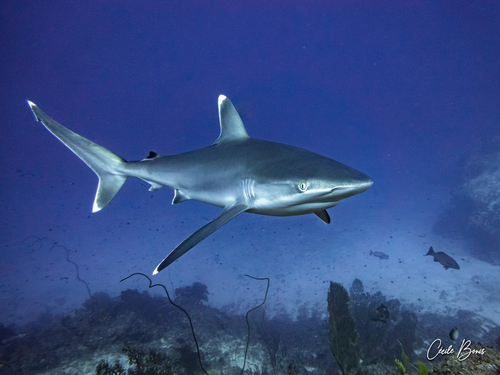
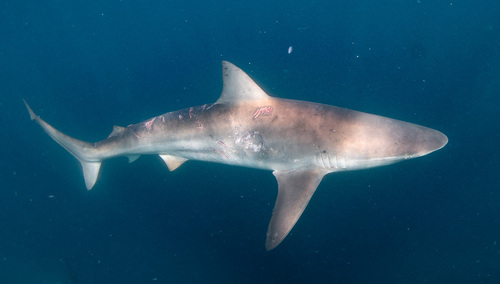
Carcharhinus brachyurus, commonly called the copper shark, has a slender, streamlined body with a slightly arched profile just behind the head. Its snout is fairly long and pointed, and low flaps of skin sit in front of the nostrils. Its round, moderately sized eyes have nictitating membranes, which are protective third eyelids. Short, faint furrows mark the corners of its mouth, which holds 29–35 upper tooth rows and 29–33 lower tooth rows. Each tooth has a single narrow cusp and serrated edges. Upper teeth have a distinct hooked shape and grow more angled toward the jaw corners, while lower teeth stay upright. Adult males have longer, narrower, more curved, and more finely serrated upper teeth than adult females and juvenile sharks. This species has five fairly long pairs of gill slits. Its pectoral fins are large, pointed, and falcate (sickle-shaped). The first dorsal fin is tall, with a pointed apex and a concave trailing margin, and its origin lines up roughly with the tips of the pectoral fins. The second dorsal fin is small and low, positioned roughly opposite the anal fin. There is usually no ridge between the two dorsal fins. The caudal fin has a well-developed lower lobe and a deep ventral notch near the tip of the upper lobe. The upper body of this shark ranges from bronze to olive-gray with a metallic sheen, and sometimes carries a pink tint; color darkens toward fin tips and margins, but not noticeably. After death, its color quickly fades to a dull gray-brown. Its underside is white, and this white color extends onto the flanks as a prominent band. The copper shark is easily confused with other large Carcharhinus species, especially the dusky shark (C. obscurus), but can be distinguished by the shape of its upper teeth, the absence or weakness of its interdorsal ridge, and its lack of obvious fin markings. Reported maximum measurements for this species are 3.3 m (11 ft) in length and 305 kilograms (672 lb) in weight. The copper shark is the only member of its genus that is mostly found in temperate rather than tropical waters, in waters warmer than 12 °C (54 °F). It has a wide distribution split into separate regional populations, with little to no movement between populations. In the Atlantic Ocean, it occurs from the Mediterranean Sea to Morocco and the Canary Islands, off the coast of Argentina, and off the coasts of Namibia and South Africa, where two separate populations may exist. Infrequent records place it off Mauritania, in the Gulf of Guinea, and possibly in the Gulf of Mexico. In the Indo-Pacific, it occurs from the East China Sea to Japan, excluding Hokkaido, and southern Russia; off southern Australia, mostly between Sydney and Perth but occasionally further north; and around New Zealand, but not as far out as the Kermadec Islands. There are also unconfirmed reports of this shark from the Seychelles and the Gulf of Thailand. In the eastern Pacific, it occurs from northern Chile to Peru, and from Mexico to Point Conception, California, including the Gulf of California. The copper shark is common off parts of Argentina, South Africa, Australia, and New Zealand, and rare in all other areas. In many regions, its full range is unclear because it is often confused with other shark species. It is one of the most commonly encountered sharks in New Zealand’s waters. Copper sharks can be found from the surf zone to just beyond the continental shelf in the open ocean, and can dive to depths of 100 m (330 ft) or more. This species often enters very shallow habitats including bays, shoals, and harbors, and also lives around rocky areas and offshore islands. It tolerates low and changing salinities, and has been recorded in estuaries and the lower sections of large rivers. Juveniles stay in inshore waters less than 30 m (98 ft) deep year-round, while adults typically live further offshore, and only regularly approach the coast during spring and summer, when large groups can be easily seen in shallow water. Copper shark populations in both hemispheres make seasonal migrations in response to temperature changes, reproductive events, and/or prey availability. Movement patterns vary by sex and age. Adult females and juveniles spend winter in the subtropics, and generally move to higher latitudes as spring approaches; pregnant females also move toward the coast to give birth in inshore nursery areas. Adult males stay in the subtropics for most of the year, except in late winter or spring when they also move to higher latitudes to meet and mate with post-partum females leaving the nurseries. Individual sharks have been recorded traveling up to 1,320 km (820 mi) during migrations. This species is philopatric, meaning it returns to the same areas year after year. The oldest known fossil evidence of a copper shark nursery comes from Peru’s Pisco Basin, preserved in the Chilcatay and Pisco Formations, dating from the Early Miocene to the Late Miocene. The copper shark is fast and active, and can be found alone, in pairs, or in loosely organized schools of up to hundreds of individuals. Some aggregations form for reproduction, while others form around concentrated food sources. Larger sharks and killer whales may prey on this species. Known parasites of the copper shark include the tapeworms Cathetocephalus australis, Dasyrhynchus pacificus, D. talismani, Floriceps minacanthus, Phoreiobothrium robertsoni, and Pseudogrillotia spratti; the leech Stibarobdella macrothela; and the fluke Otodistomum veliporum.