About Carcharhinus amblyrhynchos (Bleeker, 1856)
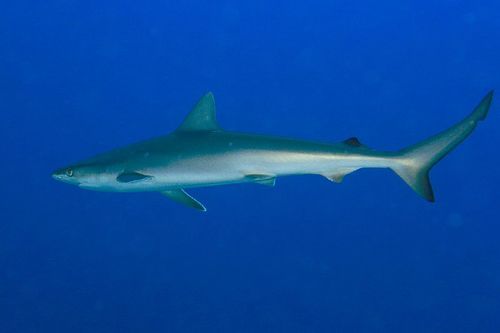
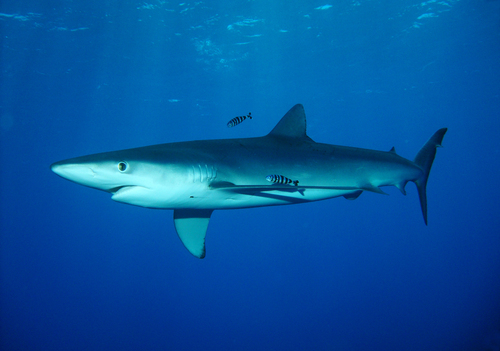
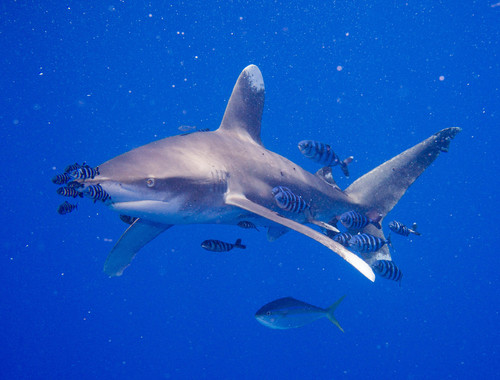
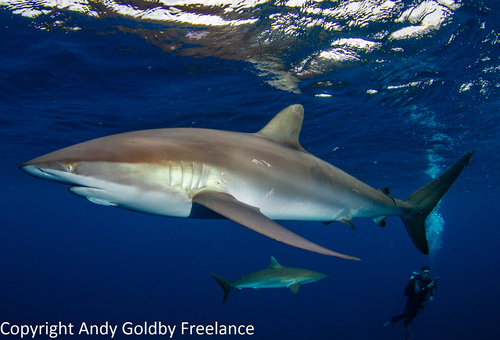
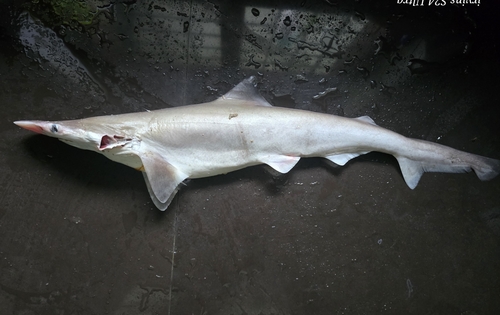
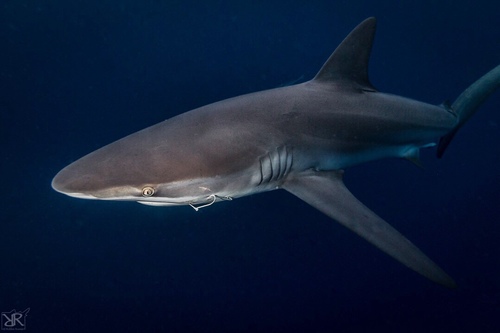
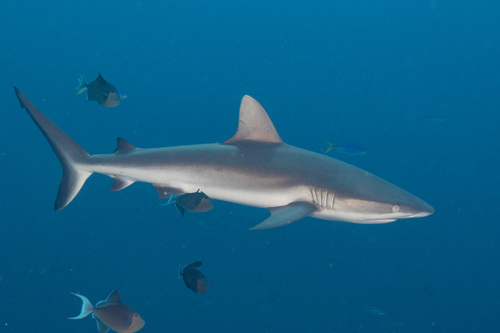
The grey reef shark, Carcharhinus amblyrhynchos, has a streamlined, moderately stout body with a long, blunt snout and large, round eyes. Each of its upper and lower jaws holds 13 or 14 teeth, most often 14 in the upper jaw and 13 in the lower. Upper teeth are triangular with slanted cusps, while lower teeth have narrower, erect cusps. Tooth serrations are larger in the upper jaw than in the lower. The first dorsal fin is medium-sized, and no ridge runs between the first and second dorsal fins. Its pectoral fins are narrow and sickle-shaped (falcate). Its coloration is grey above, sometimes with a bronze sheen, and white below. The entire rear margin of the caudal fin has a distinctive, broad, black band. The tips of the pectoral, pelvic, second dorsal, and anal fins range from dusky to black. Individuals from the western Indian Ocean have a narrow white margin at the tip of the first dorsal fin, a trait that is usually absent in Pacific populations. Grey reef sharks that spend time in shallow water gradually darken in color from tanning. Most grey reef sharks are less than 1.9 m (6.2 ft) long. The maximum reported length is 2.6 m (8.5 ft), and the maximum reported weight is 33.7 kg (74 lb). This species is native to the Indian and Pacific Oceans. In the Indian Ocean, it ranges from South Africa to India, including Madagascar and nearby islands, the Red Sea, and the Maldives. In the Pacific Ocean, it is found from Southern China to northern Australia and New Zealand, including the Gulf of Thailand, the Philippines, and Indonesia. It has also been recorded from numerous Pacific islands: American Samoa, the Chagos Archipelago, Easter Island, Christmas Island, the Cook Islands, the Marquesas Islands, the Tuamotu Archipelago, Guam, Kiribati, the Marshall Islands, Micronesia, Nauru, New Caledonia, the Marianas Islands, Palau, the Pitcairn Islands, Samoa, the Solomon Islands, Tuvalu, the Hawaiian Islands, and Vanuatu. It is generally a coastal shallow-water species, found mostly at depths less than 60 m (200 ft), though it has been recorded diving to 1,000 m (3,300 ft). It occurs over continental and insular shelves, and prefers the leeward (current-facing away) sides of coral reefs that have clear water and rugged topography. It is often found near drop-offs at the outer edges of reefs, particularly near reef channels with strong currents, and is less commonly found inside lagoons. Occasionally, this shark may travel several kilometers out into the open ocean. Alongside the blacktip reef shark (C. melanopterus) and the whitetip reef shark (Triaenodon obesus), the grey reef shark is one of the three most common sharks that live on Indo-Pacific reefs. It actively drives most other shark species out of its preferred habitats, even larger species. In areas where grey reef sharks coexist with blacktip reef sharks, blacktip reef sharks occupy shallow flats while grey reef sharks remain in deeper water. Areas with large numbers of grey reef sharks usually have few sandbar sharks (C. plumbeus), and vice versa; this may stem from competitive exclusion caused by their similar diets. The impact that grey reef sharks have on reef fish communities is likely to vary depending on whether the sharks forage within the reef environment, or on pelagic resources, which has been observed at Palmyra Atoll. On the rare occasions they swim in oceanic waters, grey reef sharks often associate with marine mammals or large pelagic fishes such as sailfish (Istiophorus platypterus). One record notes around 25 grey reef sharks following a large pod of bottlenose dolphins (Tursiops sp.), alongside 25 silky sharks (C. falciformis) and a single silvertip shark. Rainbow runners (Elagatis bipinnulata) have been observed rubbing against grey reef sharks, using the sharks' rough skin to scrape off parasites. Grey reef sharks are prey for larger sharks such as the silvertip shark. At Rangiroa Atoll in French Polynesia, great hammerheads (Sphyrna mokarran) feed opportunistically on grey reef sharks that are exhausted from pursuing mates. Known parasites of this species include the nematode Huffmanela lata, several copepod species that attach to the sharks' skin, and juvenile stages of the isopods Gnathia trimaculata and G. grandilaris that attach to gill filaments and gill septa, the dividers between each gill.