About Carcharhinus albimarginatus (Rüppell, 1837)
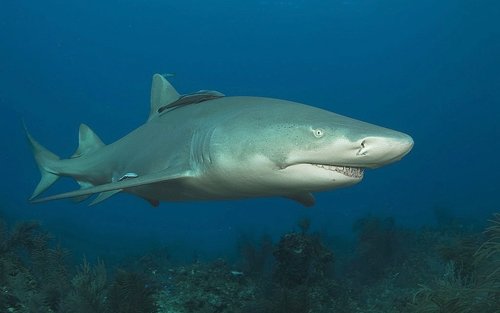
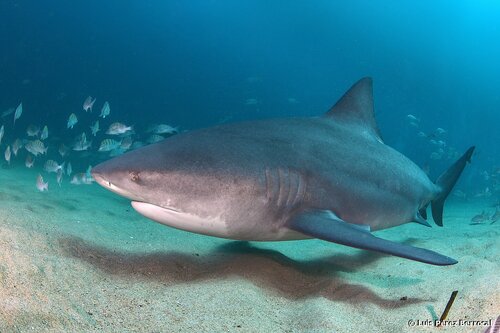
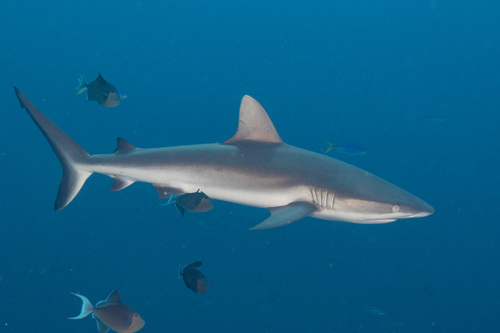
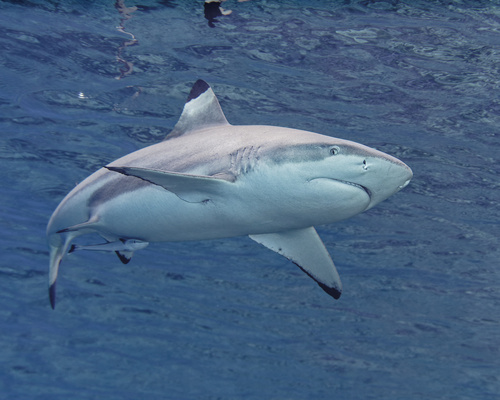
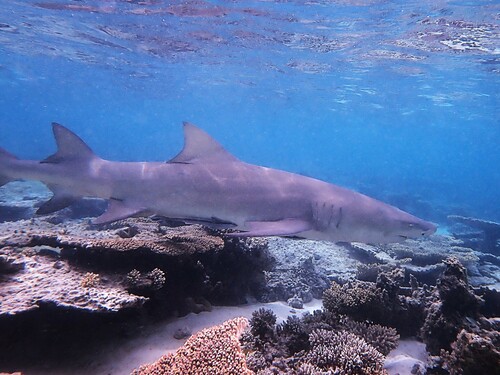
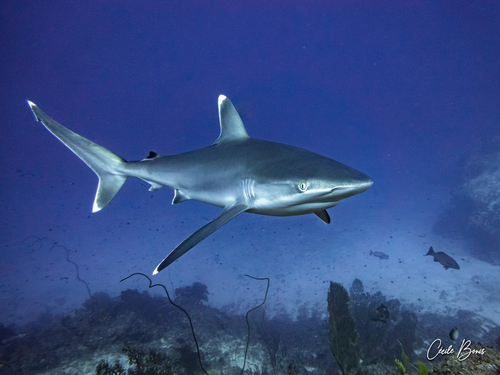
The silvertip shark, scientifically named Carcharhinus albimarginatus (Rüppell, 1837), is a robust, streamlined shark species with a moderately long, broad snout and large, round eyes. It has five pairs of short gill slits. There are 12 to 14 tooth rows on each side of both jaws, plus one or two small teeth at the symphysis, the middle of the jaws. Upper teeth are broad with oblique triangular cusps and coarse serrations near the base, while lower teeth have erect cusps with fine serrations. Its first dorsal fin is large and triangular, starting above or slightly forward of the free tips of the pectoral fins. A ridge sits between the first and second dorsal fins. Compared to most requiem sharks, its pectoral fins are proportionately longer, sickle-shaped (falcate) with pointed tips. This species is blue-gray above with a bronze sheen, and white below. A faint white band runs along its sides, and all fins have distinctive white tips and borders. Silvertip sharks can reach a maximum length of 3 m (9.8 ft), but most adults are 2.0–2.5 m (6.6–8.2 ft) long. The maximum recorded weight is 162.2 kg (358 lb), and females grow larger than males. The silvertip shark has a wide but discontinuous distribution across the tropical Indian and Pacific Oceans. In the western Indian Ocean, it is found from the Red Sea to South Africa, including Madagascar, the Seychelles, the Aldabra Group, Mauritius, and the Chagos Archipelago. In the western Pacific, it occurs off southern Japan to northern Australia, including Taiwan, the Philippines, Indonesia, Papua New Guinea, New Caledonia, Guam, Palau, the Solomon Islands, the Marshall Islands, the Phoenix Islands, and Tahiti. In the eastern Pacific, it ranges from southern Baja California to Colombia, including the Cocos, Galapagos, and Revillagigedo Islands. Its occurrence in the Gulf of Mexico and the Caribbean Sea has not been confirmed. This shark inhabits continental and insular shelves at depths between 30 and 800 m (98–2,625 ft), and occupies all levels of the water column. It is most common around isolated islands, coral banks, and reef drop-offs. Juveniles typically stay in coastal shallows or lagoons, while adults live in deeper water, with very little overlap in habitat between the two age groups. Though highly mobile, silvertip sharks show site fidelity to certain areas, and there are reports of territorial behavior. They are usually found alone or in pairs, though small groups of adult females have been observed in deep water. Individual silvertip sharks act very aggressively toward each other, and many individuals have heavy scarring. When competing for food, silvertip sharks dominate equal-sized Galapagos sharks (C. galapagensis) and blacktip sharks (C. limbatus). This species sometimes forms mixed-species groups with grey reef sharks. Rainbow runners (Elagatis bipinnulata) have been observed rubbing against silvertip sharks to scrape parasites off using the sharks' rough skin. Silvertip sharks sometimes follow marine mammals such as bottlenose dolphins (Tursiops sp.) in open water, and are themselves followed by pilot fish (Naucrates ductor). Like grey reef sharks, silvertip sharks sometimes perform a fixed threat display when pursued by divers to warn that they may attack. The display starts with the shark accelerating away to a distance of 15 m (49 ft), then turning and charging toward the perceived threat. When it is two body lengths from the threat, the shark brakes, turns broadside, drops its pectoral fins, opens its jaws, lowers the posterior two-thirds of its body, and "shivers". The final two elements of this display are unique to the silvertip shark; the "shivering" may help highlight its white fin markings. If the diver does not leave, the shark may quickly close in and slash with its upper teeth.