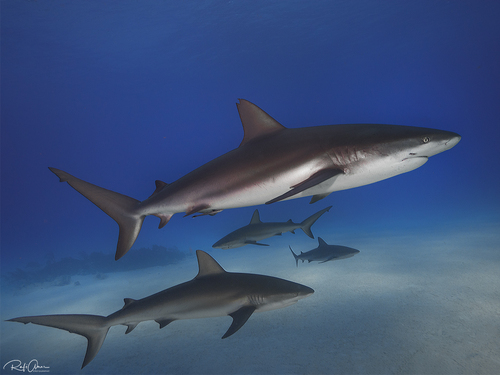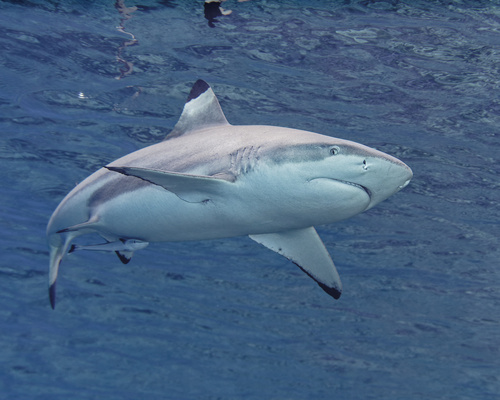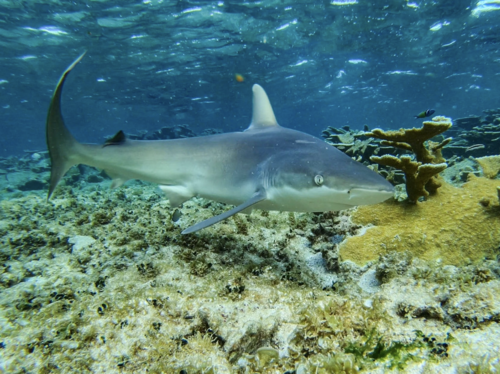
About Carcharhinus acronotus (Poey, 1860)
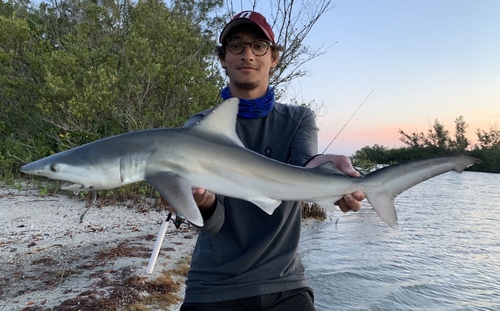
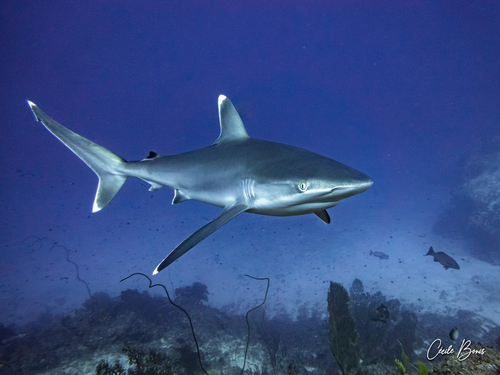
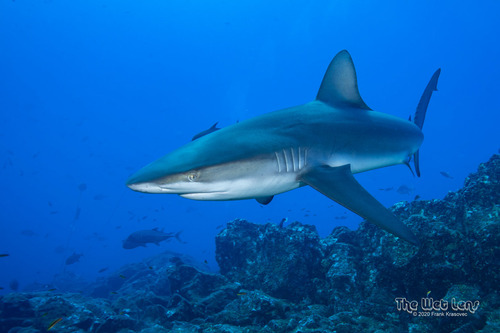
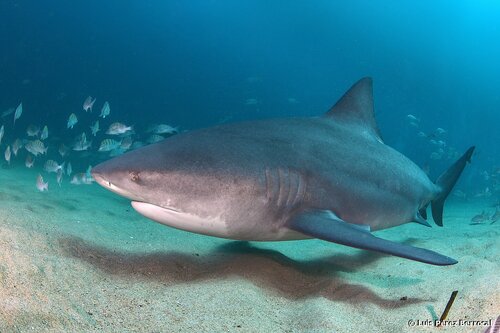
The blacknose shark (Carcharhinus acronotus) has a slender, streamlined body, with a long rounded snout and large eyes. A well-developed skin flap sits in front of each nostril, marking separate inflow and outflow openings. There are 12 to 13 tooth rows per side in the upper jaw and 11 to 12 tooth rows per side in the lower jaw, plus one or two additional teeth at the symphysis, or middle, of the jaws. Its teeth are triangular, angled, and have serrated edges; upper teeth are stouter than lower teeth. It has five pairs of short gill slits, each shorter than one third the length of the first dorsal fin base. The first dorsal fin is small, somewhat sickle-shaped, with a pointed apex and a short free rear tip; its starting point lies over the free rear tips of the pectoral fins. The second dorsal fin is relatively large, but still less than half the height of the first dorsal fin, and there is no ridge between the two dorsal fins. The pectoral fins are short and tapered. The shark's body is covered in overlapping dermal denticles. These denticles have five to seven longitudinal ridges, or three in very young individuals, that lead to three to five marginal teeth. The shark is yellowish to greenish-gray or brown on its upper side and white to yellow on its underside. A distinctive dark blotch on the snout tip is most visible in young sharks. The tips of the second dorsal fin, upper caudal fin lobe, and sometimes the lower caudal fin lobe are dark. Most adult blacknose sharks are 1.3–1.4 m (4.3–4.6 ft) long and weigh 10 kg (22 lb). The maximum recorded length and weight for the species is 2.0 m (6.6 ft) and 18.9 kg (42 lb), respectively. The blacknose shark lives on continental and insular shelves off the eastern coast of the Americas, ranging as far north as North Carolina and as far south as southern Uruguay. Its range includes the Bahamas, the Gulf of Mexico, and the Caribbean Sea. It most often occurs in coastal waters over seagrass beds, sandy flats, and areas of shell or coral rubble. This species is spatially separated by size and sex. Generally, only young sharks are found in shallow water, while adults prefer depths greater than 9 m (30 ft) and are most common at 18–64 m (59–210 ft). Blacknose sharks in the South Atlantic Bight, off the Atlantic coast of the southern United States, migrate north in summer and south or possibly offshore in winter. A similar migration pattern occurs for blacknose sharks in the Gulf of Mexico. The blacknose shark is a small, fast-swimming predator. It feeds primarily on small bony fishes including pinfish, croakers, porgies, anchovies, spiny boxfish, and porcupinefish, as well as octopus and other cephalopods. When competing for food, its speed lets it snatch food away from larger sharks such as the Caribbean reef shark (C. perezi). This species can form large schools, which are sometimes found near anchovies and mullet. Blacknose sharks show a high degree of philopatry: both juveniles and adults have been recorded returning to the same local area year after year. Larger sharks prey on blacknose sharks. Captive blacknose sharks have been observed performing an apparent threat display toward approaching divers or new members of their own species. This display involves hunching the back, lowering the pectoral fins, opening the jaws wide, and swimming with exaggerated side-to-side movements. Known parasites of the blacknose shark include the copepods Nesippus orientalis, Perissopus dentatus, Pandarus sinuatus, Kroyeria sphyrnae, Nemesis atlantica, and Eudactylina spinifera, as well as tapeworms from the genera Paraorygmatobothrium and Platybothrium.