About Carassius carassius (Linnaeus, 1758)
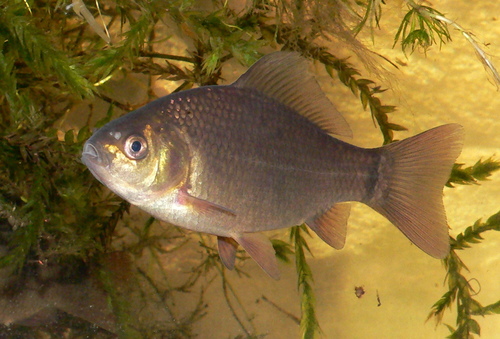
Crucian carp (Carassius carassius) is a medium-sized member of the cyprinid (common carp) family Cyprinidae, widely distributed across northern Europe. Its common name is derived from the Low German terms karusse or karutze, which likely originated from Medieval Latin coracinus, a term for a type of river fish. Its native range stretches from England to Russia, reaching as far north as the Arctic Circle in Scandinavian countries, and as far south as central France and the Black Sea region. It is confirmed to be native, not introduced, to England. Its natural habitat includes lakes, ponds, and slow-moving rivers. This species is typically 15 centimetres (5.9 in) long, and rarely weighs more than 2 kilograms (4.4 lb). The maximum recorded total length for a male individual is 64 centimetres (25 in), and the heaviest published specimen weighed 3 kilograms (6.6 lb). It is generally described as having a golden-green shining body colour, more specifically young crucian carp are golden-bronze that darken as they mature: mature individuals develop a dark green back, deep bronze upper flanks, gold colouring on the lower flanks and belly, and reddish or orange fins, though other colour variations do occur. A key distinguishing feature of crucian carp is its convexly rounded fin, unlike the concave fins found on goldfish or hybrids between crucian carp and Carassius gibelio. Crucian carp is the type species for the genus Carassius, a fact that has contributed to taxonomic confusion surrounding East Asian native species in the genus. Hybridisation between crucian carp and domestic or feral goldfish has been reported, and viable hybrids have been produced in laboratory settings. While these hybrids are sterile or nearly sterile, genetic contamination of native crucian carp populations is a noted concern. Even if hybrids cannot reproduce further, F1 hybrids display hybrid vigour (heterosis), and are much better at finding food and evading predators than either parent species, which is thought to pose a potential threat to native crucian carp populations. Crucian carp are occasionally kept as freshwater aquarium fish and in water gardens, but they are not commonly available commercially. This is mostly because they are not in high demand, as more colourful ornamental fish such as koi or orfe are more popular. Crucian carp are considered an important part of pond ecosystems, because they can consume the excrement of other organisms and prevent nitric overload. It has been claimed that crucian carp are heavily farmed worldwide; the most recent FAO statistics from 2008 (published 2011) list total production of C. carassius at 1,957,337 tonnes, worth US$2,135,857,000, ranking 9th in global aquaculture including marine fish and crustaceans. However, these statistics count the Asian Carassius gibelio as a subspecies of European crucian carp, so the vast majority of this production total comes from Asian fish farmed in China. For wild freshwater catches of Carassius species, FAO 2006 statistics record 5.53 thousand tonnes harvested, ranking 13th worldwide among caught freshwater fishes. The national breakdown of this catch is: Kazakhstan 2.2 thousand tonnes, Japan 1.12 thousand tonnes, Serbia 0.84 thousand tonnes, Moldova 0.19 thousand tonnes, Uzbekistan 0.19 thousand tonnes, Poland 0.13 thousand tonnes. Some portion of the tonnage reported from European countries in these statistics may represent pure Carassius carassius. In Poland, crucian carp (called karaś in Polish) is considered the best-tasting pan fish, and is traditionally served with sour cream in the dish karasie w śmietanie. A Polish breed of crucian carp called King's carp (previously named Galician carp, after the Galicia region of the former Austro-Hungarian Empire) has a larger-than-average hump and larger-than-average scales. Carp is included among traditional holiday foods in Poland, a tradition that may have Jewish origins. In Russia, this species is called Золотой карась, meaning "golden crucian", and it is one of the fish used in a borscht recipe known as borshch s karasey (Борщ с карасе́й) or borshch s karasyami (Борщ с карася́ми). Another classic Russian dish is fried crucian carp cooked in sour cream. The variety of crucian carp native to lake Nedzheli is highly valued in Yakutia, and has been introduced to other lakes in the region.