About Carassius auratus (Linnaeus, 1758)
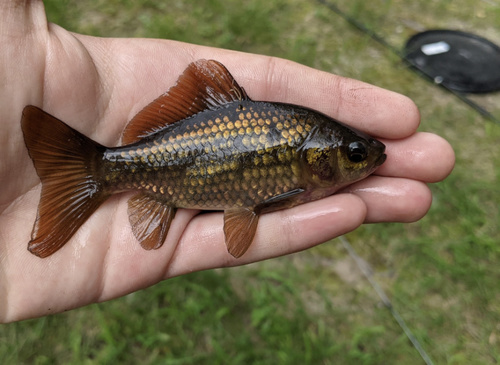
The goldfish, with the scientific name Carassius auratus, is a freshwater fish belonging to the family Cyprinidae of the order Cypriniformes. It is commonly kept as a pet in indoor aquariums, and is one of the most popular aquarium fish in the world. Goldfish that have been released into the wild have become an invasive pest in parts of North America and Australia. Goldfish are native to China, and are a relatively small member of the genus Carassius, which also includes the Prussian carp and the crucian carp. Goldfish were first selectively bred for color in imperial China more than 1,000 years ago, and several distinct breeds were developed during this period. Goldfish breeds vary widely in size, body shape, fin configuration, and coloration. Combinations of white, yellow, orange, red, brown, and black coloration are documented across different breeds. Goldfish can only reach sexual maturity when they have access to enough water and the right nutrition. Most goldfish breed successfully in captivity, especially when kept in pond settings. Breeding typically occurs after a significant change in water temperature, most often in spring. Males chase gravid female goldfish (females carrying eggs), and prompt the females to release their eggs by bumping and nudging them. Like all cyprinids, goldfish are egg-layers. Their eggs are adhesive, and attach to aquatic vegetation, typically dense plants such as Cabomba or Elodea, or a manmade spawning mop. The eggs hatch within 48 to 72 hours. Within about a week after hatching, the fry begins to develop its final body shape, although it may take a full year before the young goldfish develops its mature adult coloration. Until they develop mature coloration, young goldfish are a metallic brown, just like their wild ancestors. In their first weeks of life, the fry grow quickly—this is an adaptation to the high risk of being eaten by adult goldfish, other fish, or insects in their environment. Some highly selectively bred goldfish can no longer breed naturally, due to their altered body shape. An artificial breeding method called "hand stripping" can help these fish breed, but the process can harm the fish if it is not done correctly. In captivity, adult goldfish may also eat young goldfish that they encounter.