About Caranx sexfasciatus Quoy & Gaimard, 1825
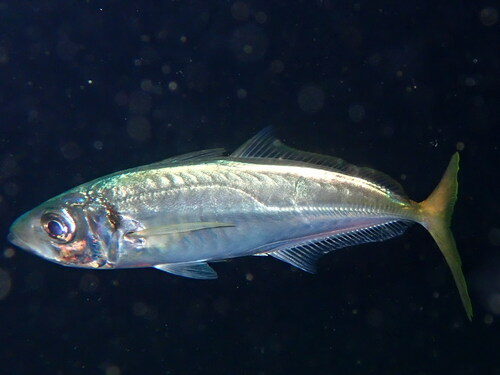
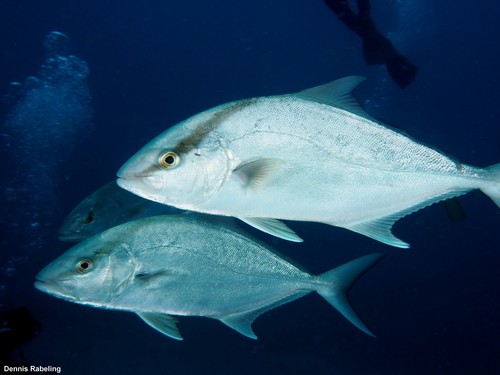
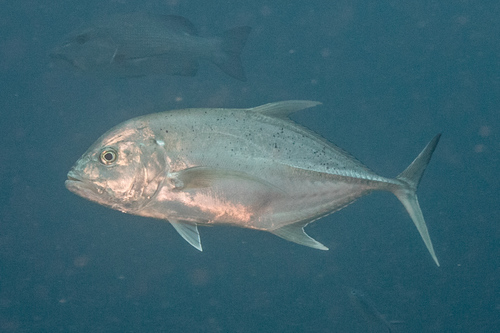
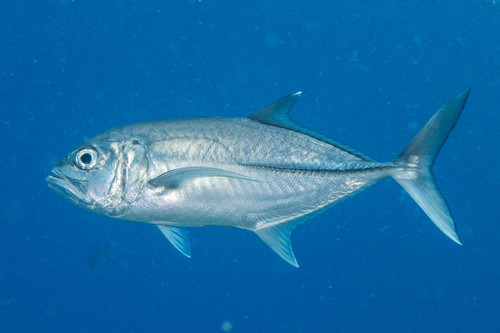
The bigeye trevally (Caranx sexfasciatus Quoy & Gaimard, 1825) is one of the larger species in the Caranx genus, reaching a maximum recorded size of 120 centimeters in length and 18.0 kilograms in weight. Like most other jacks, it has a compressed, oblong body, with a dorsal profile that is slightly more convex than the ventral profile, particularly in the front part of the body. Its snout is slightly pointed, and is longer than the diameter of its eye.
Its dorsal fin is split into two distinct sections: the first section has 8 spines, while the second section has 1 spine and 19 to 22 soft rays. The anal fin has 2 spines that are detached from the anterior portion, followed by 1 spine and 14 to 17 soft rays. The pelvic fins have 1 spine and 17 to 18 soft rays; the caudal fin is strongly forked, and the pectoral fin is falcate. The species' lateral line has a moderate anterior arch, which contains 49 to 50 scales. The straight section of the lateral line holds 0 to 3 scales and 27 to 36 strong scutes. The entire breast is covered in scales. Bigeye trevally have well-developed adipose eyelids. Their dentition includes an outer row of widely spaced canine teeth and an inner band of villiform teeth in the upper jaw, plus a row of widely spaced conical teeth on the lower jaw. The species has 21 to 25 gill rakers and 25 vertebrae.
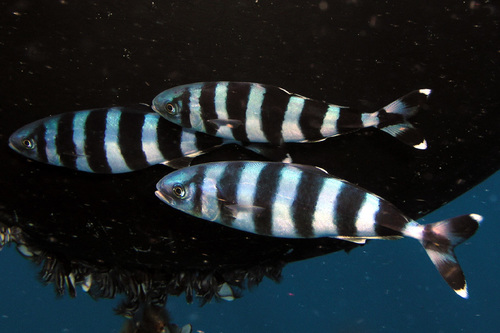
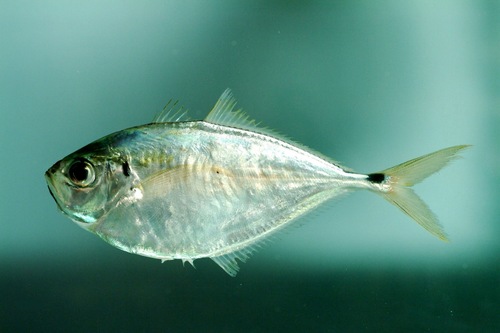
Bigeye trevally change their color and body patterns as they age. Juveniles are silvery yellow to silvery brown, and have five to six dark vertical bands along their sides – this feature gives the species its specific epithet sexfasciatus. As the fish mature, these bands fade and become indistinct, and the overall body color shifts to silvery blue on the upper half and whitish on the lower half. Fully mature adults have no remaining vertical bars, and have a silvery olive to blue green dorsal color that fades to silvery white on the underside. Juveniles have pale grey to yellow fins with darker edges; adults have overall darker fins, with the anal and caudal fins ranging from yellow to black, and the second dorsal fin ranging from olive to black. The tip of the second dorsal fin has a distinctive white marking. Bigeye trevally also have a small dark spot on the upper margin of the operculum.
Bigeye trevally are widely distributed across tropical and subtropical waters of both the Indian and Pacific Oceans. In the Indian Ocean, their range extends from South Africa and Madagascar in the west, north along the East African coastline to the Red Sea and Persian Gulf. The range extends east through India, Southeast Asia, Indonesia, and many offshore Indian Ocean islands, reaching north to Japan and south to Australia in the central Indo-Pacific region. In the Pacific Ocean, bigeye trevally live in most tropical island groups including Hawaii, and their range extends east to the western American coastline. In this eastern part of their distribution, they have been recorded from the U.S. state of California in the north (including the Gulf of California) and south to Ecuador and the Galapagos Islands.
Bigeye trevally predominantly inhabit inshore coastal waters, though they also occur in pelagic areas far offshore, and around remote islands and seamounts. The species is known to occur at depths up to around 100 meters. Adults are mostly found over coral and rocky reef complexes, but small numbers often move into more inshore areas in sandy bays and lagoons. Offshore individuals often live on deeper seamounts or reefs surrounding offshore islands. In some regions, the species moves with the tide: it enters shallow lagoonal areas as the tide rises, and returns to deeper reefs as the tide falls. Juveniles live in more inshore, shallower coastal waters, and often enter lagoons, tidal flats, mangrove zones and even estuaries. Juvenile bigeye trevally have been reported in rivers at multiple locations, and are known to move far into the upper reaches of rivers. As the fish grows, it moves back to deeper reef waters. The species has also been found in pelagic open ocean areas, circling stationary buoys, which suggests it may follow floating debris far out to sea.
Bigeye trevally reach sexual maturity at a length of around 42 centimeters, with both males and females reaching maturity at a similar length and age. Spawning occurs between July and September in the eastern Pacific, and between November and March in South Africa, showing variation across the species' range. There is also evidence that spawning may take place during new moon periods. Before spawning, fish gather in large schools, and pairs break away from the main group to spawn. The pair increases their swimming speed to leave the school, and the individual fish underneath instantly changes color to dark black; this individual will also chase away any other fish that approach the pair. The two trevally then press their ventral surfaces together to spawn, often swimming almost horizontally, before returning to the school and changing back to their normal silvery color.
Bigeye trevally larvae have been extensively described, with defining characteristics including a conspicuously pigmented supraoccipital crest, a relatively deep body, and an anal fin ray count of 15 to 17 – the lowest count of any carangid in the eastern Pacific. There has been little research on later growth stages and growth rates. Juveniles are known to live either in inshore habitats such as estuaries, with an influx of these small fish after spawning in South Africa, and in other cases juveniles have been found living pelagically around floating objects.
One documented hybrid of bigeye trevally has been recorded: a cross between C. sexfasciatus and C. melampygus (bluefin trevally), collected from the waters of Kane'ohe Bay, Hawaii. The specimen was initially identified as a bigeye trevally, but its lack of a black opercular spot, light-colored scutes, and smaller than normal eye prompted further examination. DNA analysis confirmed it was a hybrid between C. sexfasciatus and C. melampygus, a cross that has been difficult to explain due to the two species' very different lifestyles and spawning characteristics.