About Caranx ruber (Bloch, 1793)
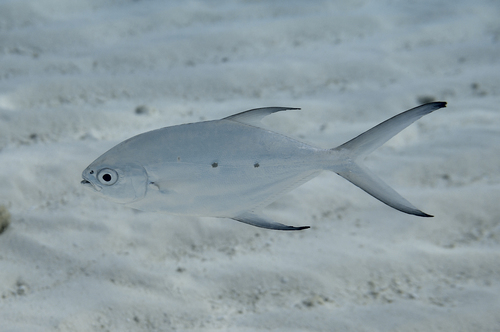
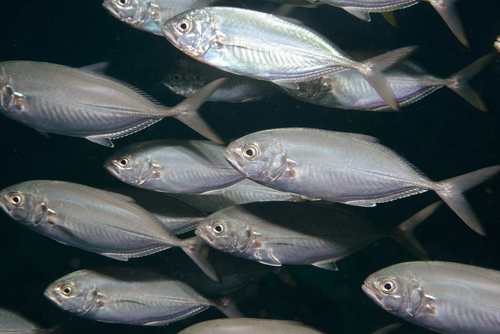
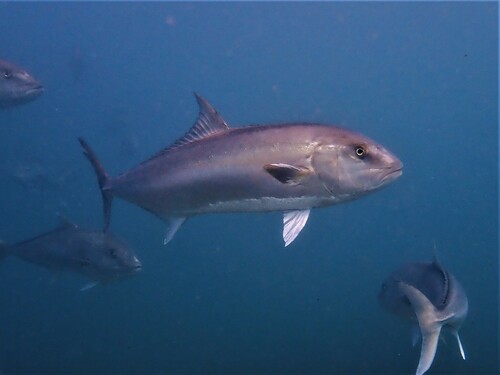
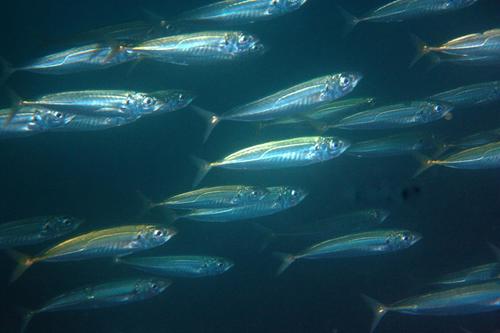
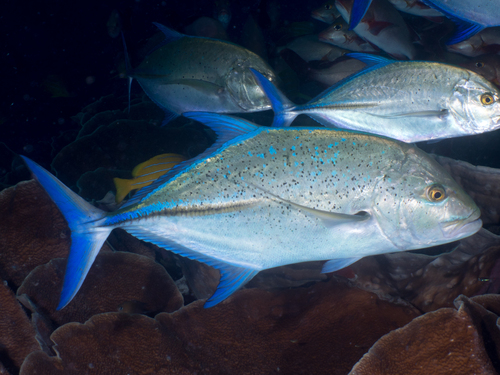
Caranx ruber, commonly known as the bar jack, is a moderately large jack fish species. It reaches a recorded maximum length of 69 cm (27 in) and maximum weight of 6.8 kg (15 lb), but individuals are most commonly found at lengths less than 40 cm (16 in). It has the typical body shape of most jacks: an elongate, moderately deep, compressed form, with dorsal and ventral profiles of approximately equal convexity. Its dorsal fin is split into two sections: the first holds 8 spines, while the second holds 1 spine followed by 26 to 30 soft rays. The anal fin is made up of 2 anteriorly detached spines, followed by 1 spine and 23 to 26 soft rays. Both the anal fin lobe and the soft dorsal fin lobe are slightly elongated. The pectoral fins are falcate, longer than the head, and contain 19 to 21 soft rays. The lateral line is moderately arched in its anterior section, has 17 to 104 scales including 23 to 29 scutes posteriorly, and has bilateral paired caudal keels. The entire chest is covered in scales, a trait that easily distinguishes the bar jack from the similar crevalle jack, Caranx hippos. The bar jack has a moderately pointed snout. Both jaws hold narrow bands of villiform teeth, which become wider toward the front of the mouth. The upper jaw also has an outer row of enlarged recurved teeth. There are 10 to 14 gill rakers on the upper limb and 31 to 38 on the lower limb, and the species has 24 vertebrae. The upper body of the bar jack is gray to grayish blue with a silvery tint, fading ventrally to a white belly. As the common name suggests, adult bar jacks have a horizontal stripe running along their back and through the lower lobe of the caudal fin. This stripe is golden brownish to blackish, and often has an electric blue bar running parallel to it directly underneath. All other fins are pale dusky to hyaline. Juveniles have up to 6 dark bands across their body, and the lower caudal lobe is darker than the upper lobe, which foreshadows the stripe that develops later in life. In this juvenile stage, bar jacks are difficult to distinguish from Carangoides bartholomaei, and gill raker counts are the most reliable identifying feature. The entire body of the bar jack has been observed changing to a blackish color when the fish is feeding near the bottom. The bar jack is widely distributed across the tropical and subtropical waters of the western Atlantic Ocean, and is common throughout most of its range. Its northernmost range limit is New Jersey in the northern United States, and its range extends south along the continental coast to Venezuela. It also inhabits a number of offshore islands and archipelagos, including Bermuda and the West Indies. The species is most abundant in the Gulf of Mexico, the West Indies, and the Caribbean; in the Gulf of Mexico, it is limited to offshore waters. There are reliable reports of the species from Rio de Janeiro in Brazil and far offshore at Saint Helena in the south central Atlantic, which would extend the species' southern limit significantly if confirmed. The bar jack generally lives in clear shallow water environments, predominantly around coral reefs to depths of around 18 m (60 ft). Tagging studies show the species is highly mobile, does not stay on one reef patch for long, and often moves between reefs across large stretches of sand. Bar jacks often move into lagoons from seaward reefs, preferring to travel over sandy substrate in these shallow waters, and frequently form shoals alongside barracudas, stingrays, and sharks. Unlike most fish that occupy both lagoon and reef habitats, there is no age-based habitat partitioning here: both juveniles and adults enter lagoons to forage. Records of bar jacks from Saint Helena come from seamounts in waters deeper than 100 m (330 ft), indicating the species also lives in more offshore pelagic waters. Juveniles are often found underneath floating sargassum mats, using the algae for protection. They also live in areas around docks and pilings, and can be caught with a sabiki rig. The bar jack spawns twice each year, with this timing tied to seasonal changes. During peak feeding periods, the fish accumulate body fat to prepare for spawning. In Cuba, spawning occurs between March and August, with peaks in March–April and June–July. Fish gather in hundreds-strong schools to spawn, and individual pairs break away from the school to spawn. Each female releases between 67,000 and 231,000 eggs, and fertilization happens externally. The eggs are pelagic, around 0.75 mm to 0.85 mm in diameter, and hatch when larvae reach approximately 2 mm in length; caudal flexion occurs when larvae are 4–5 mm long. The larval stage of the bar jack has been extensively described by Richards (2006). Larvae appear between April and October in the Gulf Stream current, and grow fastest during their first three years of life. In this early life stage, they are very similar to Carangoides bartholomaei, and often associate with floating pelagic Sargassum mats that provide young fish with protection. Young fish typically inhabit shallow reef waters, and move offshore once they reach sexual maturity. No published studies exist on the growth of the bar jack, due to a lack of discernible otolith rings. Males and females reach sexual maturity at different lengths: males reach maturity at 25 cm (9.8 in), and females at 31 cm (12 in).