About Caranx papuensis Alleyne & Macleay, 1877
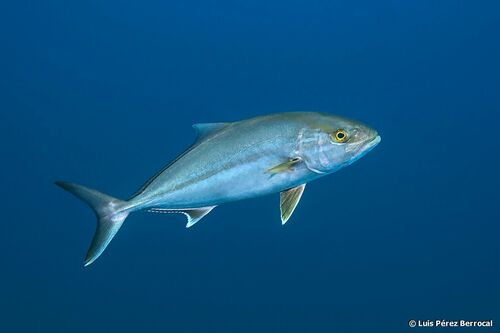
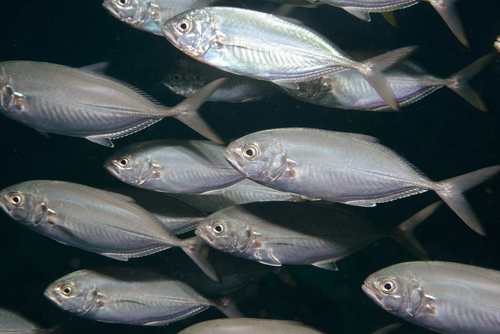
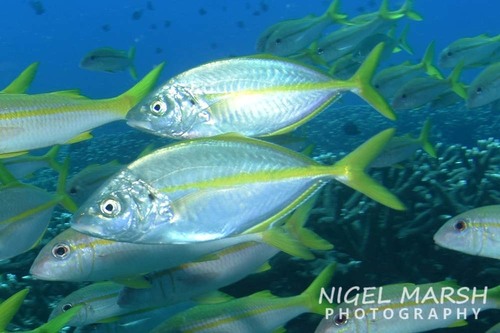
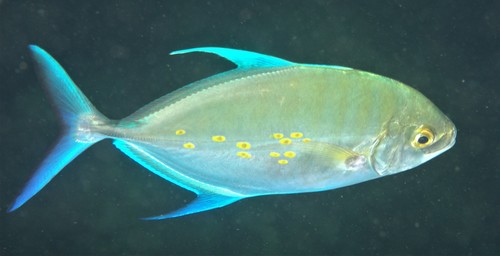
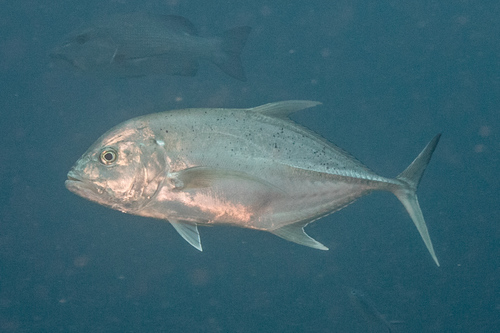
The brassy trevally, Caranx papuensis, is a large fish species that reaches a known maximum size of 88 cm in length and 6.4 kg in weight. As its common name suggests, this species has a brassy to yellow-greenish color on its dorsal (upper) side, fading to silvery white on its underside. Juvenile brassy trevally are entirely silver, and generally do not have the characteristic brassy tinge of adults. Small black spots are scattered across the head and the part of the body above the lateral line; occasionally, a small number of these spots appear much lower, near the pectoral fins. The number of these black spots increases as the fish ages. Brassy trevally also have a prominent pale silvery-white shoulder spot with black margins, located near the upper opercle. All fins are yellow to dusky, except for the caudal fin: the caudal fin has a dusky upper lobe, a dusky to yellow lower lobe, and a distinct narrow white band along its trailing edge. This species is often mistaken for the giant trevally, Caranx ignobilis, but can be easily distinguished by its lighter dorsal coloring and high number of black spots. Like other jacks in its genus, it has a compressed, oblong body, with a dorsal profile that is more convex than the ventral profile, particularly in the front section of the body. Its dorsal fin is split into two distinct parts: the first part has eight spines, and the second part has one spine and 21 to 23 soft rays. The anal fin has two anteriorly detached spines, followed by one spine and 16 to 19 soft rays. Pelvic fins have one spine followed by 19 to 20 soft rays. The lateral line has a moderate anterior arch, with 53 to 61 scales in the arched section; the straight section of the lateral line holds zero to three scales and 31 to 39 strong scutes. The ventral side of the breast is mostly without scales, except for a small patch of scales located in front of the pelvic fin. The species has weakly developed adipose eyelids. Its dentition features an outer row of widely spaced canines and an inner band of villiform teeth in the upper jaw, and a row of widely spaced conical teeth in the lower jaw. Brassy trevally have 26 to 30 gill rakers and 24 vertebrae. Brassy trevally are widespread across tropical and subtropical waters of the Indian and West Pacific Oceans. Their range extends from South Africa and Madagascar north along the East African coast, but there are no recorded observations of this species in the Red Sea or Persian Gulf. Records of the species resume starting from India, and extend eastward through Southeast Asia, the Indonesian Archipelago, and numerous Indian Ocean and West Pacific island groups. The species has been recorded as far south as Sydney, Australia, and as far north as the Ryukyu Islands of Japan. Its range extends eastward to the Marquesas Islands in the central Pacific. Brassy trevally can live in both inshore and offshore environments. Adults predominantly live on the seaward side of reef complexes or on deepwater pinnacles. Other confirmed habitats include rock outcrops in sandy bays and lagoons. Juveniles are most often found in tidal mangrove-lined creeks with turbid water, and also occur in estuaries across the species' range, occasionally moving into the upper reaches of rivers.