About Caranx latus Agassiz, 1831
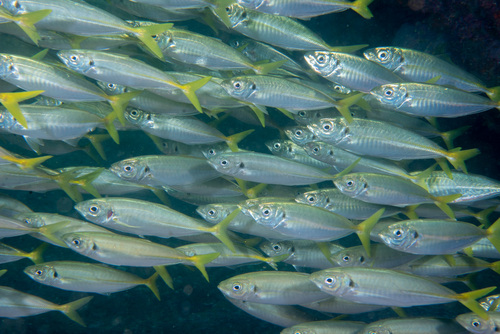
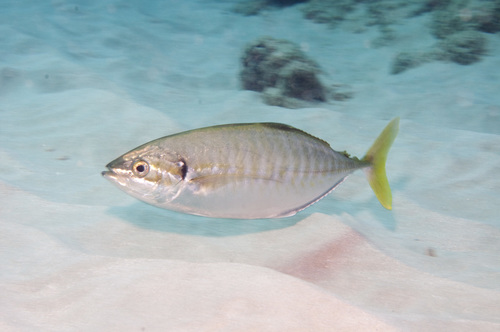
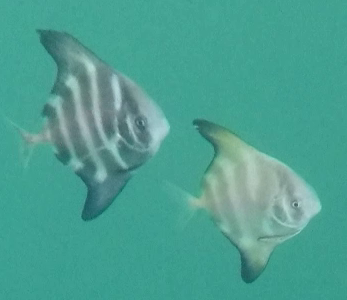
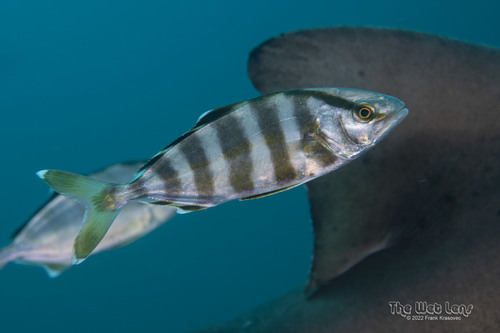
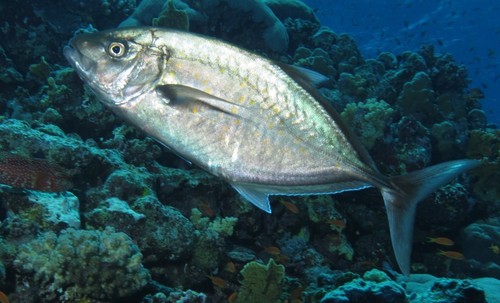
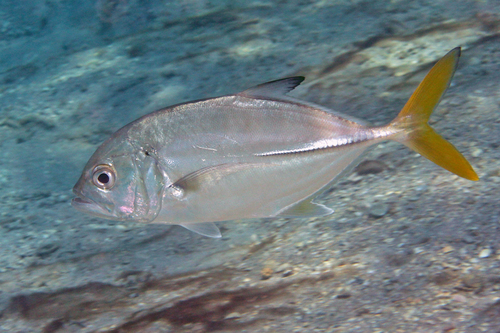
Caranx latus (Agassiz, 1831), commonly called the horse-eye jack, is a large fish. It reaches a maximum recorded length of 101 cm and maximum recorded weight of 13.4 kg, but most individuals are shorter than 60 cm. Its body shape matches other large jacks found in its range: it is moderately compressed, elongate, and deep. The dorsal profile has a stronger curve toward the head, and the forehead is less blunt than that of the crevalle jack. Its eyes are large relative to the head, and are covered by a well-developed adipose eyelid. The back edge of the jaw sits vertically under or past the back edge of the eye. The dorsal fin is split into two sections: the first has 8 spines, and the second has 1 spine followed by 19 to 22 soft rays. The anal fin has two detached spines at the front, followed by 1 spine and 16 to 18 soft rays. The lobes of the soft dorsal and anal fins are elongated, while the pectoral fin is falcate and longer than the length of the head. The lateral line has a prominent, moderately long anterior arch. The straight section of the lateral line holds 32 to 39 very strong scutes, and bilateral keels are present on the caudal peduncle. The entire chest is covered in scales. The upper jaw holds a series of strong outer canines, with an inner band of smaller teeth, while the lower jaw has a single row of teeth. The species has a total of 22 to 25 gill rakers, and 24 vertebrae. Like the crevalle jack, the horse-eye jack is known to develop hyperostosis in parts of its skeletal structure. Adult horse-eye jacks are typically dark blue to silvery-blue on their upper bodies, fading to silvery white to golden on their lower bodies. In some individuals, the tip of the soft dorsal fin lobe and the scutes may be dark blue to black. The caudal fin ranges from yellow to dusky in color. Unlike the crevalle jack, the horse-eye jack has no dark spot at the base of the pectoral fin, though it may have dark spots on the gill covers. Juveniles have a series of about five dark vertical bars on their flanks that fade as the fish ages. The horse-eye jack is commonly found in the subtropical Atlantic Ocean, ranging from Bermuda and the northern Gulf of Mexico south to Rio de Janeiro. In the eastern Atlantic, it occurs from St. Paul's Rocks to Ascension Island, and is rarely found in the Gulf of Guinea. It is a pelagic fish, and can be found around reefs and offshore oil rigs. Juveniles live closer to shore along sandy and muddy bottoms. The species may enter brackish waters and survive in river mouths, but it is most often found in saltwater at depths up to 140 m. Adult horse-eye jacks usually swim in schools, which may be made up only of horse-eye jacks or mixed with crevalle jack. The fish may sometimes swim in a pair with individuals of completely different species, such as Halichoeres radiatus, a type of wrasse.