About Caranx fischeri Smith-Vaniz & Carpenter, 2007
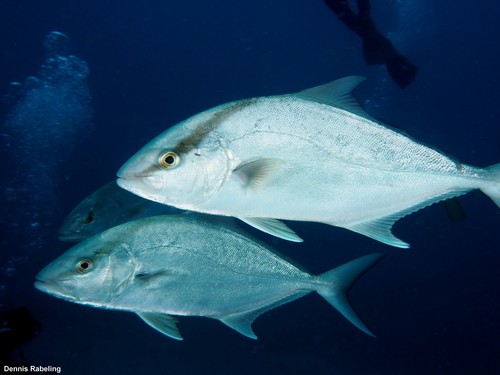
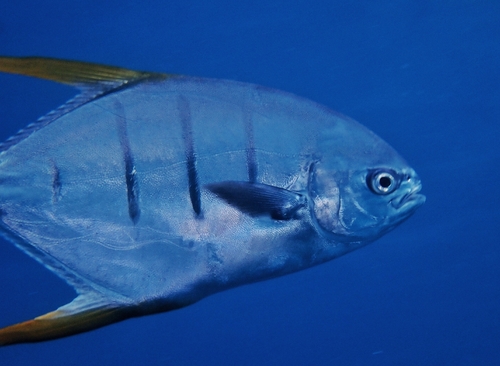
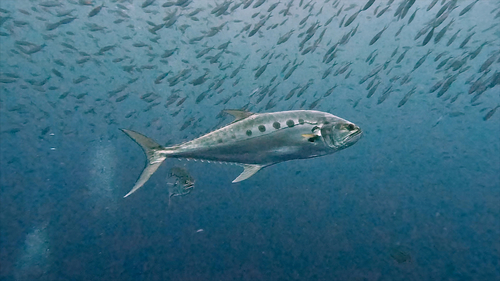
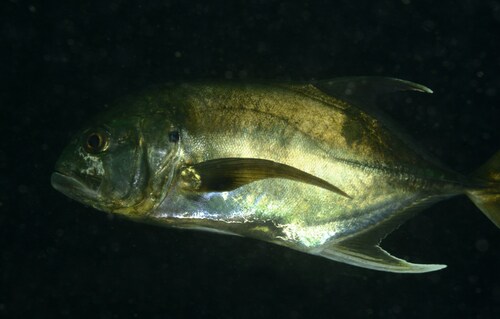
The longfin crevalle jack (Caranx fischeri) is a large fish species. The maximum recorded size from the original species description by Smith-Vaniz and Carpenter is 53 cm, but the same publication’s discussion of the species’ angling value notes it grows significantly larger, with anglers who mistook it for Caranx hippos recording individuals up to 127 cm. Its body profile matches that of most large species in the genus Caranx: it has a strongly compressed, roughly oblong body shape. The dorsal body profile is much more convex than the ventral profile, and it has a quite slender caudal peduncle. The dorsal fin is split into two parts: the first part has 8 spines, and the second has 1 spine followed by 21 to 24 soft rays. Slightly elongated dorsal and anal fin lobes distinguish this species from the similar crevalle jack. The anal fin has 2 detached spines positioned anterior to the main fin, which consists of 1 spine followed by 17 to 19 soft rays. The lateral line is moderately arched in its anterior section, which holds 50 to 73 scales; the straight posterior section of the lateral line holds 0 to 16 scales and 24 to 41 scutes. The breast is completely scaleless up to the origin of the pelvic fins, and a narrow band of scales separates the scaleless breast area from the base of the pectoral fins. This species has 20 to 25 total gill rakers and 24 vertebrae. Its dorsal coloration ranges from olive to greenish blue, fading to pale white on its ventral side. The dorsal fin is dark brown to grey, the anal fin is brownish yellow turning white toward its lobe, the caudal fin is brown-yellow, and the pelvic fins are white. It has a dark spot on both its opercle and its lower pectoral fin rays. The longfin crevalle jack lives in subtropical waters of the eastern Atlantic Ocean, and its currently confirmed range extends from Mauritania south to at least Moçamedes in southern Angola. Publications describing historical fish specimens collected in the Mediterranean confirm the species was present in this region, though no recent specimens have been recorded there. The species is capable of traveling long distances: one adult was collected from Ascension Island in the mid-Atlantic. Based on limited available data, the longfin crevalle jack is primarily an inshore species, but captures like the Ascension Island individual suggest it may also live pelagically. In inshore environments, it has been recorded from reefs and estuarine environments, and it may penetrate the upper reaches of rivers. Because the species was only recently described and was previously confused with C. hippos, the details of its biology are not well understood. All crevalle jack species are confirmed to be powerful predators that feed on a variety of small schooling fish, including herrings, other carangids, and porgies from the family Sparidae. Small jacks, which likely include C. fischeri, also feed on invertebrates such as shrimp and crabs. Little is known about its reproduction, and spawning may take place in estuaries and rivers.