About Caranx caninus Günther, 1867
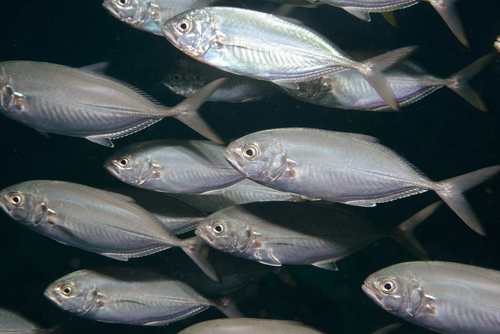
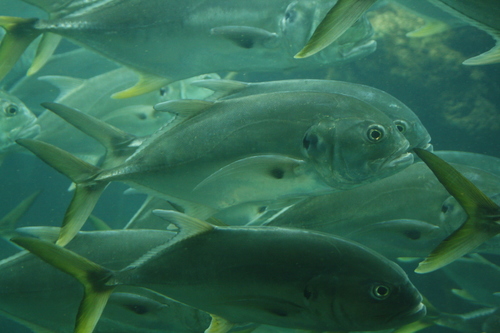
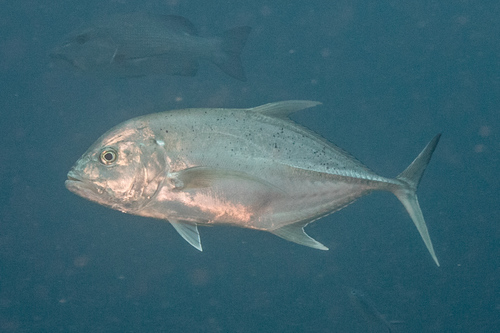
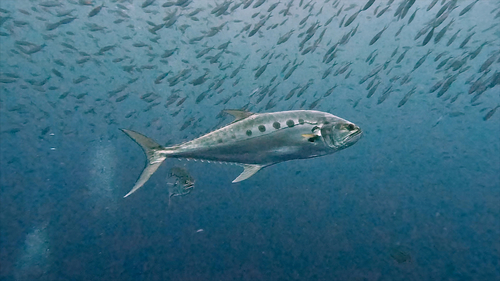
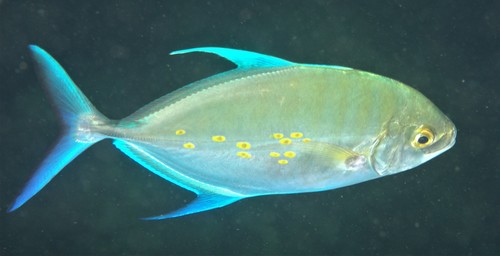
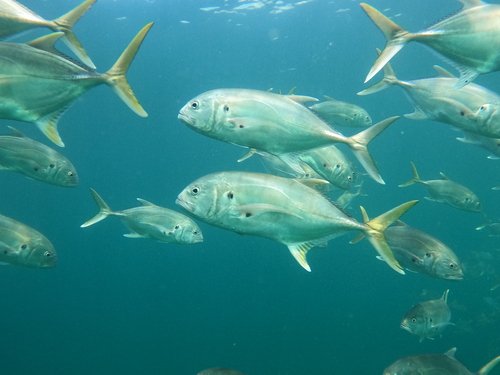
Caranx caninus, commonly known as the Pacific crevalle jack, is a relatively large fish that reaches a recorded maximum size of 101.6 cm in length and 19.7 kg in weight. Like most other jacks in the genus Caranx, it has a moderately deep, compressed oblong body. The dorsal profile of the body is more convex than the ventral profile, especially in the anterior portion. The dorsal fin is split into two distinct sections: the first section contains eight spines, and the second section holds one spine plus 19 to 21 soft rays. The anal fin has two anteriorly detached spines, followed by one spine and 16 to 17 soft rays. Its pectoral fins are falcate and contain 19 to 21 soft rays, while the caudal fin is strongly forked. The species' lateral line has a moderate anterior arch, with 58 to 79 scales in the arched section; the straight posterior section of the lateral line holds zero to seven scales and 34 to 43 strong scutes. The breast is mostly scaleless, with the only exception being a small patch of scales located in front of the pelvic fins. The Pacific crevalle jack has well-developed adipose eyelids. Its dentition features an outer row of widely spaced canine teeth and an inner band of villiform teeth in the upper jaw, plus a row of widely spaced conical teeth on the lower jaw. It has 21 to 27 gill rakers and 24 vertebrae, and there are significant differences in hyperostosis development between this species and Caranx hippos. Dorsally, the Pacific crevalle jack ranges in color from bluish-green to bluish-black, fading to silvery white or golden ventrally. Juveniles are generally lighter in overall color, and have five dark vertical bars on their sides. Almost all fins are dusky white, but the anal fin and lower lobe of the caudal fin are white to brownish-orange; this color also extends to the ventral surface of the caudal peduncle. This coloration differs from C. hippos, which has bright lemon yellow anal and lower caudal fins. The Pacific crevalle jack also has a black spot at the base of its pectoral fins, and a dark blotch on the margin of the operculum. The Pacific crevalle jack lives in tropical to subtropical waters of the eastern Pacific Ocean. Its range runs along the western American coastline, from Lobos de Tierra Island, Peru in the south to San Diego Bay, California in the north. The species is generally rare north of the Gulf of California, but El Niño events carry warm tropical waters further north than usual, transporting Pacific crevalle jack and other species beyond their normal range. All recorded occurrences of the species in San Diego Bay have been linked to El Niño events in the year of observation. The species is also found at several offshore Pacific islands, including the Galápagos, Malpelo, Cocos, and Revillagigedo Islands. It is most common in coastal regions, though it occasionally occurs in more pelagic habitats, and has never been recorded living deeper than 350 m. In coastal waters, the species prefers sandy and rocky substrates, including protected bays, lagoons, and harbours, where it forms large schools. Larger individuals are often solitary, and live in deeper offshore environments. Pacific crevalle jack are also common in estuaries; juveniles typically prefer these environments, but adults also enter brackish waters and tidal streams. Juveniles are known to travel far upstream, showing that the species has a wide salinity tolerance. This fish is sold at markets fresh, frozen, smoked, salted, or dried, and is also processed into fishmeal and fish oil. Despite being caught in large numbers, the Pacific crevalle jack is considered a second or third-class commercial product, and fetches fairly low market prices. Its market value varies across its range depending on local opinion of the species. It is generally viewed as marginal table fare, though it is said that bleeding the fish immediately after capture improves its flavor.