About Carangoides orthogrammus (Jordan & Gilbert, 1882)
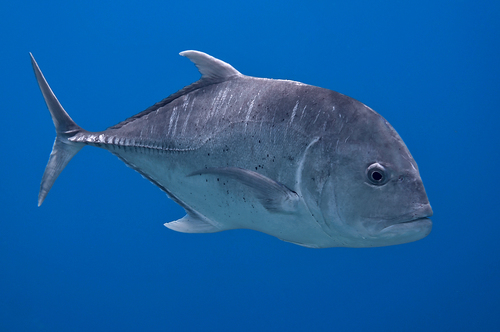
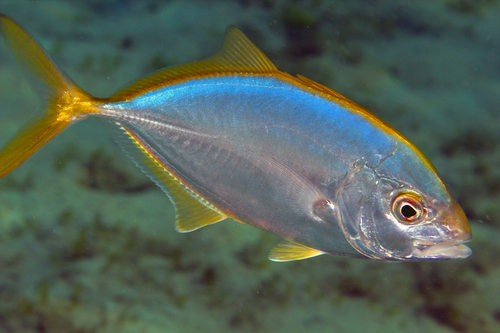
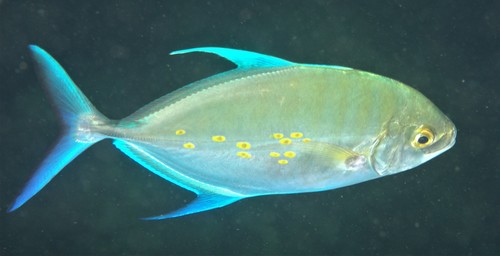
Carangoides orthogrammus, commonly known as the island trevally, is a moderately large fish that reaches a maximum recorded length of 75 cm and maximum recorded weight of 6.61 kg. It is quite similar to F. ferdau, but its prominent yellow spots act as a quick identifying feature. The island trevally has a compressed, oblong-shaped body, with a dorsal profile that is more convex than the ventral profile, and a usually slightly rounded snout. Its dorsal fin is split into two sections: the first has eight spines, and the second has one spine plus 28 to 31 soft rays. The lobe of the second dorsal fin is slightly falcate in younger individuals, and is always shorter than the head length. The anal fin has two detached spines, followed by one spine attached to 24 to 26 soft rays. The pelvic fin has one spine attached to 21 or 22 soft rays. The lateral line has a very slight anterior arch; the intersection of its straight and curved sections falls between the 15th and 19th soft rays of the dorsal fin. The curved section of the lateral line holds 96 to 106 scales, while the straight section holds 20 to 30 scales and 21 to 28 scutes. The ventral side of the breast is scaleless all the way to the origin of the pelvic fins, and often has a small patch of prepelvic scales. Laterally, this scaleless area of the breast is separated from the scaleless base of the pectoral fins by a moderate band of scales. Adult island trevally have notably fleshy lips, and both jaws hold narrow bands of villiform teeth that become obsolescent as the fish ages. In total, the species has 28 to 32 gill rakers and 24 vertebrae. The island trevally is pale blue-green on its upper body, fading to a more silvery color below. Adults have several large, elliptical yellow to brassy spots scattered across their bodies near the midline. Nine or 10 dark vertical bars may be present on the body from the head to the caudal peduncle. The soft dorsal, anal, and caudal fins range from pale brownish to brilliant blue, while all other fins are pale green to hyaline. The island trevally is distributed across the offshore tropical and subtropical waters of the Indian and Pacific Oceans. In the Indian Ocean, its range extends from Mozambique on the east coast of Africa north to the Gulf of Aden; it has not been recorded further north until India and Sri Lanka. In the eastern Indian Ocean, its range spans Southeast Asia, Indonesia, and northern Australia. In the Pacific Ocean, the species has been recorded from Taiwan, Japan, and Hawaii east to the Revillagigedo Islands off Mexico, as well as many Pacific islands. As its common name partly suggests, the island trevally is very rarely found on continental shelves. Instead, it lives around offshore islands formed by volcanic activity, or isolated fragments of continental material left behind from continental drift. These islands are often quite large, and have most of the geographic features found in continental environments, including beaches, reefs, lagoons, and even estuaries. The island trevally occurs in all of these habitats, as well as in slightly deeper seaward reefs up to 50 m deep. In Hawaii, the species is less often found inside protected bays, and more often found slightly further offshore, presumably due to competition with other fish species. The island trevally is one of several carangid species known to be attracted to man-made fish-attracting devices, which are installed to aggregate fish for anglers.