About Caragana halodendron (Pall.) Dum.Cours.
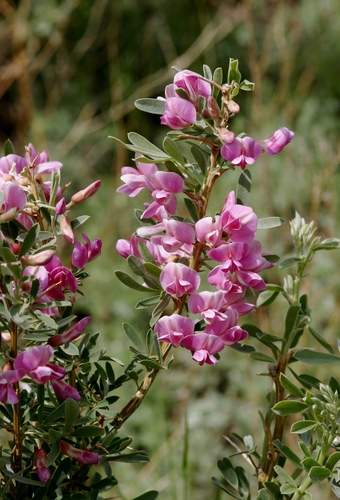
Caragana halodendron (Pall.) Dum.Cours. is a species of flowering plant in the pea family, Fabaceae. It has several common names, including common salt tree and Russian salt tree. It is native to Russia and southern Asia, and has been introduced to other continents, where it often grows as a noxious weed. This deciduous, spiny shrub can reach up to 3 meters in height, and spreads to a maximum width of a few meters. Its stems branch from the base, and grow clusters of around four leaflets on sharp spurs. The tips of branches narrow into spines. Flowers grow at the ends of spurs, in clusters of two to four pink, pea-shaped blossoms. Each blossom is 1 to 2 centimeters wide. The fruit is a black, woody, inflated pod around 2 centimeters long, which holds legume seeds. This plant has a deep, extensive root system, and lateral roots produce new shoots. This growth habit allows the plant to form large, dense thickets. When introduced to areas with suitable climates, such as California where it is classified as a known weed, it can invade cultivated land and spread relatively quickly. It is tolerant of saline soils.