About Caragana arborescens Lam.
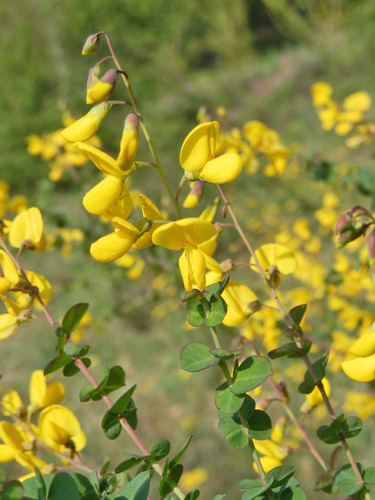
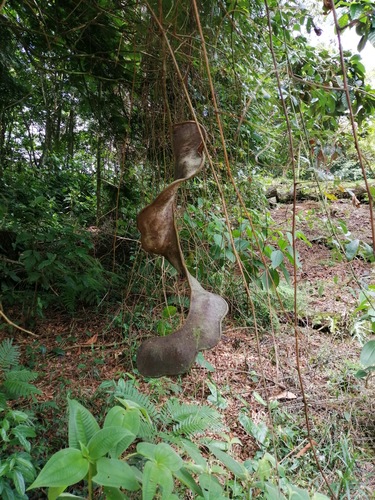
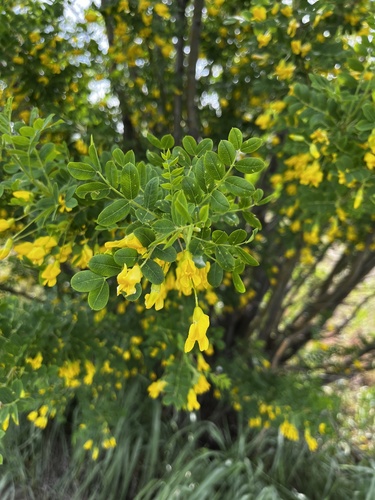
Caragana arborescens Lam. is a perennial shrub or small tree that reaches 2–6 m (6 ft 7 in – 19 ft 8 in) in height. It typically has a moderate to fast growth rate, and can grow one to three feet in the first year after trimming. Its leaves range from light green to dark green, are alternate and compound, and bear many small leaflets. Fragrant yellow flowers bloom in May or June, and its fruits are legumes containing multiple seeds that ripen in July. As the seed pods dry, they tend to twist and pop open to release their seeds. This plant tolerates a wide range of climatic conditions across locations in the United States, including Alaska, California, and New Mexico. It can live up to 140 years.
Caragana arborescens can be grown as an ornamental plant and has been widely used in windbreaks. It has an extensive root system, so it can be used for erosion control. It produces a very large number of seeds, which are small in size and bland in flavor. The seeds are edible for humans and chickens, though people should cook them before consumption. As a legume, it fixes nitrogen, and can neutralize soil to prepare it for further planting. It is suitable for single-row field windbreaks that require a dense, short barrier, and it is recommended for planting in the outer rows of multi-row windbreak plantings. Several songbirds use C. arborescens for nesting, but the songbirds rarely eat its seeds. The plant is not a preferred food source for browsing animals, but its fragrant flowers attract many pollen-consuming animals.