About Capsicum chinense Jacq.
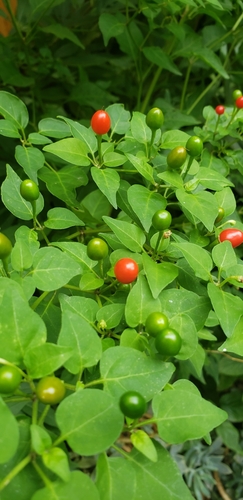
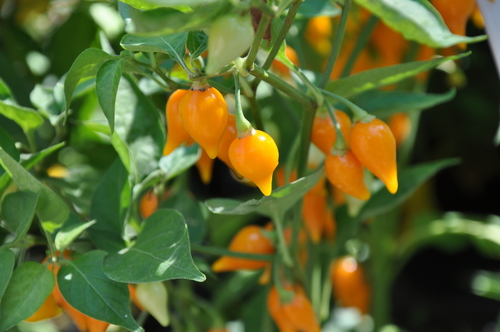
Capsicum chinense Jacq., commonly called habanero-type pepper, is a chili pepper species native to the Americas. Varieties of this species are known for their distinct flavors and often extreme heat. The world’s hottest peppers belong to this species; in 2023, the cultivar Pepper X measured 2.69 million Scoville heat units. Some taxonomists classify C. chinense as part of the species C. annuum, and it is a member of the C. annuum complex. C. chinense and C. annuum plants can sometimes be told apart by the number of flowers or fruit per node: two to five for C. chinense, and one for C. annuum, though this method is not always reliable. The two species can also hybridize to produce interspecific hybrids. C. frutescens may be the ancestor of the C. chinense species. Pinpointing the origin of C. chinense is difficult. Multiple studies by researchers McLeod, Pickersgill, and Eshbaugh place its center of origin in the tropical northern Amazon, ranging from southern Brazil to Bolivia. After originating there, it migrated to the Caribbean basin and Cuba. This history gave rise to the name "Habanero", which means "from Habana (Havana, Cuba)" – Havana was the port from which many peppers of this species were exported. Notably, despite this name, habaneros and other extremely spicy ingredients are rarely used in traditional Cuban cooking. In warm tropical climates, C. chinense is a perennial that can live for several years. In cooler climates, it does not usually survive the winter, but its seeds from the previous growing season readily germinate the following year. C. chinense seeds recovered from Central American cave dwellings show native peoples were consuming these peppers as early as 7,000 B.C. Dry pepper fruits and seeds from 9,000-year-old burials in Tamaulipas and Tehuacán in eastern Mexico also confirm human use of the species starting around 7,000 B.C. Domestication of C. chinense likely occurred between 10,000 and 12,000 years ago in central-east Mexico. The species has been cultivated for thousands of years in its native range, but has only been grown outside the Americas for roughly 400 to 500 years, after the Columbian Exchange. Artificial selection in new growing regions has produced new varieties that are now bred and farmed in Asia and Africa. Many home gardeners grow C. chinense both for its ornamental bright-colored fruits and for its edible peppers. For thousands of years, C. chinense and its varieties have been used in Yucatán and Caribbean-style cooking to add significant heat to traditional dishes. It is most often used in stews, sauces, and marinades for meats and chicken. These chiles are also sometimes used in American food. For example, habaneros, which are a group of C. chinense varieties, are commonly used in hot sauces and extra-spicy salsas, due to the widespread popularity of Tex-Mex and Mexican cuisines in American culture.