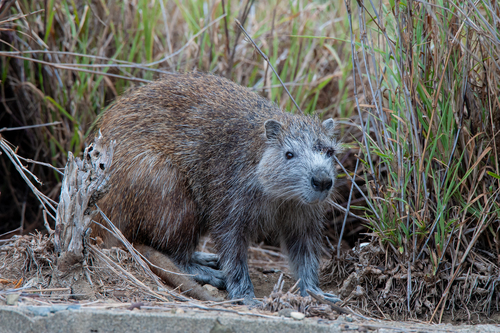
About Capromys pilorides (Say, 1822)
Desmarest's hutia (Capromys pilorides, first described by Say in 1822) has a head-and-body length of 31–60 cm (12–24 in), a tail length of 14–29 cm (5.5–11.4 in), and a body weight of 2.8–8.5 kg (6.2–18.7 lb). It has thick, coarse fur that covers its body all the way to the tip of the tail. Body fur colour ranges from black to brown, with individuals also showing light sand colour and red fur. It has a stocky build and short legs. It typically moves with a slow, waddling gait, but can make a quick hop when it is being pursued. Each of its feet has five toes with large claws that help the animal climb. The stomach is split into three distinct compartments by gut constrictions, making it one of the most complex stomachs among all rodents. This species has a karyotype with 2n = 40 and FN = 64. Desmarest's hutia occupies a wide variety of habitats. Populations in northern Cuba are generally concentrated in areas with abundant mangroves, while southern populations prefer more terrestrial habitats. The species is abundant in Guantánamo Province, especially around the Guantanamo Bay Naval Base. Populations of Desmarest's hutia are declining in the mountainous areas of eastern Cuba. Desmarest's hutia is endemic to Cuba, where it is widespread across its range. It occurs on Cuba's main island, Isla de la Juventud, the Sabana archipelago, the Doce Laqunas archipelago, and many other islands and cays of the Cuban archipelago. An extinct subspecies, C. p. lewisi, once lived in the Cayman Islands before it went extinct shortly after European colonization. This subspecies may have been what Francis Drake described when he visited the islands, writing of "little beast-like cats" and "coneys" found across the area. Desmarest's hutias usually live in pairs, but can also occur alone or in small groups. They are diurnal and do not dig burrows; instead, they rest at night in hollows in rocks or trees. They are omnivorous, but their diet consists mostly of bark, leaves and fruit. They will occasionally prey on small vertebrates such as lizards. Both males and females use urine to scent mark their territories. They breed year-round, with a gestation period of 110 to 140 days, most commonly 120 to 126 days, though the peak breeding season falls in June and July. They typically give birth to between one and three young, which have an average weight of 230 g (8.1 oz). The young are precocial: they are born with fur, fully open eyes, and the ability to walk. They are weaned at around five months old and reach sexual maturity at around ten months old. Individuals kept in captivity live for eight to eleven years.

