About Caprodon longimanus (Günther, 1859)
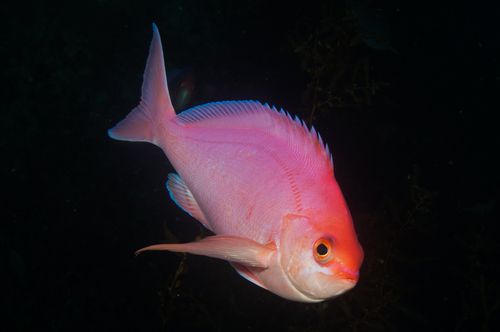
Caprodon longimanus, commonly called the pink maomao, has a distinct set of physical traits. It has long, pointed pectoral fins that are longer than the fish’s head, a long-based dorsal fin, and a slightly forked caudal fin. The dorsal fin has 10 spines and 19-21 soft rays, while the anal fin has 3 spines and 7-9 soft rays. Specimens from the eastern Pacific have 58-65 scales along the lateral line, while specimens from the western Pacific have 61-71 lateral line scales. Females are an overall mauvish pink in colour; males share this similar base colour, but may develop blackish blotches on the back, upper flanks, and dorsal fin, and males also have yellowish dorsal, caudal, anal and pelvic fins. The maximum recorded fork length for this species is 55 centimetres (22 in), but most individuals have a fork length of 28–30 centimetres (11–12 in). They normally weigh around 1 kilogram (2.2 lb), and can reach a maximum weight of 2 kilograms (4.4 lb).
The pink maomao has a wide distribution across the Pacific and southeastern Indian Oceans. It occurs in the southeastern Indian Ocean off Rottnest Island in Western Australia; in the southwestern Pacific off eastern Australia, ranging from Coffs Harbour to Bermagui in New South Wales, as well as around the Tasman Sea’s Lord Howe Island and Norfolk Island; around New Zealand from the Kermadec Islands south to D'Urville Island and Kaikōura, and is especially common around the North Island. It is also found in the southeastern Pacific around Easter Island, the Juan Fernández Islands, the Nazca Ridge, and Isla Salas y Gómez, and has been reported from the Hawaiian Islands.
This species inhabits areas near inshore reefs, and lives both a benthopelagic and benthic lifestyle. It can also be found on the outer edge of the continental shelf and around seamounts. It feeds on zooplankton and small swimming organisms. Stomach content analysis of individuals caught around Chile’s Juan Fernandez Islands found this species feeds opportunistically. The most common prey item was salps of the genus Thalia, but the analysis also identified 17 genera of consumed crustaceans, alongside pteropods, chaetognaths, and polychaetes. During the day, pink maomao form schools, which are often mixed with silver trevally (Pseudocaranx georgianus), yellowtail horse mackerel (Trachurus novaezelandiae), and blue mackerel (Scomber australasicus). They retreat to rocky areas to spend the night. Pink maomao are protogynous hermaphrodites: all individuals hatch as females, and some may later change sex to become male. Juvenile fish are only rarely observed, suggesting this species breeds infrequently and produces low numbers of offspring.