About Caprimulgus tristigma Rüppell, 1840
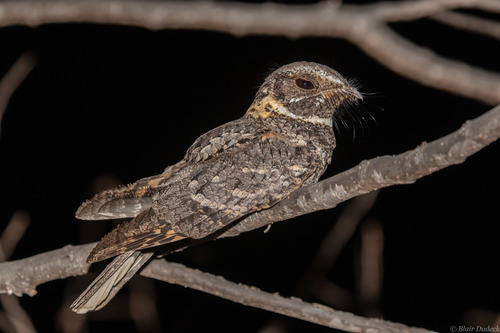
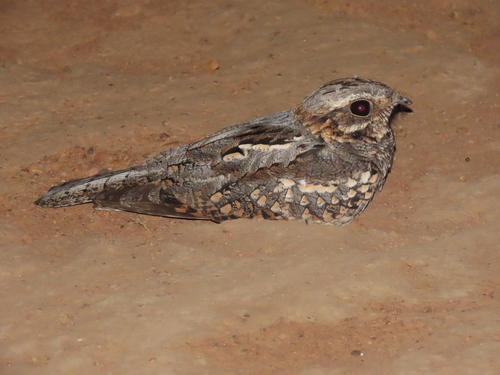
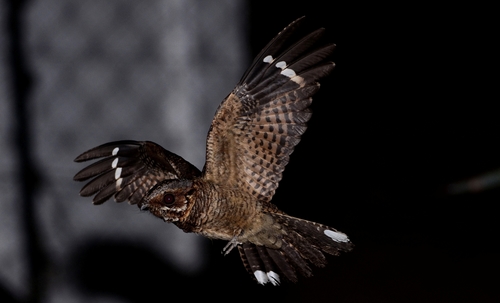
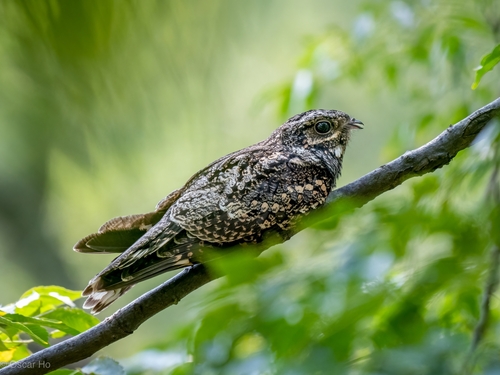
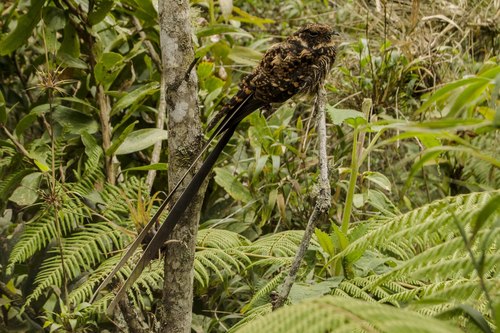
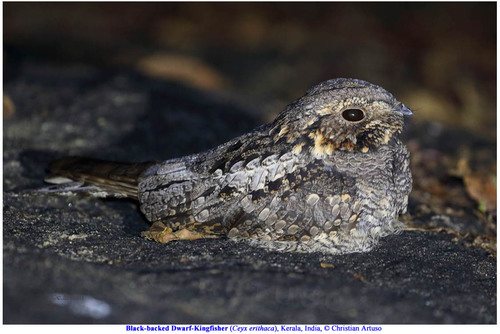
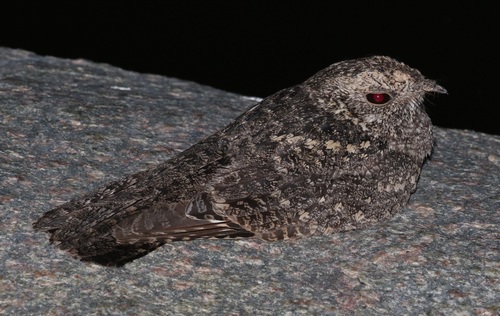
The freckled nightjar (Caprimulgus tristigma Rüppell, 1840) is a large, powerfully built nightjar species with long wings and relatively short tails. It has no prominent markings, and appears dark gray or nearly black when viewed from a distance. When viewed up close, adult upperparts show visible freckling in white, cinnamon, and pale buff. The species' underparts are typically dark brown, with a barring pattern of whitish and cinnamon. Its plumage gives excellent camouflage against rocky surfaces. This species is sexually dimorphic. In flight, males have small white spots on the four outer primaries, and their two outer tail feathers have white tips. Females have 3 to 4 smaller white spots on their outer primaries, and have no white coloring on their outer tail feathers. For both sexes, the white spots are generally not visible when the wings are folded. This species occurs across sub-Saharan Africa in localized populations. It is scarce in western Africa, and is more common in eastern Africa. In the southern part of the continent, it is a year-round resident of colder and drier areas, and is most common in Zimbabwe, northern and eastern Botswana, western Mozambique, and eastern South Africa. It has been recorded in Angola, Benin, Botswana, Burkina Faso, Burundi, Cameroon, Central African Republic, Republic of the Congo, Democratic Republic of the Congo, Ivory Coast, Eswatini, Ethiopia, Gabon, Ghana, Guinea, Kenya, Liberia, Malawi, Mali, Mozambique, Namibia, Niger, Nigeria, Rwanda, Sierra Leone, South Africa, South Sudan, Tanzania, Togo, Uganda, Zambia, and Zimbabwe. This species is monogamous, with fairly long-lasting pair bonds; one recorded pair bond lasted for 3 years. Individuals tend to show strong site fidelity, and often re-use the same nesting sites each year. It is a rupicolous breeder, meaning it nests in barren, natural hollows within rock formations that may be partially shaded or completely unshaded. Wind-blown plant matter and rock chip debris often fill these nesting hollows. In eastern Africa, the egg-laying season runs from September to November or from May to June, depending on the region. In southern Africa, egg-laying generally takes place between August and December, with a peak from September to November. In Nigeria, egg-laying occurs between January and May. If the first clutch is lost, the species usually lays a replacement clutch. It may also lay a second clutch after the first brood has fledged. Females lay clutches of two eggs on successive days. Incubation lasts between 18.5 and 20 days; incubation is performed by females during the day, and partially by males during the night. The young become quite mobile within 24 hours of hatching, and are cared for by both parents. The female broods during the day, while at night she alternates with the male to brood and feed nestlings. Chicks are very well camouflaged and blend in with the surrounding rocks. They take their first flight when they are 19 to 20 days old.