About Caprimulgus pectoralis Cuvier, 1816
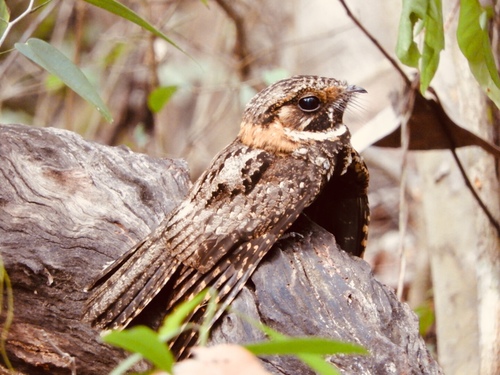
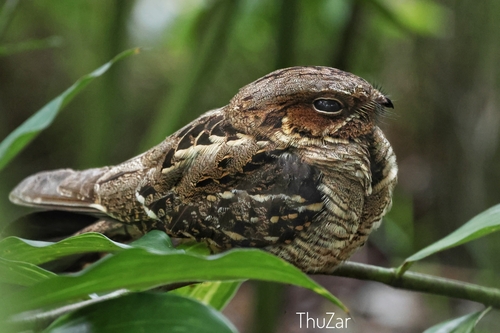
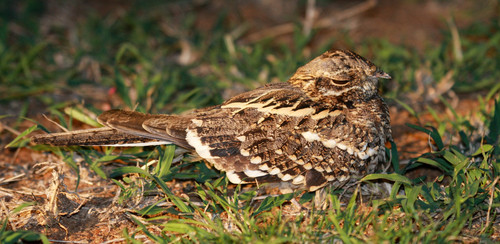
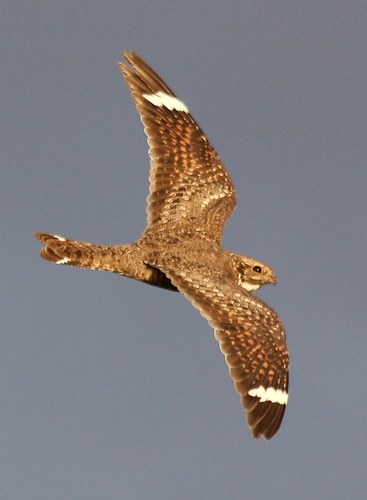
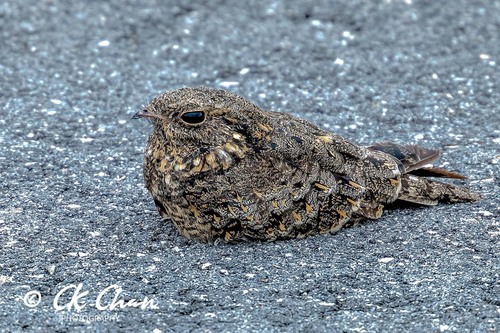
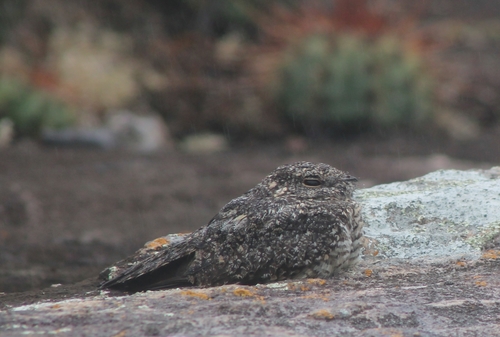
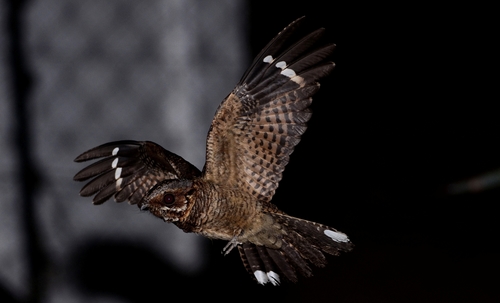
An adult fiery-necked nightjar (Caprimulgus pectoralis Cuvier, 1816) is relatively small, measuring between 23 and 25 centimeters. Their plumage is mostly a variegated mix of grayish-brown and brownish-white. The species has a distinct rufous (tawny) collar of feathers at the back of the neck, which gives it its common name. They have a large white throat patch, and the feathers around their eyes and at their shoulders are chestnut brown. They have a light-colored crown on the top of their head, with a darker spot at the center. Black spots run down either side of the scapulas. Their underfeathers are brown, speckled and barred with brownish white. Their tail is roughly square-shaped. This species has a dark-colored beak and entirely black eyes. It is also sexually dimorphic: males have white spots on the four outermost primary wing feathers and white tips on the two outermost tail feathers, while these markings are much smaller and slightly more buff-colored in females. Like other nightjars, fiery-necked nightjars have long, stiff hair-like rictal bristles around their beak, which is usually a distinguishing feature for the group. These bristles can grow up to 20 mm long, and birds can have up to 8 bristles on either side of the face. On newly hatched chicks, rictal bristles take 18 days to fully grow. The bristles are pale ivory colored at the base and darker at the tips. Bristles above the beak curl upwards to protect the bird's eyes, while those below curl downwards to help the bird catch prey. Fiery-necked nightjars also have a pectinate claw on their middle toe, with 9 bristles each, that lets the bird comb its feathers during preening. Fiery-necked nightjar chicks are semi-precocial, meaning they are roughly mature and mobile immediately after hatching. As a result, they are born with a thin covering of downy plumage: this plumage is gray down marked with dark brown stripes that run from the bill, through the eyes, across the wings and along the dorsal tracts, joining at the preen gland. They also have russet-colored plumes on their face and wings, plus fuzzy light-colored plumes on the crown of their head. Newly hatched chicks measure roughly 5 cm and weigh about 5 grams. The fiery-necked nightjar is widely distributed across most of south-eastern Africa, including South Sudan, Kenya, central Tanzania, Congo, the Democratic Republic of Congo, Angola, Namibia, Botswana, and South Africa. It has also been recorded in some central and west African countries: Gambia, Senegal, western Sierra Leone, Nigeria, and Cameroon. The species is found only within the African continent. It returns to the same breeding location every year for breeding season, but never travels far from its home range. It is a terrestrial bird species, most commonly found in forests, savannas, shrublands, and grasslands. It is most frequently encountered in Brachystegia-dominated woodland savannas, but also occurs in other deciduous woodlands across southern Africa. It can also be found in acacia scrublands, eucalyptus plantations, and sometimes in suburban gardens surrounded by trees. The fiery-necked nightjar is an insectivore, feeding primarily on insects. Individuals have been recorded eating species from almost every insect family, though they prefer certain types of insects. Analysis of the species' diet finds that butterflies, moths, beetles, cockroaches, termites, and mantids are the most common prey items. To forage, the fiery-necked nightjar uses a hunting technique called hawking: it swoops off a perch to catch flying insects mid-flight. When feeding newly hatched chicks, parents only feed chicks after the chick grasps the parent's beak.