About Caprimulgus longipennis Shaw, 1796
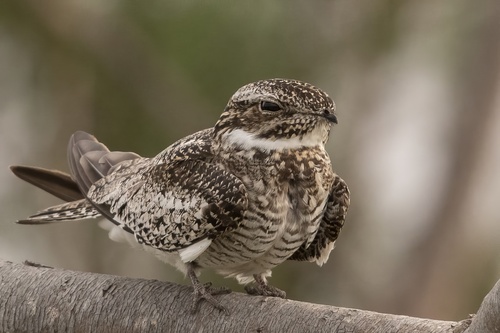
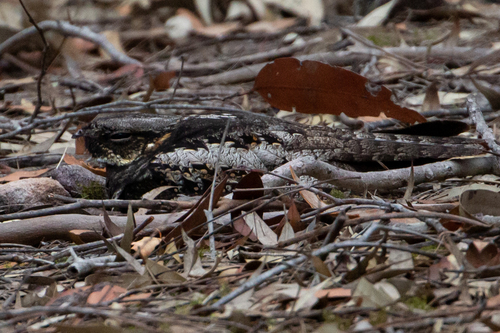
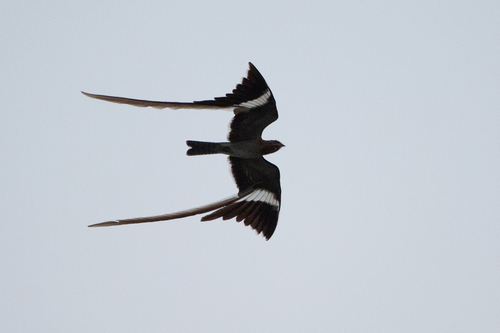
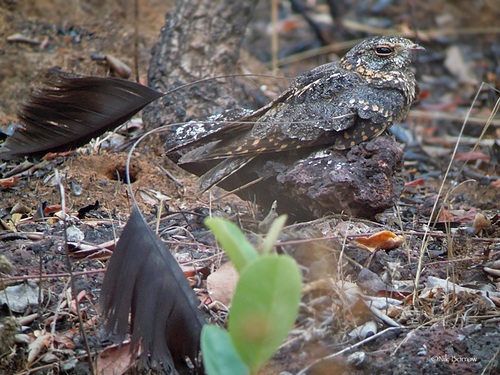
This species is a medium-sized nightjar, measuring 20–23 centimetres (7.9–9.1 in) in length. When roosting on the ground during the day, its plumage is mainly variegated grey, with a browner collar. It has a shadowy body shape, with easy, silent flight that resembles a moth's. It is relatively short-tailed, and has no white markings in its wings or tail. Its song is a churring trill. During the breeding season, adult males grow specialized ornamental feathers: a broad secondary flight feather on each wing that elongates to up to 53.5 centimetres (21.1 in), over twice the length of the bird's entire body. In normal flight, these elongated feathers trail behind the bird, but they are held upright like standards during display flight. Researchers have hypothesized that these large feathers evolved through intense sexual selection. Outside of the breeding season, females can be distinguished from males by their smaller size, and their similarity to the pennant-winged nightjar, most notably a white patch on the throat and dark barring on the belly. The standard-winged nightjar is a resident breeder across Africa, ranging from southern Senegal eastward to Ethiopia. It spends the non-breeding season in the Sahel region to the north. Its occupied habitats include lightly wooded savanna with scattered scrub, and agricultural land located within thickly wooded savanna. It has been recorded at elevations as high as 2,030 metres (6,660 ft) in Ethiopia, but most commonly occurs from sea level up to 1,400 metres (4,600 ft) in elevation. Standard-winged nightjars are migratory, and travel to and from their breeding grounds each year. The exact timing of the breeding season varies by region, and is influenced by prey availability and rainfall. Southern populations breed earlier than populations located further north. The global population of the standard-winged nightjar is not considered threatened, and the species is listed as Least Concern on the International Union for Conservation of Nature (IUCN) Red List.