About Caprimulgus europaeus Linnaeus, 1758
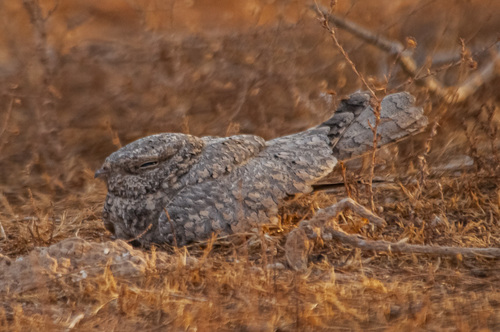
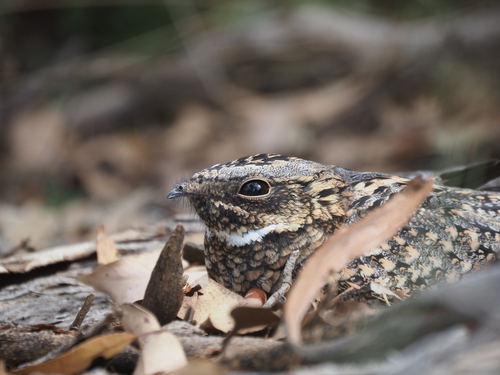
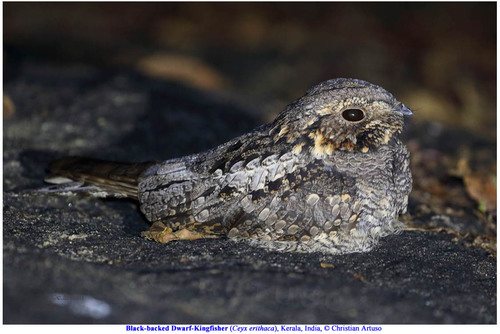
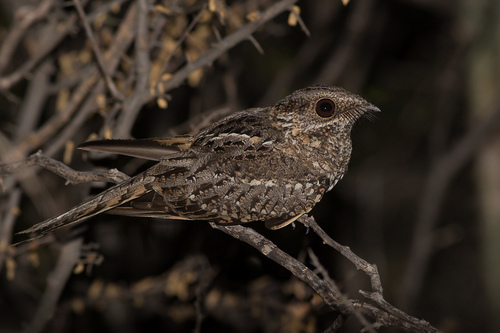
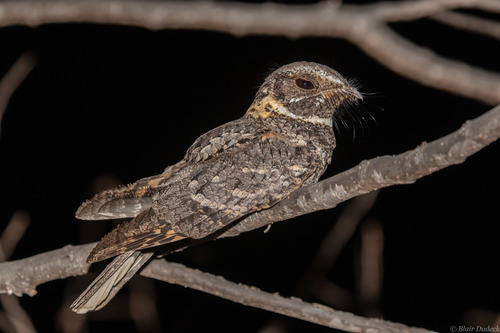
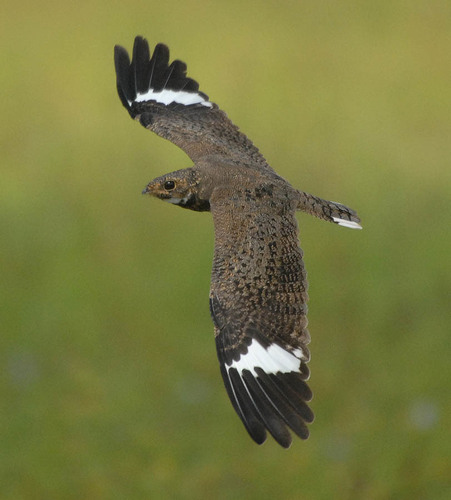
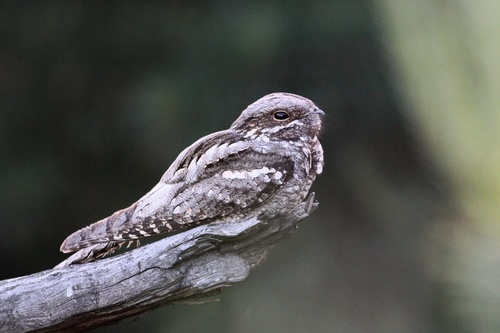
The European nightjar (Caprimulgus europaeus Linnaeus, 1758) measures 24.5–28 cm (9.6–11.0 in) in length, with a wingspan of 52–59 cm (20–23 in). Males weigh 51–101 g (1.8–3.6 oz), while females weigh 67–95 g (2.4–3.4 oz). Adult nominate subspecies have greyish-brown upperparts marked with dark streaking, a pale buff collar on the hindneck, and a white moustachial line. Their closed wings are grey with buff spotting, and underparts are greyish-brown with brown barring and buff spots. The bill is blackish, the iris dark brown, and the legs and feet brown. Their flight, performed on long pointed wings, is noiseless due to soft plumage, and very buoyant. Flying birds can be sexed: males have a white wing patch across three primary feathers and white tips on the two outer tail feathers, while females show no white in flight. Chicks have downy brown and buff plumage, and fledged young resemble adult females. Adults begin moulting their body feathers in June after breeding, pause moulting during migration, and replace their tail and flight feathers on the wintering grounds. Moult is completed between January and March. Immature birds follow a similar moult strategy to adults unless they come from late broods, in which case their entire moult may occur in Africa. Other nightjar species overlap with the European nightjar in parts of its breeding and wintering ranges. The red-necked nightjar, which breeds in the Iberian Peninsula and northwest Africa, is larger, greyer, and longer-winged than the European nightjar, with a broad buff collar and more conspicuous white markings on the wings and tail. In Africa, wintering European nightjars may overlap with related rufous-cheeked nightjars and sombre nightjars. Both of these species have a more prominent buff hind-neck collar and more spotting on the wing coverts, and the sombre nightjar is also much darker than the European nightjar. Due to their nocturnal habits, cryptic plumage, and elusiveness, observing nightjars is described as being as much a matter of fortune as effort or knowledge. The European nightjar's breeding range covers Europe north to around 64°N, and Asia north to about 60°N, extending east to Lake Baikal and eastern Mongolia. Its southern breeding limits are northwestern Africa, Iraq, Iran, and the northwestern Himalayas; the species formerly bred in Syria and Lebanon. All populations of this species are migratory. Most individuals winter in Africa south of the Sahara, with only a small number of records from Pakistan, Morocco, and Israel. Migration occurs mainly at night, with birds travelling singly or in loose groups of up to twenty individuals. European breeding populations cross the Mediterranean and North Africa, while eastern populations travel through the Middle East and East Africa. As a result, some Asian birds may cross 100° of longitude during their migration. Most individuals begin migration when there is a full moon. Most wintering birds are found in eastern or southeastern Africa, though individuals of the nominate race have recently been documented wintering in the Democratic Republic of the Congo; records from elsewhere in West Africa may be wintering birds of this subspecies or C. e. meridionalis. Most autumn migration takes place from August to September, and birds return to their breeding grounds by May. Recent tracking data shows that European nightjars follow a loop migration route from Western Europe to sub-equatorial Africa, crossing multiple ecological barriers including the Mediterranean Sea, the Sahara, and the Central African Tropical Rainforest. Individuals use similar stop-over sites to other European migratory birds. Vagrants have been recorded in Iceland, the Faroe Islands, the Seychelles, the Azores, Madeira, and the Canary Islands. The European nightjar inhabits dry, open country with scattered trees and small bushes, such as heaths, commons, moorland, forest clearings, or felled or newly planted woodland. During breeding season, it avoids treeless areas, heavily wooded areas, cities, mountains, and farmland, but it often forages over wetlands, cultivated land, or gardens. In winter, it uses a wider range of open habitats, including acacia steppe, sandy country, and highlands. It has been recorded at altitudes up to 2,800 m (9,200 ft) on breeding grounds, and up to 5,000 m (16,000 ft) in wintering areas.