About Capricornis sumatraensis (Bechstein, 1799)
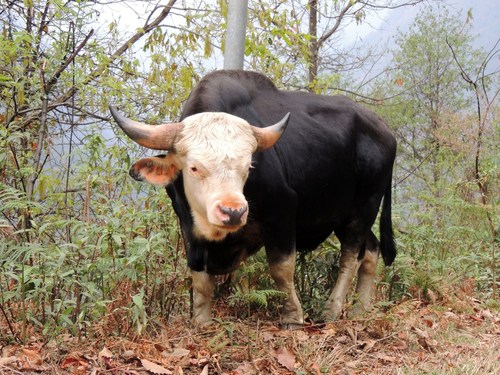
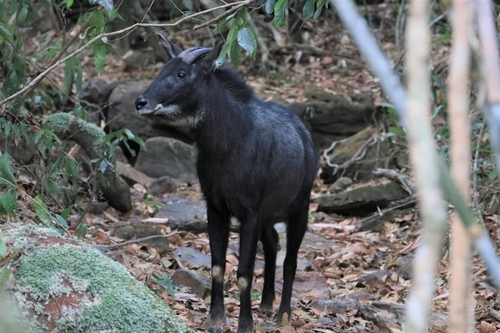
The mainland serow, scientifically named Capricornis sumatraensis, has specific physical characteristics. Its coat has bristly, coarse guard hairs that cover the underfur, which lies closest to the skin, to varying degrees. It has a mane that extends from its horns to the middle of its back, between the shoulder blades, covering the skin. Only male mainland serows grow horns; these horns are light-colored, roughly six inches long, and curve slightly toward the animal's back. Both male and female adult mainland serows stand around three feet high at the shoulder, and typically weigh around 200 pounds (91 kg).
Mainland serows are distributed across central and southern China, India, Vietnam, Cambodia, Laos, Myanmar, Thailand, and the Indonesian island of Sumatra. In Assam, they live in hilly forests at elevations above 300 meters (980 feet), but move down to elevations as low as 100 meters (330 feet) during winter. In the Nepal Himalayas, they prefer elevations between 2,500 and 3,500 meters (8,200 to 11,500 feet). In Tibet, their range follows forested mountain ranges.
Behaviourally, the mainland serow is territorial, and lives either alone or in small groups. It is active at different times of day and night, with peaks of activity during both daytime and nighttime. After a gestation period of approximately eight months, female mainland serows give birth to a single young. Fossils recovered from Khok Sung in northeastern Thailand indicate that the species was already a forest-dwelling animal in this ancient prehistoric environment. Analysis of dental microwear textures from both living and fossil populations of this species shows that it is primarily a browsing herbivore, and its browsing diet is dominated by leaf consumption.